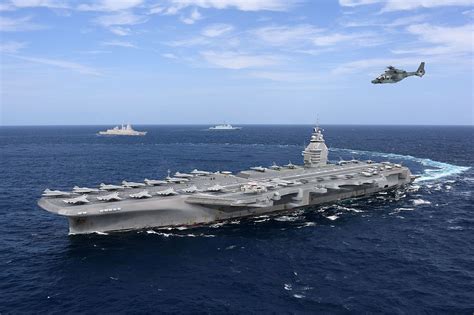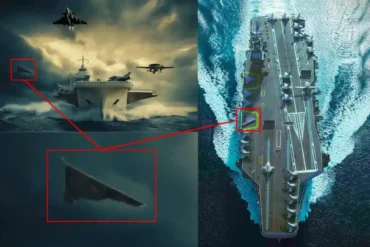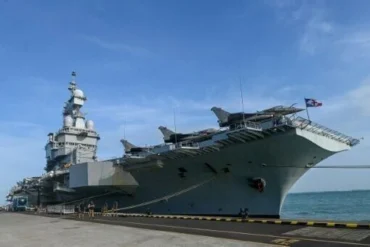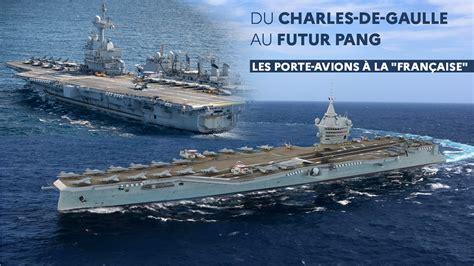
French President Emmanuel Macron has officially approved the construction of a next-generation nuclear-powered aircraft carrier, a groundbreaking move that will see France reaffirm its dominance as Europe’s foremost naval power. The announcement, made during Macron’s address to French troops in the United Arab Emirates, sets the stage for France to replace the Charles de Gaulle with a significantly more formidable warship, known as PANG (Porte-Avions Nouvelle Génération).
Macron’s Strategic Shift Toward Maritime Supremacy
President Macron’s endorsement of the PANG program follows years of planning, analysis, and technological feasibility studies. He framed the decision as essential in an era marked by resurging geopolitical tensions and growing maritime rivalries. “In an age of predators, we must be strong in order to be feared,” Macron declared, underlining France’s ambition to deter threats and secure strategic autonomy through military modernization.
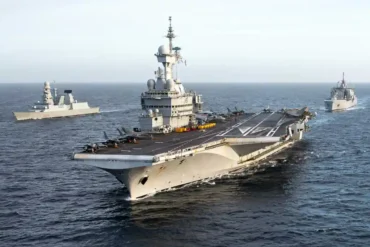
First conceptualized in 2018, the replacement for the Charles de Gaulle, which entered service in 2001, has now received its formal green light. Macron’s decision completes a long phase of military programming, risk-reduction studies, and preliminary design work.
From Charles de Gaulle to PANG: A Giant Leap in Capability
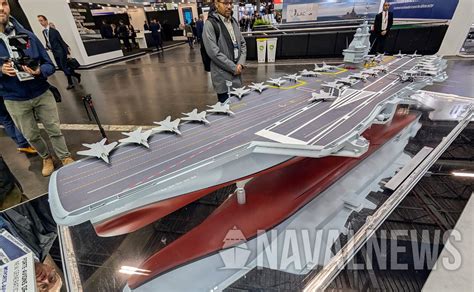
The upcoming PANG supercarrier represents a quantum leap over its predecessor. While the Charles de Gaulle displaces 42,000 tons and measures 261 meters, the new vessel will displace nearly 80,000 tons and stretch to an imposing 310 meters. This scale aligns PANG with the world’s most powerful carriers, including the U.S. Navy’s Gerald R. Ford-class and China’s Fujian, although only France and the U.S. will operate nuclear-powered carriers.
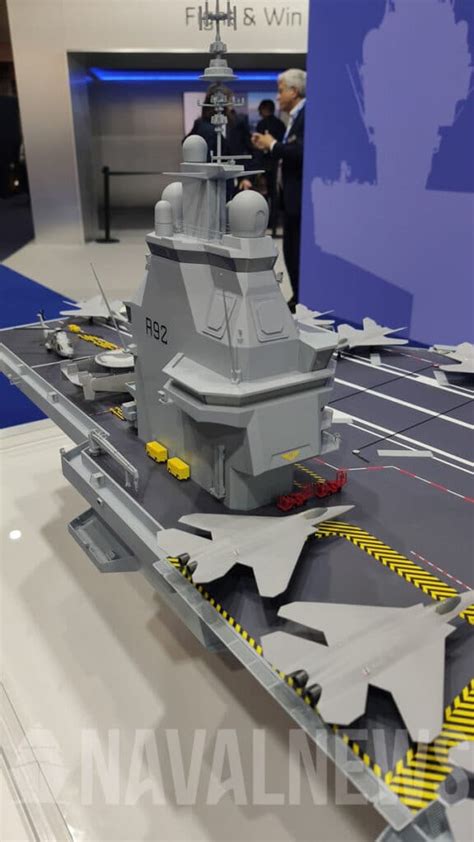
Equipped to house a crew of 2,000, the new carrier will support 30–40 next-generation fighter jets, along with early warning and unmanned aerial systems. The air wing is expected to consist of the Rafale M, future FCAS (Future Combat Air System) fighters, and E-2D Advanced Hawkeye aircraft for airborne command and control.
Technological Advancements and Nuclear Power
Central to the PANG’s superiority is its nuclear propulsion system, driven by two state-of-the-art K22 reactors developed by TechnicAtome. Each reactor produces 220–230 megawatts, powering the ship’s three propeller shafts and providing massive onboard electrical capacity. This surplus energy supports high-end systems like EMALS (Electromagnetic Aircraft Launch System), enabling faster, more efficient aircraft launches, and future-directed energy weapons.
Nuclear propulsion offers unparalleled strategic advantages:
- Unlimited operational range, limited only by food and crew endurance
- Extended time on station, crucial for power projection
- Sustained speeds up to 30 knots, enhancing mobility and response time
Refueling is needed only once every ten years, significantly reducing maintenance downtimes and enhancing mission-readiness.
Project Timeline: From Blueprint to Battle-Ready
According to current projections, the PANG’s construction will span a full decade. Key milestones include:
- Preliminary Design Review – late 2028
- Critical Design Review – late 2029
- First Sea Trials – late 2035 or early 2036
- Delivery & Commissioning – between 2036 and 2038
This extensive timeline underscores the complexity of such a massive undertaking, integrating cutting-edge propulsion, avionics, radar, and flight operations systems in a singular warfighting platform.
Geopolitical Implications and Global Interest
France’s decision to build a second-generation nuclear carrier not only extends its maritime supremacy but also solidifies its role as Europe’s only nuclear naval power. While the U.K.’s Queen Elizabeth-class carriers are formidable, they remain conventionally powered, limiting endurance and scalability for future tech integrations.
Globally, France’s innovation has attracted interest. Former Indian Navy Chief Admiral Arun Prakash has publicly suggested that India could partner with France on nuclear carrier technology. A potential Indo-French collaboration could significantly shape the future of Asian maritime strategy, balancing against China’s rapid carrier fleet expansion.
Future of Naval Warfare: Beyond Steel and Steam
The PANG carrier is more than a ship—it is a strategic symbol of European resolve, technological prowess, and military independence. Its design is future-proofed for autonomous systems, next-generation fighters, and high-energy weapons, marking a shift toward digitalized, intelligent warfare.
As the world edges toward multipolar naval competition, France is investing not just in steel and reactors—but in a platform capable of defining power projection for decades. With construction beginning in 2026, the next chapter of French naval dominance is underway, with the PANG set to rule the waves by 2038.