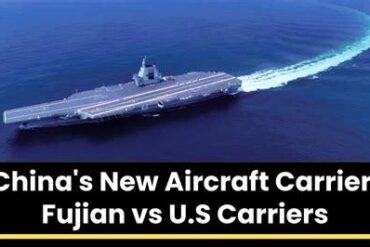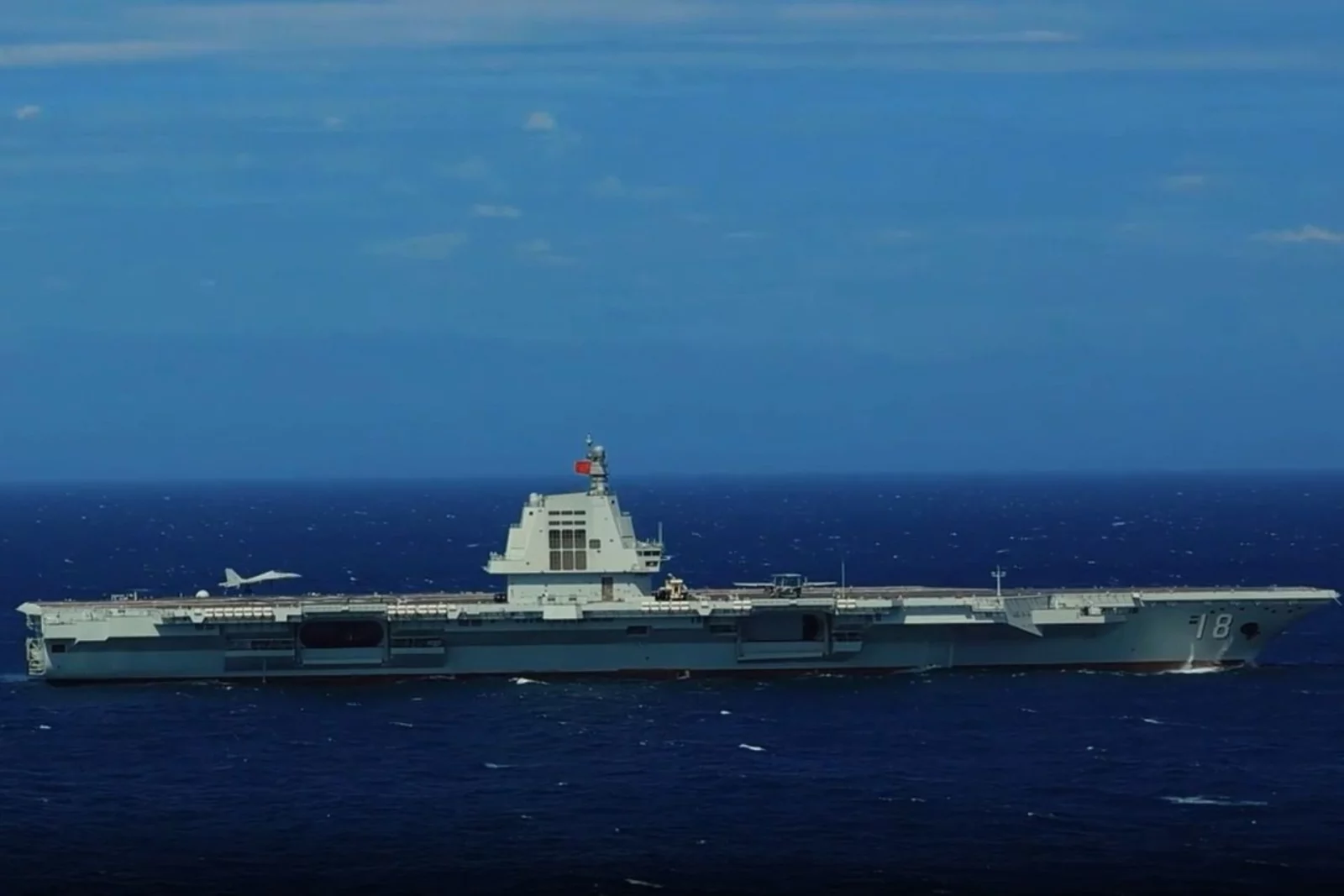
Barely two weeks after its commissioning, China’s newest and most advanced aircraft carrier, the Fujian, has embarked on its first live-force maritime training exercise. Conducted with its full carrier strike group in the contested waters of the South China Sea, the training marks a significant leap in the People’s Liberation Army Navy’s (PLAN) operational reach. The deployment underscores China’s intent to forge a capable, global-reaching blue-water navy and signals strategic messaging amid growing regional tensions, particularly with Japan and around Taiwan.
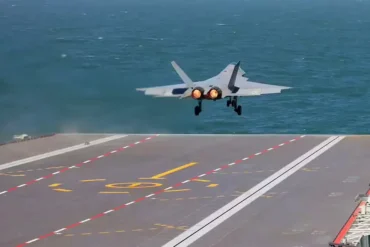
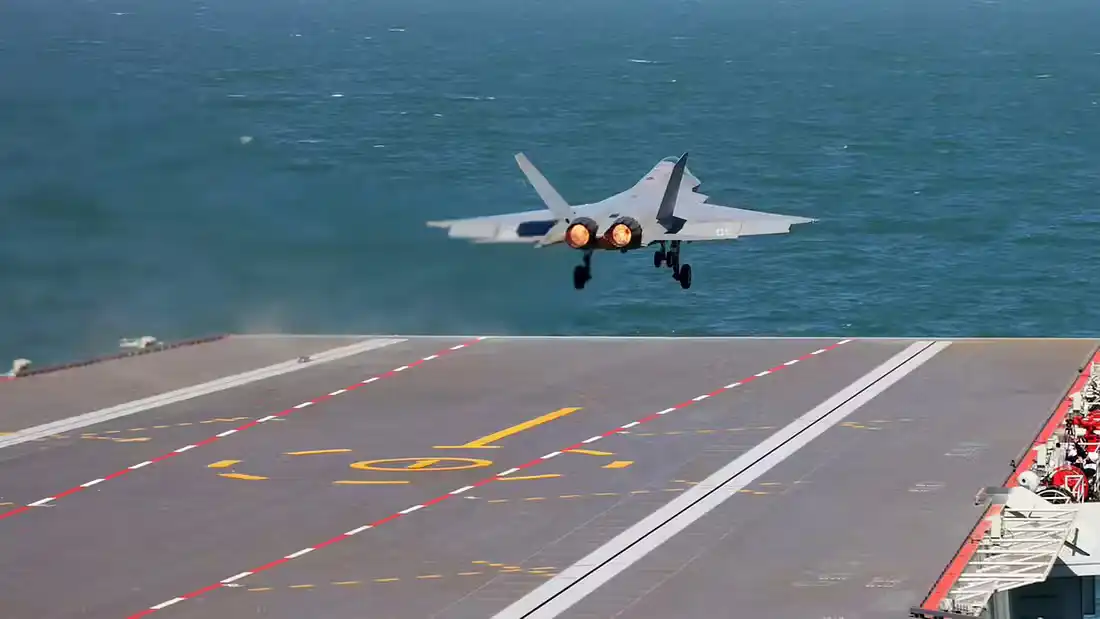
The exercise, highlighted in Chinese state broadcaster CCTV, presented not just a routine drill but a show of force. For the first time, the Fujian demonstrated catapult-assisted takeoffs and arrested landings, indicating the operational readiness of its Electromagnetic Aircraft Launch System (EMALS) — a system that leapfrogs older ski-jump designs and places China closer to the capabilities fielded by the U.S. Navy.
Strategic Timing Amidst Geopolitical Tensions
The timing of this exercise is far from coincidental. It comes just days after the November 5 commissioning ceremony in Sanya, Hainan, and amid increasing political heat between Beijing and Tokyo. Japanese Prime Minister Sanae Takaichi’s remarks regarding Japan’s role in a potential Taiwan conflict have stirred diplomatic waters, and China’s live-force demonstration appears a pointed strategic retort. By showcasing a fully operational carrier strike group so quickly, Beijing sends a calculated message across the Indo-Pacific — one of deterrence, preparedness, and unflinching naval ambition.
A Technological Leap: What Sets Fujian Apart
As China’s third aircraft carrier and the first indigenously designed for CATOBAR (Catapult Assisted Take-Off But Arrested Recovery) operations, the Fujian represents a quantum leap from its predecessors, Liaoning and Shandong. Its technological prowess is centered on the following:
- Displacement: Estimated between 80,000 and 85,000 tonnes
- Length: Approximately 316 meters
- Launch System: Three electromagnetic catapults powered by EMALS
- Arresting Gear: Indigenous arresting wire system
- Air Wing Capacity: 60–75 aircraft, including 48–60 fixed-wing fighters and up to a dozen helicopters
The flat deck and EMALS not only increase launch frequency but also enable heavier takeoffs with more fuel and payload. This innovation translates directly into greater mission variety, longer ranges, and higher sortie generation rates, essential for sustained carrier-based power projection.
First Operational Air Wing: A Modern Lethal Mix
Central to the Fujian’s training campaign was its air wing, which debuted with an array of next-generation aircraft purpose-built for carrier operations:
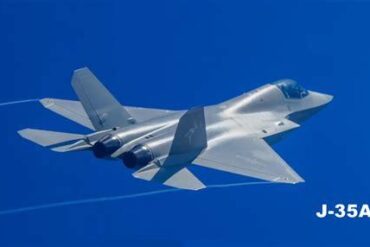
- J-35 Stealth Fighter: A twin-engine fifth-generation fighter designed for low observability, extended range, and multi-role capabilities. With an internal weapons bay and advanced radar and EO sensors, the J-35 stands as China’s direct answer to the U.S. F-35C.
- J-15T Multirole Fighter: A catapult-compatible evolution of the J-15, allowing greater launch loads and fuel efficiency.
- J-15DT Electronic Warfare Variant: Adds electronic attack and countermeasure support to the strike group, similar to the U.S. Navy’s EA-18G Growler.
- KJ-600 AEW&C Aircraft: A turboprop airborne early warning and control platform modeled on the E-2 Hawkeye, crucial for extending radar coverage and integrating the Recognized Maritime Picture (RMP) and Common Operational Picture (COP).
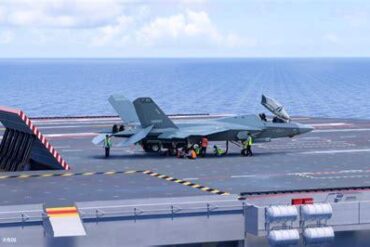
These aircraft were showcased executing complex launch and recovery cycles, confirming the strike group’s initial flight deck operational tempo.
Coordinated Operations with Escort Vessels
The Fujian did not operate alone. The carrier was escorted by a Type 055 guided missile destroyer (Yan’an) and a Type 054A frigate (Tongliao), forming a tightly integrated strike group.
- The Type 055 provided area air and missile defense, equipped with active array radars and 112 vertical launch cells capable of launching HHQ-9 surface-to-air and YJ-18 anti-ship missiles.
- The Type 054A strengthened anti-submarine warfare (ASW) and close-range protection, using towed array sonar, Yu-8 rocket-assisted torpedoes, and short-range air defense systems.
Together, the formation conducted formation maneuvers, ship-aircraft coordination, and search and rescue drills, aimed at refining the battle group’s communications, emissions control (EMCON), and real-time decision loops.
A Decade of Naval Modernization Culminates in Fujian
The Fujian’s debut encapsulates China’s meteoric rise in naval capabilities. In just over a decade, the PLAN has transformed from a regional coastal defense force into the world’s largest navy by ship count, with:
- 3 Aircraft carriers (1 undergoing sea trials)
- 13 Type 055 destroyers launched
- 30+ Type 052D destroyers
- Dozens of frigates and corvettes
- Amphibious assault ships (Type 075) and logistic support vessels
While the U.S. Navy still holds the qualitative edge in experience, logistics, and carrier numbers, China’s high-tempo production and training intensification are narrowing the gap. The Fujian, with its modern launch and deck systems, demonstrates a carrier built for the next war, not the last.
Testing Combat Readiness: Strengths and Limitations
Although visually impressive and technologically ambitious, the Fujian remains untested in combat. Lessons from previous carriers, Liaoning and Shandong, revealed challenges in:
- Sortie generation rates
- Maintenance and logistics reliability
- Coordination between air wing and escort vessels
The PLAN has responded by adopting realistic, high-frequency exercises, upgrading onboard support systems, and training air crews more rigorously. However, true combat effectiveness — especially in contested electromagnetic environments or under pressure from U.S. and allied naval aviation — remains to be seen.
Enhancing Operational Reach Across Taiwan and the First Island Chain
The Fujian’s carrier air wing and EMALS allow it to operate far beyond China’s immediate coastline. With the J-35 flying longer-range missions and the KJ-600 extending radar coverage, China can now maintain sustained air cover over the Taiwan Strait, the South China Sea, and even into Western Pacific sea lanes.
This capability changes the calculus for adversaries:
- Early detection and interception of U.S., Japanese, or Taiwanese assets becomes more feasible.
- Power projection beyond the First Island Chain now enters the realm of operational plausibility.
- The carrier group’s resilience against submarine threats and long-range missiles improves with every integration milestone met by the PLAN.
Implications for Regional and Global Naval Dynamics
The rise of a CATOBAR-capable Chinese carrier force has global ripple effects. Even as U.S. naval supremacy holds, the Fujian forces strategic reconsiderations:
- U.S. Indo-Pacific Command (INDOPACOM) will face increasing complexity in planning operations around the Philippines, Guam, and Japan.
- Japanese Maritime Self-Defense Force (JMSDF) must reassess its fleet defense doctrines, especially amid Taiwan contingencies.
- European navies, particularly those with Indo-Pacific ambitions (e.g., France, UK, Germany), must account for Chinese strike group deployments in joint exercises and strategic projections.
The carrier’s homeport at Sanya Naval Base, itself a focal point of Chinese naval power, provides a forward deployment advantage. Future carrier rotations through the Indian Ocean or joint patrols with Russian or Iranian navies may follow.
Conclusion: Fujian as a Harbinger of China’s Maritime Future
The Fujian‘s live-force debut is more than a technological milestone — it is a strategic inflection point. It embodies Beijing’s ambition to transcend regional constraints and operate with global influence. Though still in its early stages of integration and capability validation, the carrier’s entry into operational drills marks the beginning of a new naval reality.
Whether China can translate this potential into sustained performance remains to be tested. But one truth is now self-evident: the age of Chinese carrier aviation has begun, and the world’s maritime balance must now shift to accommodate its presence.