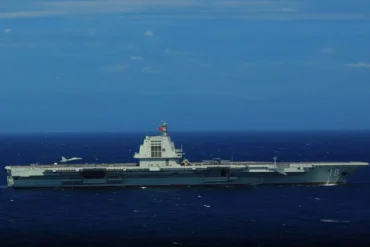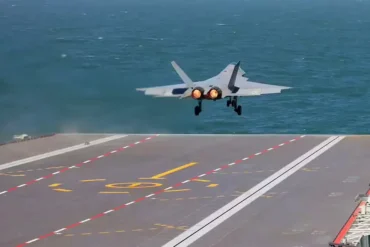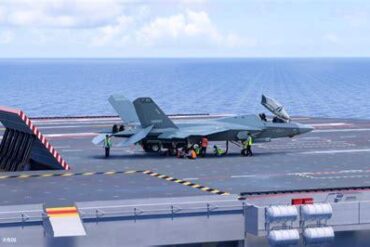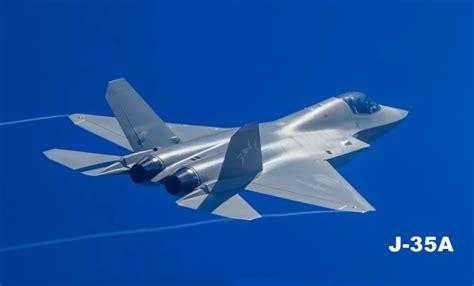
China has officially commenced mass production of its J-35 fifth-generation stealth fighter jets, an aggressive move aimed at transforming the air power capabilities of its People’s Liberation Army Navy (PLAN). These aircraft are specifically engineered for deployment aboard the Type 003 Fujian aircraft carrier, marking a significant evolution in China’s naval aviation strategy. The J-35, often referred to as the carrier-based FC-31 variant, introduces advanced stealth, electronic warfare, and long-range strike capabilities that fundamentally alter the Indo-Pacific’s power dynamics.
The rollout of the J-35 represents a strategic and technological watershed for China. Built for CATOBAR (Catapult-Assisted Take-Off But Arrested Recovery) operations, the aircraft is a substantial upgrade over the older J-15 jets, which rely on less efficient ski-jump (STOBAR) systems aboard China’s Liaoning and Shandong carriers. By pairing the J-35 with the Fujian’s state-of-the-art Electromagnetic Aircraft Launch System (EMALS), the PLAN is significantly boosting the range, payload, and sortie rate of its carrier air wings.
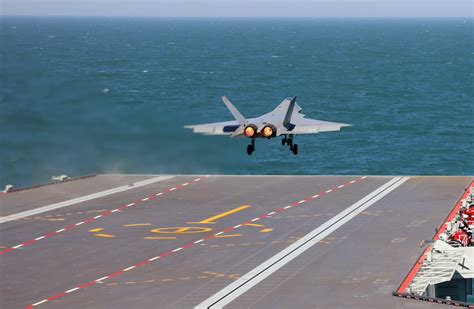
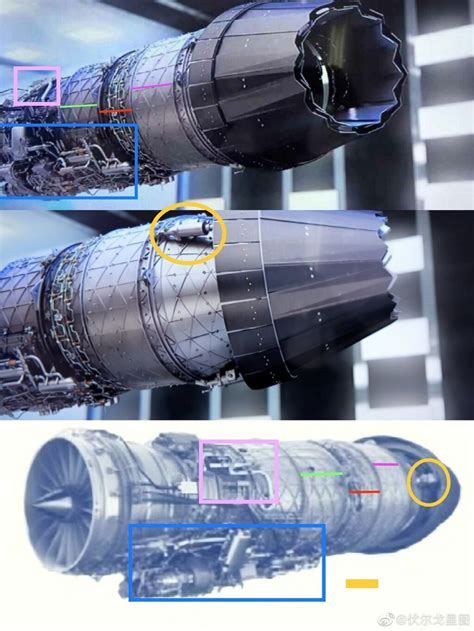
Unlike its predecessors, the J-35 is built from the ground up to operate in the most demanding maritime combat scenarios. Its stealth-optimized airframe, chin-mounted Electro-Optical Targeting System (EOTS), internal weapons bay, and embedded Active Electronically Scanned Array (AESA) radar allow it to conduct high-risk missions in contested airspaces. Its twin-engine layout, reportedly upgraded to the WS-19 powerplants in later versions, offers redundancy and improved thrust—crucial for carrier-based operations that demand reliability and rapid recovery under stress.
J-35 vs. F-35C: A Stealth Fighter Faceoff on the High Seas
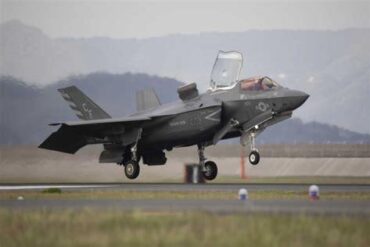
The J-35 is often viewed as China’s answer to the U.S. Navy’s F-35C. Though similar in size and mission profile, the J-35 diverges notably in design philosophy and system integration. Its twin-engine setup contrasts with the F-35C’s single-engine architecture, potentially offering superior survivability and payload capacity for long-duration missions. In carrier operations, such redundancy may prove invaluable.
However, the American F-35C still leads in sensor fusion, battlefield networking, and maintenance infrastructure. Backed by two decades of testing and combat experience, the F-35C’s seamless integration with U.S. and allied command-and-control systems enables a level of joint warfare capability the J-35 is still striving to match. China’s progress in data link maturity, electronic warfare, and software reliability remains under close scrutiny by foreign defense analysts.
Yet, the J-35’s development curve is accelerating fast. Visual confirmations of the fighter on land-based mock carriers and leaked imagery from production lines at Shenyang Aircraft Corporation point to at least two pre-production models in advanced flight trials. Reports now indicate a target output of 50 aircraft per year, enough to fully equip Fujian and potentially outfit future Chinese supercarriers under construction.
The Fujian Carrier: Power Projection at Scale
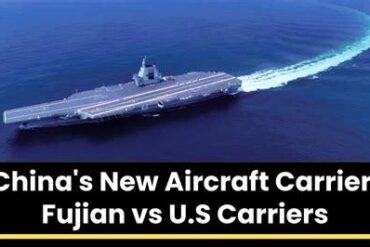
The Type 003 Fujian is a revolution in Chinese naval engineering. Launched in 2022 and undergoing rapid sea trials since May 2024, the vessel boasts an EMALS launch system, flat deck configuration, and a displacement of approximately 80,000 tons. These attributes align it more closely with American Nimitz- and Ford-class carriers than with its earlier Chinese predecessors.
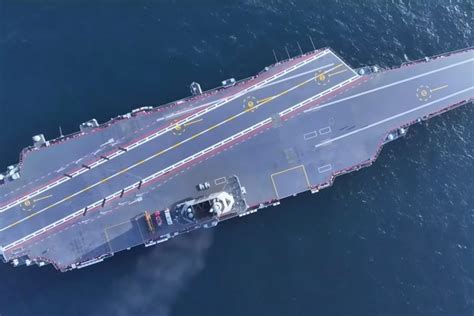
Fujian is expected to field a complement of up to 60 aircraft, including the J-35, KJ-600 airborne early warning aircraft, and various helicopters. This operational footprint allows the PLAN to deploy multi-role strike packages, defensive combat air patrols, and ISR (Intelligence, Surveillance, Reconnaissance) sorties deep into the Pacific Ocean. Integration with Chinese-developed communications and air traffic systems also signifies a move toward greater indigenous self-sufficiency, a strategic imperative in a potentially hostile geopolitical environment.
Strategic Implications for the Indo-Pacific Theater
The induction of the J-35 and Fujian presents a direct challenge to U.S. maritime supremacy in the Indo-Pacific. China becomes the only nation besides the United States to deploy fifth-generation stealth fighters aboard CATOBAR-equipped carriers, a critical threshold in high-end naval warfare.
This breakthrough has already sparked heightened military recalibration across the region:
- India is accelerating its own twin-engine deck-based fighter program and considering a third aircraft carrier.
- Japan continues modifying its Izumo-class carriers to operate F-35Bs, creating a quasi-carrier strike capability.
- The U.S. Navy has intensified its carrier strike group patrols in the South China Sea and Eastern Pacific.
The geopolitical message is unmistakable: China intends to project power well beyond its coastline. With the J-35 providing high-end air dominance and the Fujian acting as a mobile fortress, the PLAN can now contest airspace and sea lanes from the South China Sea to the Philippine Sea and beyond. The potential for power projection toward Taiwan, the Senkaku Islands, and U.S. bases in Guam has grown markedly more credible.
Technology Maturity and Operational Readiness
Despite the excitement surrounding the J-35, questions remain about its true operational readiness. While China’s military-industrial complex has made significant strides, replicating the full spectrum of U.S. carrier-based air operations—especially in terms of sortie generation, maintenance cycles, and interoperability—will be a herculean task.
The durability of radar-absorbent materials, resilience of mission systems in the harsh maritime environment, and ability to operate under electronic warfare conditions are key unknowns. Unlike the F-35C, which has benefited from real-world combat deployments and multinational support networks, the J-35’s battlefield credibility is yet to be tested.
Still, China’s pace of progress is undeniable. Over the past five years, the country has cut carrier development timelines in half, built a global satellite surveillance network, and launched naval vessels at a scale unmatched by any other navy. If current trends hold, China could operationalize an entire fifth-generation carrier strike capability before the decade’s end.
A New Era of Naval Rivalry
The emergence of the J-35 and Fujian signals the beginning of a new era in maritime contestation. It marks the transformation of China’s navy from a regional coastal force into a global expeditionary power. As a nation historically constrained by geography and encircled by strategic chokepoints, China is now building tools to break through the so-called “First Island Chain”, assert dominance over contested waters, and extend its presence deep into the Pacific.
From a strategic standpoint, these developments force regional militaries and defense planners to reassess deterrence models and force postures. The balance of power in the Indo-Pacific is no longer static. With stealth-capable air wings and a CATOBAR-equipped carrier in play, China can challenge adversaries on new terms—invisible, mobile, and potentially overwhelming.
Conclusion: The Shape of Things to Come
As China ramps up production of the J-35 stealth fighter and the Fujian aircraft carrier approaches operational status, the Indo-Pacific region is poised for a fundamental shift in naval dynamics. This is not merely about hardware—it is about strategic will, technological ambition, and the pursuit of military parity with the world’s foremost naval power.
With eyes now fixed on how quickly China can train carrier-based pilots, integrate the J-35 with maritime operations, and sustain global deployments, one truth is clear: the Indo-Pacific security environment has entered a period of irreversible transformation.