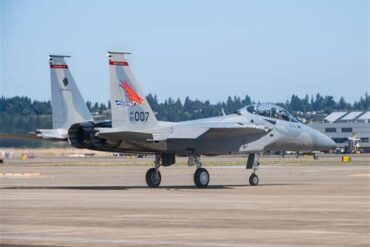
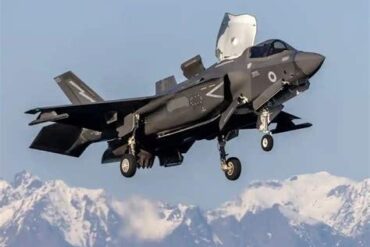
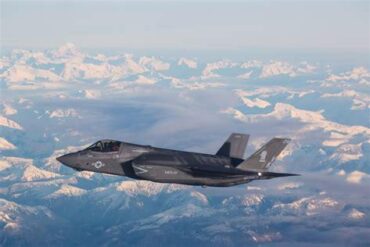
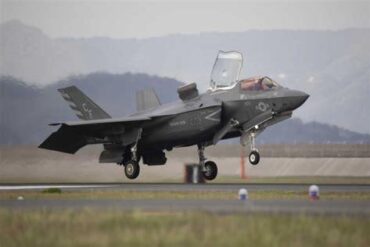
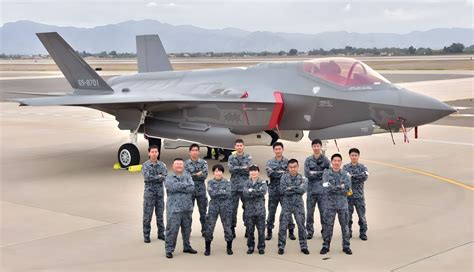
Japan is taking a bold step in reinforcing its national defense by deploying its first U.S.-made F-35B Lightning II stealth fighter jets to the southern region, a move that underscores rising security concerns in the Indo-Pacific and signals a major shift in Japanese defense strategy. Beginning August 7, 2025, four of these fifth-generation Short Takeoff and Vertical Landing (STOVL) aircraft will be stationed at Nyutabaru Air Base in Miyazaki Prefecture on Kyushu, Japan’s southernmost main island.
The deployment, confirmed by Japan’s Ministry of Defense on July 29, 2025, marks the operational debut of the F-35B in Japanese service. It also reflects Tokyo’s growing urgency to enhance rapid response capabilities along the Nansei Islands chain, an area viewed as a critical buffer against China’s expanding military footprint near Taiwan.
Japan’s Strategic Leap: A STOVL-Enabled Force Transformation
Japan’s procurement of the F-35B variant is not a simple platform acquisition; it is a strategic pivot toward multi-domain agility. Introduced under the 2018 National Defense Program Guidelines, Japan’s plan includes acquiring 42 F-35Bs, which complement an expanded fleet of F-35As, bringing the total number of stealth fighters to 147, making Japan the largest international operator of the F-35.
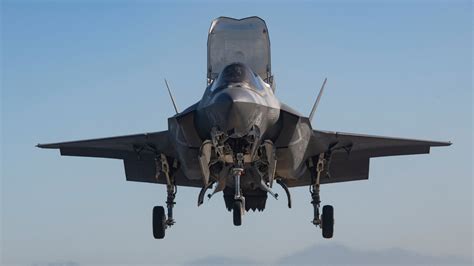
The F-35B, built by Lockheed Martin, is the only fifth-generation stealth fighter capable of STOVL operations. Unlike the F-35A or carrier-based F-35C, the B-model can operate from short, rugged runways or maritime platforms such as amphibious assault ships and light aircraft carriers. This feature allows Japan to project airpower in remote or contested environments where conventional runways might be damaged or unavailable.
The U.S. Department of State approved the sale through the Foreign Military Sales (FMS) program in July 2020, with deliveries occurring in phased batches. Now, with frontline readiness achieved, the F-35B is no longer just a concept for Japanese defense—it is an operational reality.
Force Projection from the Sea: JS Izumo and JS Kaga Reborn
The decision to operate the F-35B from land bases is only one dimension of the strategy. Japan’s Izumo-class helicopter destroyers, JS Izumo and JS Kaga, are undergoing extensive modifications to support F-35B operations. Once completed, these ships will serve as light aircraft carriers, reviving Japan’s sea-based fixed-wing aviation capability for the first time since World War II.
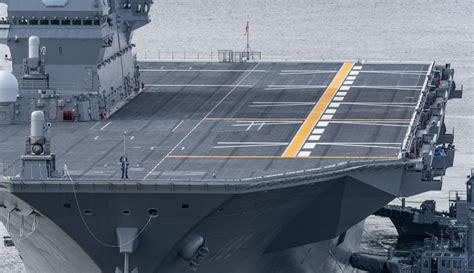
These conversions are crucial in enabling flexible and survivable deployment of airpower across Japan’s vast and often under-defended southwestern islands. Operating the F-35B from these ships provides a mobile deterrent capable of patrolling contested sea lanes, such as the Miyako Strait, and quickly reinforcing remote island garrisons in the event of a crisis.
Nyutabaru Air Base: Sentinel of the Southwest
Located in a geopolitically sensitive zone, Nyutabaru Air Base is the perfect launchpad for regional deterrence. The base gives the Japan Air Self-Defense Force (JASDF) a quick-reaction foothold near the Nansei Islands, which extend toward Taiwan and are viewed as the first island chain in the containment of China’s military ambitions.
This region has increasingly been a theater for Chinese military maneuvers, including frequent People’s Liberation Army Navy (PLAN) deployments and air patrols near Miyako Island and the Senkaku Islands, the latter of which are administered by Japan but claimed by China. Such provocations have escalated in both scale and frequency, often interpreted as rehearsals for blockades or force projection into Taiwan’s proximity.
With the F-35B’s arrival at Nyutabaru, Japan now possesses a platform that can operate from austere or damaged airfields, dramatically improving survivability and response flexibility in a region where China continues to test Japan’s defenses.
Stealth Meets Situational Dominance: F-35B Capabilities in Focus
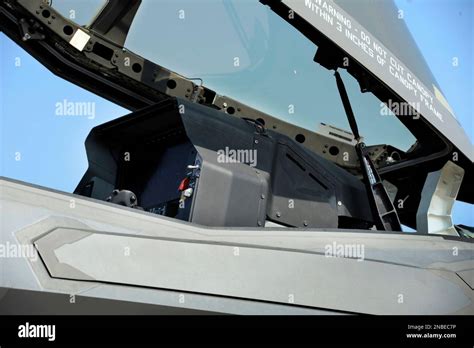
The F-35B is not just a fighter jet—it is a force multiplier. Its low radar cross-section, advanced sensor suite, and electronic warfare capabilities allow it to operate deep within contested environments while remaining largely undetected. Its sensor fusion delivers real-time battlespace awareness, enabling pilots to coordinate with joint and allied forces more effectively than any legacy platform.
From data-link integration to target acquisition and multinational interoperability, the F-35B fits seamlessly into the U.S.-Japan alliance framework. Its deployment strengthens the combined ability to conduct multi-domain operations involving air, sea, cyber, and space domains—critical in countering China’s increasingly anti-access/area denial (A2/AD) strategy.
Countering China’s Encroachment: The Taiwan Flashpoint
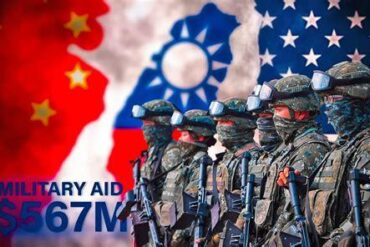
The strategic implications of this deployment extend far beyond Japan’s immediate defense. China’s military pressure on Taiwan has grown relentlessly, with drills that simulate amphibious assaults and blockade scenarios. The PLA’s Gray Zone tactics, including swarms of drones and unmanned systems, further blur the lines between provocation and invasion preparation.
In this context, the deployment of F-35Bs sends a clear political and military signal: Japan is no longer content to serve only in a passive, defensive posture. Tokyo is ready and equipped to support regional deterrence, and in doing so, it reinforces collective security frameworks involving the United States, Australia, and other regional partners under the Quad alliance.
This is also a tacit acknowledgment that the defense of Taiwan is inherently linked to Japan’s own security. If China were to move militarily against Taiwan, the likelihood of spillover effects—including threats to Japanese territory, shipping lanes, and citizens—is high. The F-35B enables Tokyo to intervene or respond in such scenarios with unprecedented speed and lethality.
A Shift Toward Distributed, Agile Defense Doctrine
The F-35B’s fielding is emblematic of a broader doctrinal transformation underway within the Japan Self-Defense Forces (JSDF). The 2022 revision of Japan’s National Security Strategy and National Defense Strategy emphasizes distributed operations, mobility, and multi-domain integration. With rising threats from ballistic missile systems, hypersonic weapons, and cyberattacks, Japan is now prioritizing platforms that can survive and operate in degraded or denied environments.
The ability of the F-35B to operate from non-traditional airfields, roadways, and maritime platforms aligns perfectly with these imperatives. Whether dispersed across small island outposts, launched from the deck of a carrier, or stationed at fortified inland bases, the F-35B provides persistent presence with minimal vulnerability.
A Broader Geopolitical Message: Power Through Partnership
Japan’s deployment of the F-35B is also a reminder that technological supremacy and international alignment remain central to countering authoritarian military expansion. As one of the United States’ closest allies, Japan’s role as a forward-operating democracy is growing.
By integrating the F-35B into its force structure, Japan not only elevates its own defense capabilities but strengthens the entire regional security fabric. The aircraft’s compatibility with U.S. and allied forces fosters joint training, interoperable missions, and seamless communication across the defense landscape.
Conclusion: A Stealthy Step Toward Strategic Resilience
The arrival of the F-35B at Nyutabaru marks more than the introduction of a new weapon system—it is the visible expression of Japan’s resolve to confront the challenges of a shifting geopolitical order. From the island chains near Taiwan to the decks of converted warships, the F-35B embodies a defense policy that is more assertive, agile, and aligned with the realities of modern warfare.
With tensions simmering across the Taiwan Strait and China’s military expansion showing no signs of slowing, Japan’s investment in STOVL airpower is both timely and necessary. It provides a foundation for strategic deterrence, strengthens allied integration, and enhances the nation’s capacity to act decisively in defense of its interests.
As the first U.S.-made F-35Bs stand ready in southern Japan, the Indo-Pacific watches—closely.