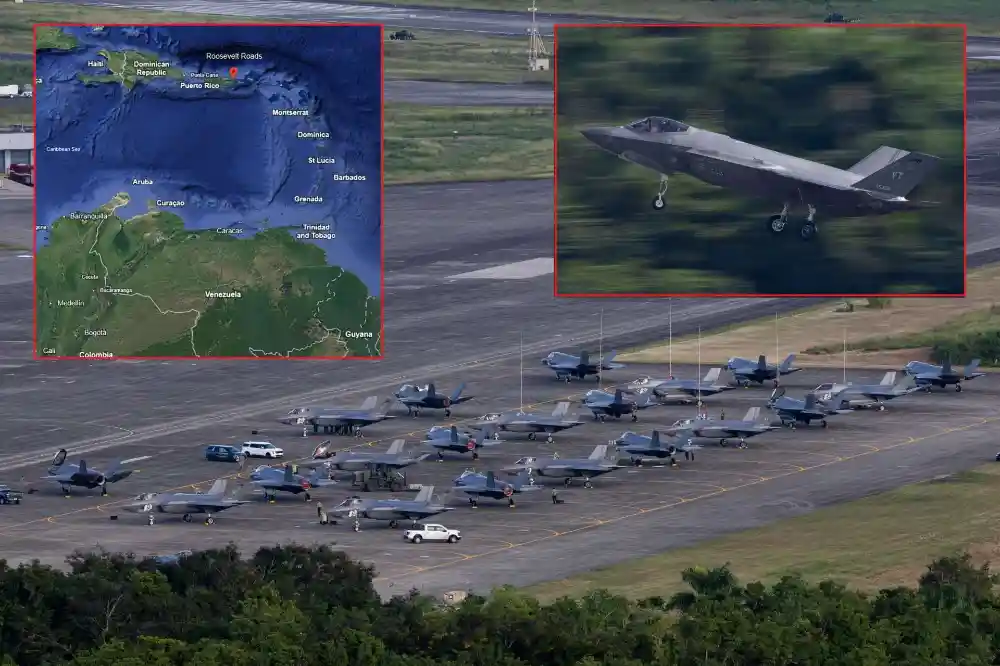
The strategic deployment of 20 F-35 Lightning II stealth fighters to Roosevelt Roads Naval Station in Puerto Rico marks a dramatic escalation in the United States’ military posture in the Caribbean, sending an unmistakable signal to Venezuela, as well as to external players like Russia.
Largest Fifth-Generation Fighter Presence in Puerto Rico’s History
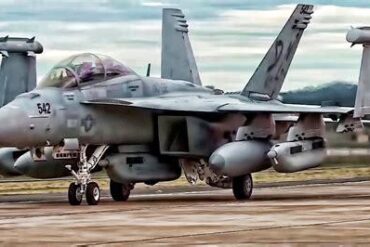
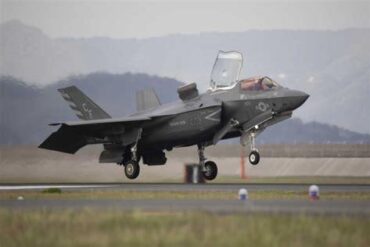
The arrival of this elite formation on December 21, 2025, captured in a high-resolution image by Ricardo Arduengo, crystallizes a new phase in American force projection. For the first time, Puerto Rico—a former Cold War outpost—hosts a potent mix of ten F-35B STOVL (short takeoff and vertical landing) aircraft from VMFA-225 and ten F-35A conventional takeoff jets from the Vermont Air National Guard’s 134th Fighter Squadron.
With Roosevelt Roads Naval Station reactivated in early 2025 after its closure in 2004, the facility has been transformed into a robust logistics and operations hub. Its 11,000-foot runway, ample tarmac, and proximity to Caribbean sea lanes make it ideal for staging not only air assets but potentially amphibious operations. The volume and sophistication of the F-35 deployment rival the total combat power of many small nations, and its presence barely 500 miles from Venezuelan airspace alters the balance of airpower in the region.
A Shift from Counter-Narcotics to Forward Military Posture
While Operation Southern Spear is officially framed as a counter-narcotics and sanctions enforcement mission, its operational contours increasingly resemble pre-positioning for high-intensity conflict. U.S. naval presence has intensified with aircraft carriers, amphibious assault ships, and advanced ISR assets (Intelligence, Surveillance, Reconnaissance) crisscrossing the region. In this context, the F-35s are more than deterrents; they are rapid response strike instruments capable of penetrating even sophisticated air defenses.
Operational Reach and Tactical Flexibility
Each fighter brings a specialized capability. The F-35A, with a combat radius of 1,200 kilometers, can fly deep into Venezuelan territory and return without refueling. Its stealth profile, internal weapons bays, and sensor fusion capabilities allow it to strike targets while evading radar. The F-35B, although sacrificing fuel capacity for vertical landing capability, excels in operating from short or improvised runways and amphibious decks, giving the U.S. unmatched operational agility in contested zones.
Together, these platforms create a networked airpower bubble over the Caribbean. Sharing real-time battlefield data with P-8 Poseidon patrol aircraft, MQ-9 Reaper drones, and U.S. Navy warships, the F-35 detachment at Roosevelt Roads can execute deep strike missions, defensive counter-air, and maritime interdiction without revealing its own position.
Venezuela’s Limited Military Options
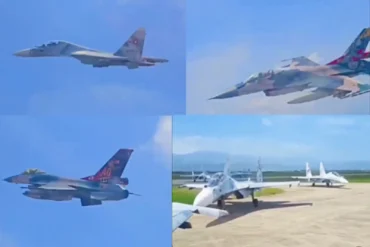
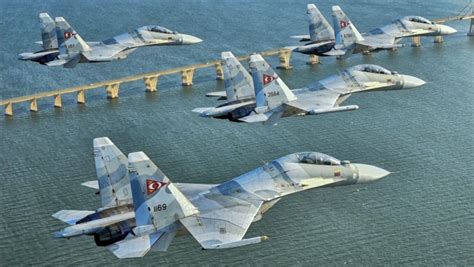
Opposite this technological titan stands the Bolivarian Military Aviation—a force hampered by maintenance woes and decaying air assets. Venezuela operates Su-30MK2s and aging F-16A/B fighters, yet their operational readiness has been degraded by years of economic crisis and international sanctions. In the event of a crisis, Venezuela’s static air-defense systems would likely struggle to intercept fifth-generation fighters flying below radar horizons and delivering precision-guided munitions.
This American deployment has shifted the calculus. With 20 F-35s in Puerto Rico alone, the U.S. can neutralize Venezuelan airbases, coastal radar stations, and SAM (surface-to-air missile) batteries in a matter of hours. It can also provide persistent air cover for maritime task forces, tracking and, if needed, engaging sanctioned oil tankers and narcotics smuggling vessels.
Rebuilding the Roosevelt Roads Complex
The reactivation of Roosevelt Roads is a long-planned strategic move. Satellite imagery over the past year has documented rapid reconstruction, the addition of hardened shelters, expanded fueling facilities, and radar arrays. The base is now capable of hosting not only fighter jets but also support aircraft, drones, and special operations forces.
U.S. planners have prioritized dispersal and survivability, designing operational layouts that allow quick relocation of aircraft to secondary fields across the Caribbean if needed. The integration of F-35Bs, with their STOVL capability, into this mosaic provides a flexible deployment doctrine resistant to pre-emptive strikes.
Moscow Watches Closely: Geopolitical Ripples
The United States’ visible militarization of Puerto Rico has drawn international attention. In response, Nicolás Maduro has sought expanded military cooperation with Russia, requesting advanced SAM systems, combat aircraft, and electronic warfare gear. Russian officials have hinted at potential deliveries of Pantsir-S1 and Buk-M2E systems to augment Venezuela’s aging S-300VM network.
Yet, even with reinforcement, Venezuela’s air defenses are based on dated Soviet-era doctrines, which are unlikely to effectively counter a full-fledged U.S. fifth-generation air campaign. The psychological weight of 20 forward-deployed F-35s cannot be overstated—it deters not only Caracas but also dissuades Russian adventurism in the hemisphere.
Escalation or Deterrence: A Tipping Point
This deployment is as much a political instrument as it is a military one. By stationing elite assets in Puerto Rico, Washington maintains a powerful escalation ladder—able to pivot quickly from deterrence to kinetic action should Maduro cross any red lines. It also strengthens diplomatic leverage, positioning the U.S. as the decisive actor in shaping the post-crisis regional order.
Still, such a massive presence also invites countermoves. Venezuela may invite Russian military advisors, or even consider hosting temporary Russian air assets as a symbolic counterweight. Additionally, regional players such as Cuba and Nicaragua could become further entwined in an emerging Caribbean power contest, one echoing the geopolitics of the Cold War but with vastly more capable technology.
Beyond Symbolism: Preparing for Any Scenario
The F-35 force stationed at Roosevelt Roads can play dual roles:
- As a deterrent signal, reinforcing sanctions, maritime interdiction, and regional diplomacy.
- As a first-strike spearhead, neutralizing key Venezuelan assets within hours of a green light from Washington.
Its mere presence reshapes strategic planning in the hemisphere. With Roosevelt Roads reborn, the U.S. is no longer relying solely on distant bases like Soto Cano in Honduras or Naval Station Guantanamo Bay. It now has a hardened, scalable platform at the heart of the Caribbean basin.
Looking Ahead: The Caribbean as a Theater of Influence
The deployment of 20 F-35s to Puerto Rico is not merely a snapshot of heightened tensions—it is a structural pivot in American military geography. With strategic airpower now embedded in the region, any future U.S. administration will inherit a forward posture that compels engagement, whether through deterrence or through action.
As the situation around Venezuela evolves, so too will the role of the Roosevelt Roads detachment. Whether it remains a sentinel or becomes a sword will depend not just on Maduro, but on Russian ambitions, regional alliances, and the will of Washington. The sky over the Caribbean, once a quiet corridor of commerce and cruise ships, is now thick with stealth, sensors, and signal—a new front line in the hemispheric balance of power.