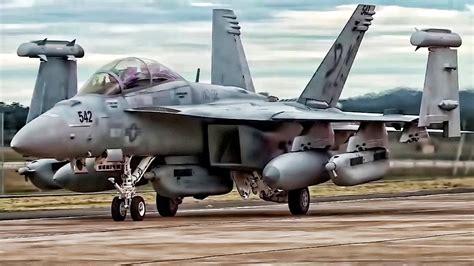
The Caribbean is once again at the center of global military attention as the U.S. Navy’s EA-18G Growler electronic warfare aircraft have been confirmed deployed to Puerto Rico, marking the most significant American force buildup in the region since the 1989 Panama invasion. With tensions flaring between the United States and Venezuela, and President Donald Trump’s administration pursuing aggressive military posturing under the guise of a counternarcotics mission, the presence of Growlers reveals a deeper strategic calculus.
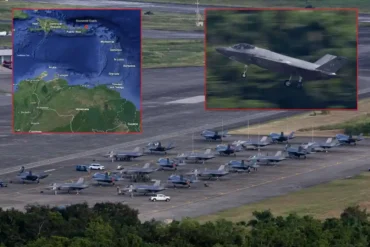
Six EA-18G Growlers were recently spotted parked at Naval Station Roosevelt Roads in Ceiba, Puerto Rico, captured in a Reuters image that has since circulated widely. This near-squadron deployment adds a highly specialized asset to an already formidable U.S. force posture in the region.
Operation Southern Spear: A Cloaked Campaign of Escalation
The Growlers’ deployment is part of Operation Southern Spear, a campaign framed publicly as a crackdown on narcoterrorism. However, the military composition and scope suggest the operation is far more expansive. Over 15,000 U.S. troops, F-35 stealth fighters, the USS Gerald R. Ford aircraft carrier, MQ-9 Reaper drones, and numerous naval assets have been strategically positioned across Puerto Rico, Trinidad and Tobago, and waters just off Venezuela’s coast.
U.S. officials claim the operation targets drug trafficking networks allegedly tied to Venezuelan President Nicolás Maduro, including Tren de Aragua and the Cartel de los Soles. Yet, critics—including independent narcotics analysts and UN data—note that Venezuela plays a negligible role in the global fentanyl trade, and its cocaine involvement is comparatively minimal.
President Trump has repeatedly emphasized that land strikes may be imminent, declaring, “Very soon we’re going to start doing it on land, too, because we know every route, we know every house.” These words, coupled with the strategic positioning of Growlers and Super Hornets in striking distance of Caracas, signal preparations beyond maritime interdiction.
The Role of the EA-18G Growler: Dominating the Electromagnetic Spectrum
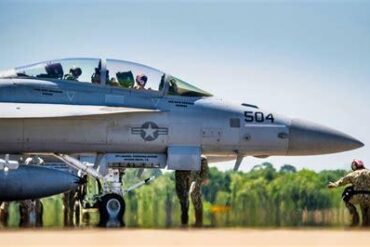
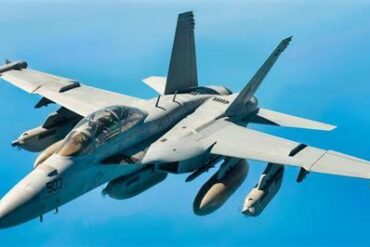
The EA-18G Growler represents a pinnacle of airborne electronic warfare (EW). Derived from the F/A-18F Super Hornet, the Growler delivers not just kinetic strike capability but advanced electronic jamming, signals intelligence (SIGINT), and enemy radar suppression—essential capabilities for launching and protecting deep-penetration strikes.
It is capable of:
- Tactical jamming of radar and communication frequencies.
- Locating and targeting RF emitters using wideband receivers.
- Suppression of enemy air defenses (SEAD) using AGM-88 HARM missiles.
- Providing electronic cover for stealth aircraft and conventional fighters.
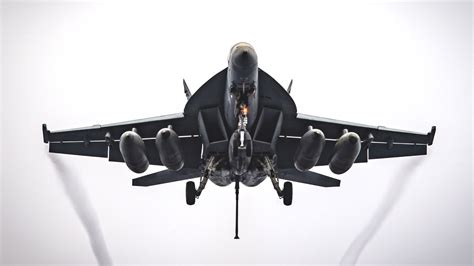
The aircraft’s signature systems include:
- AN/APG-79 AESA Radar: Enables high-resolution tracking and precision targeting.
- INCANS System: Maintains communications in heavily jammed battlespaces.
- ALQ-99 Tactical Jamming Pods: Proven suite for mid and low-band EW operations.
- AN/ALQ-218 Receivers: Offer real-time wideband signal detection.
- AN/ALQ-249 NGJ-MB Pods: The next-generation jamming system now spotted on some deployed Growlers.
Together, these features allow Growlers to “blind” air defense networks, jam enemy radars, and protect friendly aircraft from detection and targeting. The Growler’s ISR (Intelligence, Surveillance, Reconnaissance) capabilities also facilitate the mapping of enemy communications hubs and Electronic Orders of Battle, offering strategic insights that shape offensive operations.
Interception, Jamming, and Precision Targeting
What sets the Growler apart is its ability to triangulate emitter locations with remarkable precision. When three EA-18Gs are networked together, they can identify and pinpoint the origin of hostile signals, including mobile communications and radar pulses, by measuring the slight differences in signal arrival times to each aircraft.
This triangulation enables:
- Target designation without radar emissions, preserving stealth.
- Pinpointing enemy radar installations, mobile launchers, or command nodes.
- Tracking maritime targets, even while maintaining electronic silence.
In past operations, the U.S. Navy has demonstrated the ability to target ships at stand-off range by using passive sensors and networked Growler pods. This method was notably employed to neutralize vessels without alerting enemy defenses—a likely template for operations against Venezuela.
Next-Generation Jammers and the ALQ-249 Transition
The Reuters image reveals a mix of older ALQ-99 pods and newer AN/ALQ-249(V)1 NGJ-MB pods mounted on the Growlers stationed in Puerto Rico. This blend illustrates an ongoing transition within the U.S. Navy’s EW force structure, as the ALQ-249 brings significant improvements in:
- Power output and jamming range.
- Modular payloads tailored to mission needs.
- Adaptive jamming techniques against agile, modern radars.
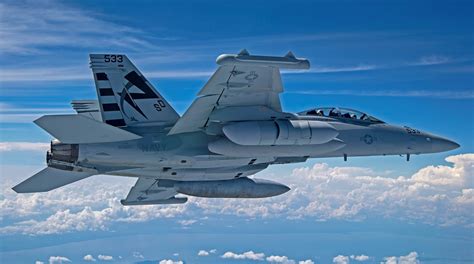
The NGJ-MB expands the Growler’s effectiveness against Russia-supplied SAMs like Venezuela’s S-300VM, Buk-M2E, and Pantsir-S1 systems. These air defense platforms are formidable but can be degraded or rendered inoperable under concentrated Growler-led electronic attacks.
Implications of the Deployment: Venezuela on High Alert
The strategic message sent by deploying Growlers to Puerto Rico is unequivocal. This aircraft is not for reconnaissance alone—it is an enabler of multi-domain kinetic operations, often arriving in-theater ahead of major strikes.
Given Venezuela’s air defense reliance on Russian technology, including long-range S-300VMs positioned around oil infrastructure and the capital, the Growlers could be tasked with:
- Disrupting radar networks ahead of a stealth strike by F-35s or B-52s.
- Jamming communication nodes critical for coordinated responses.
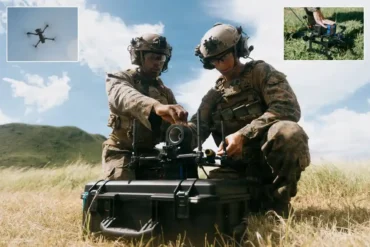
- Enabling cruise missile ingress or drone operations deep within Venezuelan territory.
- Blinding SAM radars, allowing U.S. fighters to operate with impunity.
This capability could shift the strategic balance, particularly if land-based U.S. attacks are approved by the Trump administration.
The First EA-18G Air Kill and What It Means
In a historic milestone last year, a Growler aboard the USS Dwight D. Eisenhower (also deployed near the Red Sea) scored its first aerial kill—believed to be a drone. While the target specifics remain classified, the engagement underscores the platform’s kinetic readiness, a role it is not traditionally known for.
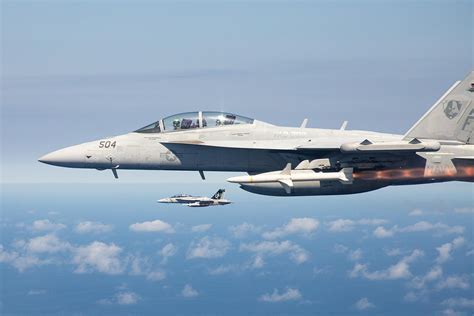
Growlers can carry AIM-120 AMRAAM missiles for air-to-air engagements and AGM-88 HARM missiles for SEAD missions. This multi-role versatility, when paired with stealth platforms or traditional bombers, allows the U.S. to coordinate multi-axis attacks with real-time jamming and intelligence support.
Strategic Significance of Roosevelt Roads and Regional Staging
The selection of Naval Station Roosevelt Roads in Puerto Rico is more than logistical convenience. Its location allows for:
- Quick sortie generation into Venezuelan airspace.
- Control of maritime chokepoints near the Caribbean Sea.
- Rapid deployment to South American coasts or Central American hotspots.
- Support to operations in Trinidad and other staging zones.
Moreover, Roosevelt Roads offers hardened infrastructure from its Cold War legacy, previously used for tracking Soviet submarines. It is now being reactivated as a forward base of operations, allowing electronic warfare and surveillance flights to operate daily.
Regional Reactions and Diplomatic Fallout
The deployment has triggered alarm across Latin America. Several regional blocs have condemned the U.S. buildup as an act of imperial aggression. Meanwhile, President Maduro has warned of “grave consequences” if Venezuelan sovereignty is breached.
China and Russia—both key allies of Venezuela—have raised concerns in international forums, with Moscow hinting that “unilateral aggression” could destabilize not just the Caribbean but global security frameworks. It remains unclear if any counter-deployments are being prepared, but the geopolitical tensions are undeniably intensifying.
A Calculated Signal or Imminent Strike?
Whether this buildup is a final pressure tactic or a prelude to conflict remains uncertain. The deployment of high-value EW assets like the Growler is not routine—it is a precursor to action or a highly visible message of intent. With U.S. special forces already conducting maritime seizures, as evidenced by the recent oil tanker raid off Venezuela’s coast, and the expanding operational radius of Super Hornets and Growlers, the window for diplomatic resolution is narrowing.
What remains clear is that the U.S. now possesses full-spectrum readiness to strike targets inside Venezuela at will—with Growlers as the vanguard of electronic dominance and airspace denial.
Conclusion: The Growler’s Shadow Over the Caribbean
The presence of the EA-18G Growler in Puerto Rico marks a strategic pivot in U.S. operations in the Western Hemisphere. It signals the potential for rapid escalation, undergirded by a platform capable of neutralizing air defenses, securing information dominance, and enabling multi-domain warfare.
As the political rhetoric sharpens and the hardware of war consolidates, the skies above the Caribbean are now patrolled by the most advanced electronic warfare aircraft on the planet. Whether it’s a show of force or the opening act of a larger conflict, the Growler has landed—and the world is watching.