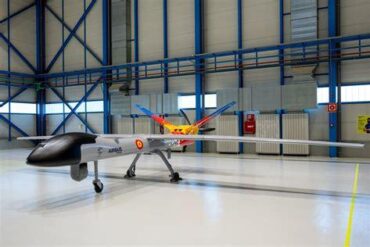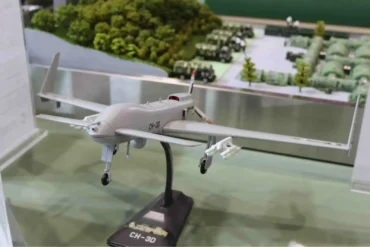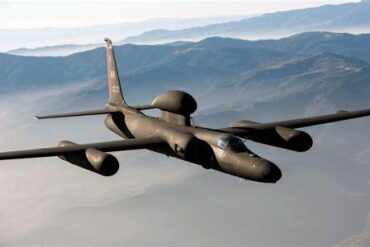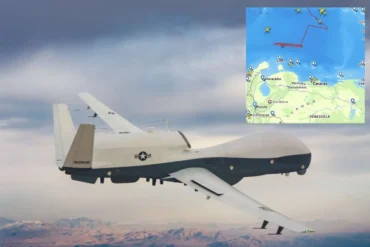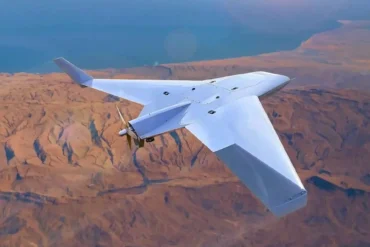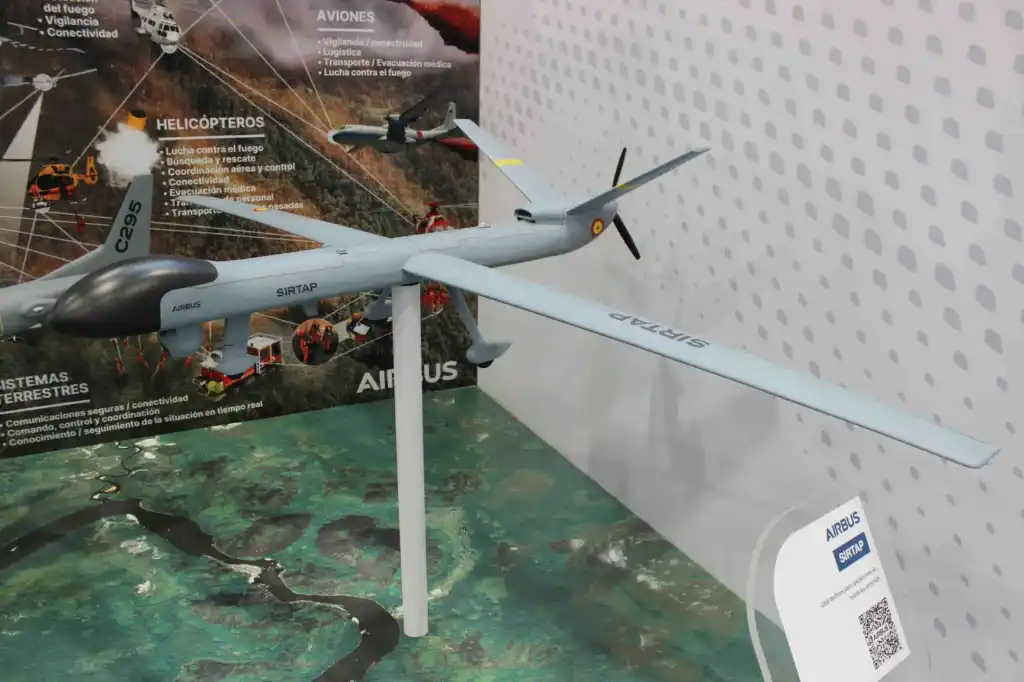
Airbus Defence and Space showcased the Sirtap tactical unmanned aircraft system during Expodefensa 2025 in Bogotá, marking the platform’s most significant public appearance as it transitions from development into a full-scale test campaign in Spain. The presentation underscored growing regional interest in long-endurance unmanned systems and emphasized Airbus’s deepening industrial cooperation with Colombia. The event also came at a pivotal moment for the program, only weeks after the rollout of the first prototype and shortly before its transfer to Spain’s CEUS flight-test center for a comprehensive campaign scheduled throughout 2026.
Sirtap enters a crowded yet rapidly expanding market segment, offering a bridge between lightweight tactical UAVs and larger medium-altitude long-endurance platforms. Its introduction at Expodefensa signaled Airbus’s intent to position the drone as a sovereign, exportable, and highly adaptable solution for intelligence, surveillance, reconnaissance, and precision support missions across Europe and Latin America.
Designed from inception for persistent ISR, multi-sensor flexibility, and interoperability with modern C4I environments, the Sirtap program aims to serve both national defense modernization and broader defense-industrial ambitions. The unveiling resonated strongly with Latin American delegations seeking strategic autonomy, maritime security tools, and affordable precision-strike capabilities.
High-End Tactical Design for Long-Endurance ISR and Precision Missions
Built as a “high-end tactical UAS,” the Sirtap delivers more than 20 hours of endurance, a service ceiling above 21,000 feet, and reliable operation in extreme temperatures ranging from –40°C to +50°C. These characteristics allow continuous deployments across mountains, deserts, dense jungle corridors, and vast maritime zones—geographies that dominate both European and Latin American security landscapes.
With a maximum take-off weight near 750 kg and payload capacity exceeding 150–180 kg, the aircraft supports a sophisticated suite of mission equipment. Its compact twin-boom airframe accommodates electro-optical/infrared turrets, maritime surveillance radars, synthetic-aperture sensors, AIS receivers, and electronic intelligence payloads. Four underwing hardpoints enable mission-specific configurations, from pure ISR to electronic warfare or precision strike.
Notably, the drone’s modular structure allows rapid disassembly, including removal of its “dry wings,” enabling deployment inside a C295 transport aircraft—an advantage for expeditionary operations. Combined with compatibility for 800-meter semi-prepared runways, the system is well-suited for remote bases and forward operating locations.
SATCOM, Interoperability, and Certification for Contested Airspace
From its earliest design stages, Sirtap has been engineered for beyond-line-of-sight connectivity, leveraging SATCOM links to support distant, multi-theater operations. Airbus is pursuing certification through Spanish military airworthiness authorities to ensure operations in segregated airspace—an essential requirement for European forces integrating unmanned and manned platforms.
The platform’s mission system is fully interoperable with customer command-and-control environments, aligning with NATO standards and future manned–unmanned teaming concepts. This positions Sirtap as a highly exportable solution for armed forces that need secure data exchange, resilient communications, and compatibility within multi-domain architectures.
Prototype Rollout and Upcoming Flight-Test Campaign in Spain
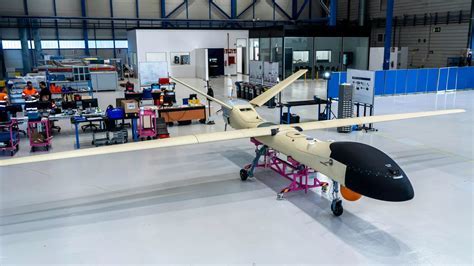
Behind the Expodefensa 2025 display lies a program entering its decisive validation phase. Airbus completed assembly of the first prototype in mid-2025 at Getafe, conducting extensive ground-test activities involving structural verification, integrated avionics checks, propulsion trials, and mission-software validation. The aircraft and its ground control station are now undergoing preparation for shipment to the INTA CEUS test center in Huelva, where a year-long flight campaign will unfold through 2026.
Spain has already contracted nine Sirtap systems, each comprising three aircraft and one ground control station, totaling 27 drones and nine stations, supported by two training simulators. The early domestic order reflects Spain’s intent to build sovereign UAV capabilities while strengthening a European defense aerospace ecosystem less reliant on ITAR-restricted technologies.
Armed Capabilities and Integration With Spanish Defense Industry
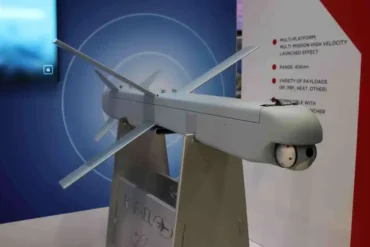
The Sirtap program is also catalyzing a network of national industrial partners. Spanish firms Aertec and Instalaza have developed the BAT precision gliding munition, designed specifically for Sirtap’s underwing hardpoints. This gives Spain a fully domestic precision-strike configuration—a capacity increasingly prioritized by European forces seeking politically unconstrained and cyber-resilient weapons.
Meanwhile, Exail is integrating its UMiX-40 inertial navigation system, built with fiber-optic gyroscopes and vibrating-beam accelerometers, to ensure stable navigation in GPS-denied environments. This feature aims to safeguard the drone’s survivability when operating inside contested electromagnetic zones.
These integrations highlight Airbus’s strategy to position Sirtap as more than an aircraft—rather, as a modular national capability enabler adaptable across multiple mission sets and evolving threat profiles.
Growing Spanish–Colombian Industrial Partnership
Sirtap’s appearance in Bogotá reinforced the long-term collaboration between Spain and Colombia that underpins the program. Colombian aerospace company CIAC is already producing structural components, including the landing gear delivered earlier in 2025 for the first test aircraft. This cooperation arises from a bilateral memorandum of understanding that aims to transform Colombia into both an operator and a co-producer of the system.
The Colombian Aerospace Force has expressed interest in acquiring up to 18 Sirtap airframes, a fleet that would dramatically improve Colombia’s ability to monitor remote border zones, illegal mining regions, and maritime approaches affected by narcotrafficking and non-state armed groups. For Colombia, Sirtap represents not only an operational upgrade but also a meaningful step in domestic aerospace industrialization.
Strategic Implications for Europe and Latin America
Beyond its technical profile, the Sirtap carries wider strategic significance. For Spain and Europe, the drone embodies a shift toward indigenous tactical UAV development at a time when NATO members are seeking greater autonomy in critical defense technologies. Sirtap offers an ITAR-free alternative to widely fielded systems like the Bayraktar TB2 and Hermes 450, but with European connectivity standards, hardened electronic warfare resilience, and compatibility with the future FCAS ecosystem.
In Latin America, Sirtap emerges as a practical tool for persistent ISR, maritime domain awareness, and precision engagement, all while providing opportunities for local industrial participation. This model is becoming increasingly attractive to regional governments trying to balance budget constraints with rising security demands and a desire for long-term capability development.
A Turning Point for the Program and a Milestone for Expodefensa 2025
Bringing Sirtap to the forefront at Expodefensa 2025 reflects Airbus’s vision of the drone as a maturing platform ready for global customers just as it enters its intensive flight-test period. With initial deliveries to Spain scheduled for 2027, Sirtap is poised to become a reference tactical UAV for medium powers seeking long-endurance ISR, precision strike, and industrial collaboration in a single package.
Its debut in Bogotá marked more than product promotion—it represented the convergence of Europe’s technological ambitions, Spain’s industrial strategy, and Colombia’s modernization efforts. As the flight-test campaign progresses, Sirtap’s performance and adaptability will determine its role in shaping the future of tactical unmanned aviation across two continents.