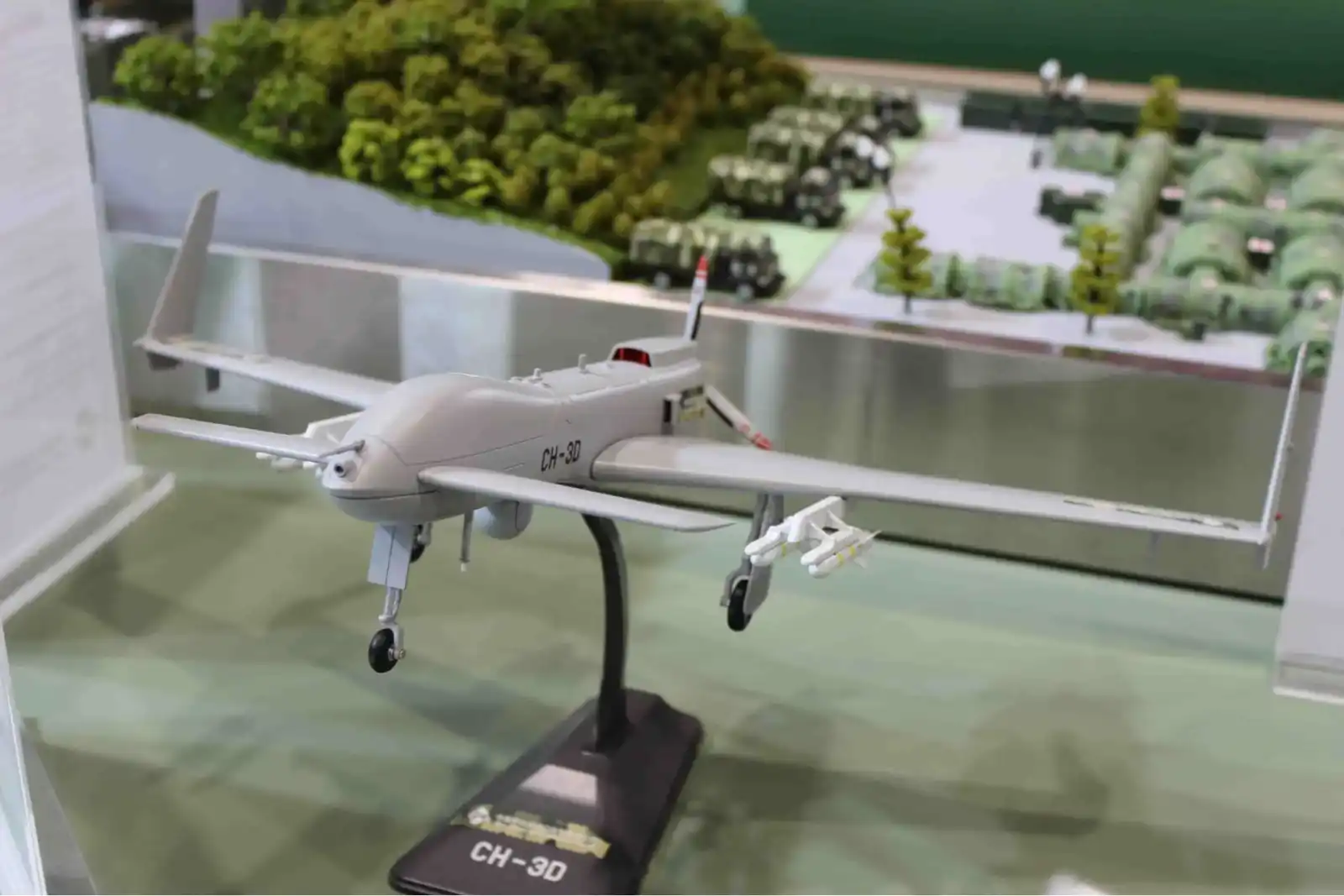
China’s unveiling of the CH-3D medium-altitude long-endurance (MALE) strike drone at Expodefensa 2025 in Bogotá marks a calculated push into one of the world’s fastest-growing defense regions. The showcase by China Xinxing Import and Export Co Ltd demonstrates how Beijing intends to compete head-to-head with established drone exporters by offering an aircraft engineered for long endurance, multi-mission flexibility, and extended-range control architectures.
The CH-3D enters the field as a 900-kilogram-class unmanned aircraft with clear ambitions. It binds intelligence, surveillance, and reconnaissance capabilities with guided strike options, presenting an all-in-one unmanned platform aimed at governments seeking both affordability and operational reach. The growing appetite across Latin America for ISR platforms — driven by border security, counter-insurgency needs, and maritime monitoring — sets the stage for the drone’s arrival.
The airframe sits at the core of Beijing’s pitch: a modular, long-legged platform designed to remain on station for more than twenty-eight hours in its electro-optical reconnaissance configuration. Operating at altitudes up to 9,000 meters, the CH-3D combines persistence with flexibility. It cruises between 160 and 220 km/h, approaching 280 km/h at maximum speed, enabling mission planners to adapt the drone for loitering, border patrol, or rapid repositioning.
The architecture revolves around two internal mission bays that accommodate payloads ranging from synthetic aperture radar to electro-optical systems and electronic warfare equipment. Five external hardpoints — four underwing and one under the fuselage — expand its mission sets with lightweight missiles and guided bombs. The drone’s operators can use one airframe to handle reconnaissance, target designation, and precision strike, reducing fleet complexity for buyers managing tight budgets or limited infrastructure.
Runway Requirements and Deployment Flexibility
The CH-3D maintains a conventional takeoff and landing profile using a wheeled landing gear, requiring roughly 550 meters of runway at sea level. This makes it compatible with typical regional air bases as well as smaller prepared airstrips, a detail that matters significantly in Latin America’s mix of urban hubs, remote Amazonian territories, and high-altitude airfields.
Taxi modes can be switched between automatic sequencing and manual operator control, a practical detail that reduces crew workload during high-tempo sortie cycles. The design aligns with operational realities in states where defense forces often juggle limited personnel and dispersed basing.
Line-of-Sight and SATCOM Control for Long-Range Missions
The drone’s communication architecture offers a dual-tier solution. A 200-kilometer line-of-sight radius supports routine domestic missions, while satellite-enabled control extends range to beyond 2,000 kilometers, limited only by coverage. The SATCOM configuration, confirmed by images posted from a Chinese test facility showing a prototype with a SATCOM fairing and retractable landing gear, signals a clear intent: globalized reach with improved aerodynamic efficiency.
This distinction gives the CH-3D an operational edge in large-area patrol missions, including coastal surveillance in the Pacific and Caribbean or wide-swath reconnaissance over sparsely populated regions such as Patagonia or the Gran Chaco.
Electronic Warfare and Survivability Enhancements
The CH-3D is not restricted to passive observation. Advertised optional EW suites allow the airframe to disrupt radars, collect electromagnetic intelligence, and complicate enemy targeting processes. In conflicts where drones face increasingly contested airspace, survivability stems not only from platform endurance but from onboard electronics capable of degrading opposing systems.
This approach mirrors Beijing’s broader emphasis on multi-role drones that can support reconnaissance, electronic intelligence mapping, and operational preparation in environments where jamming and counter-UAV measures are becoming routine.
Positioning Against Turkish and Emerging Drone Manufacturers
The CH-3D enters a marketplace already reshaped by Türkiye’s Bayraktar TB2 — an aircraft that became a global reference point for low-cost, combat-proven MALE drones. China’s response, embodied by the CH-3D, differs in several aspects. Its retractable landing gear and SATCOM connectivity extend its endurance and range beyond many baseline TB2 configurations, although the TB2S variant narrows that gap with its own satellite link.
The new entrant also competes with emerging drone suppliers in Africa, the Middle East, and Eastern Europe, many of whom are pitching strike-capable MALE platforms with competitive pricing and rapid delivery schedules. Latin American nations choosing between these systems face a landscape where reliability, supportability, and political alignment weigh as heavily as raw performance.
Why Latin America Matters to China’s UAV Strategy
Beijing’s presence at Expodefensa 2025 is an unmistakable signal of intent. Latin America’s defense sector is undergoing a steady modernization cycle, driven by border security concerns, maritime domain awareness, narcotics interdiction, and the need to monitor remote regions. States seeking strategic autonomy increasingly look beyond traditional suppliers for systems without restrictive export conditions.
The CH-3D, with its blend of endurance, strike capability, and extended-range control, matches these requirements. If the drone demonstrates reliability in service and maintains the cost advantages typical of Chinese defense exports, it could secure a meaningful foothold in a region long dominated by U.S., European, and more recently Turkish manufacturers.
A Market on the Edge of Redefinition
The MALE drone sector is no longer the domain of a few elite industrial powers. It is transforming under the pressure of proliferating technologies, shifting alliances, and rising expectations for multi-mission platforms. The debut of the CH-3D at Expodefensa 2025 reflects this new global reality: the battlefield has expanded, the market has diversified, and the next wave of unmanned competition will be shaped as much in Latin America as in the Middle East or Eastern Europe.
Beijing’s move illustrates a broader strategic trend — a determination to position Chinese UAVs as accessible, modular, and geopolitically unencumbered alternatives. The CH-3D may become a significant variable in that equation, influencing procurement decisions and shaping the operational doctrines of regional forces navigating an increasingly complex security environment.