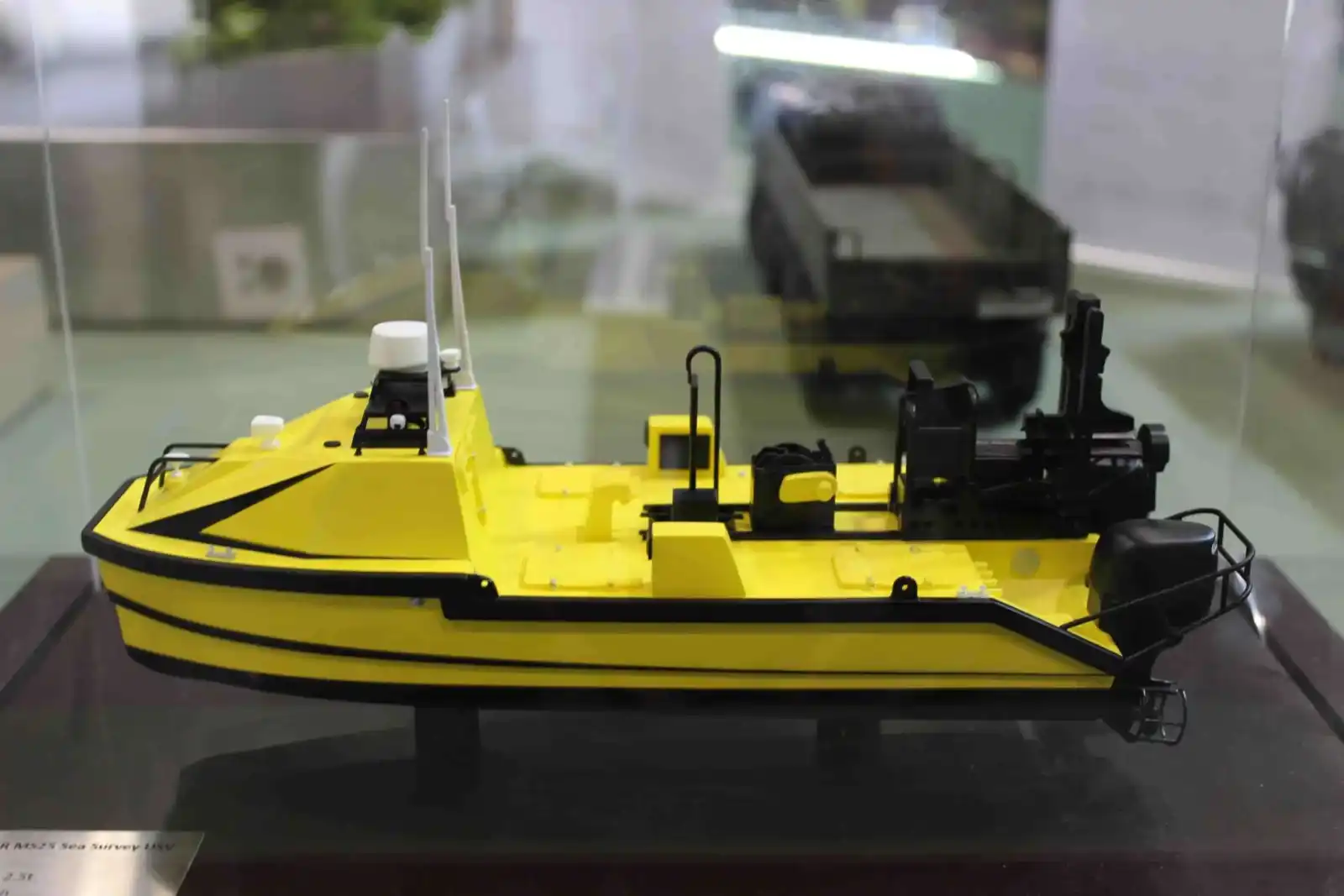
China Xinxing’s unveiling of its Marine Survey Unmanned Surface Vessel (USV) at Expodefensa 2025 in Bogotá marks a notable shift in the maritime security landscape of Latin America. The region—long strained by trafficking networks, illegal fishing fleets, and chronic port vulnerabilities—is increasingly turning to unmanned platforms to fill persistent surveillance gaps. The introduction of this compact Chinese USV signals not only a technological offering but also a strategic bid for influence in a market historically dominated by Western suppliers.
The vessel arrives at a moment when governments across the region are urgently expanding their maritime domain awareness. With thousands of kilometers of coastline and complex river basins, countries such as Colombia, Ecuador, Peru, and Brazil are actively seeking low-risk, low-cost patrol capabilities capable of operating continuously and autonomously. The Chinese craft is pitched precisely for these missions, blending reconnaissance, hydrographic survey tools, and persistent patrol functions in a single shallow-draft hull.
Its appearance at Expodefensa places China squarely in conversations about how automated maritime systems will reshape day-to-day security operations in Latin America.
Technical Specifications Tailored for Coastal and Riverine Operations
Manufacturer data from China Xinxing highlights a vessel engineered specifically for continuous coastal surveillance, hydrographic mapping, and port-area patrols. At 7.5 meters in length, 2.8 meters in width, and a displacement of 2.4 tons, the USV sits comfortably in the class of compact autonomous vessels optimized for narrow channels and shallow waters.
Operating with a draught of just 0.4 meters, the craft can enter estuaries, river mouths, and harbor zones that are off-limits to larger crewed platforms. Its maximum speed of 10 knots underscores its role as a persistent sentry rather than an interceptor, while its recommended survey speed of 4–5 knots reflects a design philosophy prioritizing fuel efficiency and long-duration missions.
Modular Payloads Expand Mission Versatility
The vessel’s 200-kilogram payload capacity supports a broad mix of mission systems. Operators can install electro-optical cameras for real-time video, maritime radar for small-craft detection, communications-relay antennas for coastal command networks, and hydrographic sensors for seabed mapping. A loudspeaker or hailer system can be added for port-security interdiction tasks.
Once deployed on fixed patrol routes around critical infrastructure—fuel terminals, container ports, naval bases, or sensitive environmental zones—the USV can transmit continuous position and surveillance data to shore-based operators. In regions where patrol personnel face high risk, especially in trafficking corridors or illegal mining zones, the ability to extend presence without exposing crews is a major operational advantage.
Strategic Implications for Latin American Security Forces
The platform’s debut reflects a broader trend: unmanned surface vessels are rapidly shifting from experimental tools to catalog-ready systems accessible to mid-tier defense budgets. For Latin American security agencies—naval, coast guard, and environmental enforcement alike—the vessel offers a route to expand surveillance reach without overhauling fleet structures or increasing manpower.
Beyond operational benefits, the deployment of Chinese USVs has geopolitical weight. Beijing’s presence in the maritime unmanned sector challenges longstanding ties between Latin American governments and U.S. or European manufacturers. By offering a cost-effective, shallow-draft system uniquely aligned with regional geography, Chinese defense firms are positioning themselves as suppliers for coastal and riverine security ecosystems.
If adopted broadly, these platforms could integrate Chinese software, maintenance pipelines, and training standards into national security networks. Such dependencies tend to be long-lasting, shaping procurement patterns and technological alignment for decades.
A Turning Point in Regional Unmanned Maritime Adoption
The Marine Survey USV displayed at Expodefensa captures the accelerating shift toward compact unmanned maritime solutions across Latin America. With its persistent surveillance capability, shallow-water access, dual-use civil-military roles, and low operating risk, the vessel represents a new category of practical, scalable security tools.
Its presence in Bogotá is more than a product reveal; it demonstrates how unmanned maritime platforms are becoming instruments of both security policy and international influence. Decisions made by regional governments in the coming years—regarding where they source their autonomous vessels and how they integrate them—will define not only coastal protection strategies but also the geopolitical architecture of maritime partnerships in Latin America.