Modern battlefields are being reshaped by one threat more than almost any other: small unmanned aerial systems. Cheap, fast, disposable, and increasingly intelligent, drones have changed how militaries scout, strike, jam, and overwhelm defenses. For the United States Marine Corps, the answer is not only larger missile batteries or expensive radar networks. It is also something far simpler and far more practical — giving frontline riflemen the power to shoot drones out of the sky with upgraded service rifles.
That is where the SMASH 2000L smart scope enters the picture. Developed by Smart Shooter, this advanced optic transforms a standard rifle into a precision anti-drone platform. Instead of relying solely on human reflexes, Marines gain access to fire-control technology that calculates movement, tracks airborne targets, and only permits a shot when the system predicts a likely hit. In plain terms, it helps make every round count.
The significance of that capability cannot be overstated. Drone warfare has exposed a brutal math problem. A low-cost quadcopter carrying explosives may cost only a fraction of the missile used to destroy it. When adversaries launch drones in waves, defenders can burn through expensive interceptors rapidly. Militaries worldwide are now searching for cheaper, scalable responses. The Marine Corps appears to see the smart scope as one answer.
After years of testing and evaluation, Marines are now fielding this next-generation optic as part of a broader counter-UAS strategy designed for mobility, speed, and distributed operations.
How the SMASH 2000L Smart Scope Works
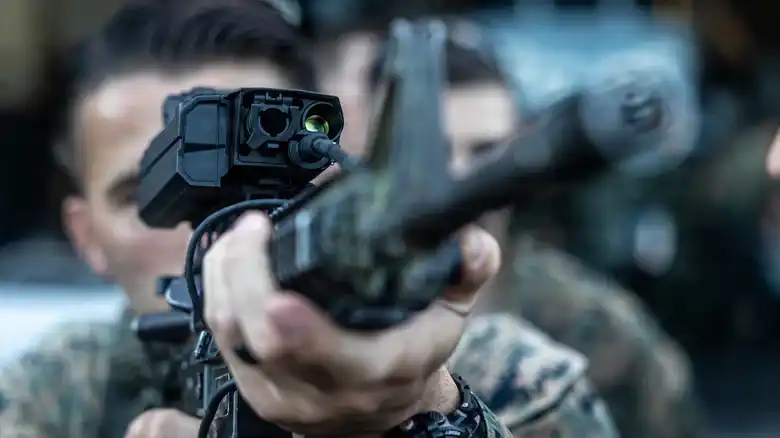
At first glance, the SMASH 2000L resembles a ruggedized optic mounted on a combat rifle. Under the housing, however, sits a sophisticated targeting computer. The system can function as a standard red-dot sight until the operator activates its smart engagement mode.
Once engaged, the optic uses advanced image processing and proprietary algorithms to identify, track, and predict target movement. This is especially valuable against drones, which can dart unpredictably, hover briefly, then accelerate in another direction. Hitting such targets with ordinary iron sights or a basic optic is extremely difficult, particularly under stress.
The smart scope solves part of that challenge by following the target continuously while compensating for shooter movement, target speed, and ballistic factors. It then delays the trigger release until the weapon is aligned for a high-probability hit. That means the Marine still decides when to fire, but the system ensures the round leaves the barrel at the best possible moment.
This concept drastically improves efficiency. Rather than spraying rounds into the air and hoping for contact, riflemen can engage drones with disciplined, calculated fire. On a battlefield where ammunition resupply may be contested, that matters.
Why Marines Need Rifle-Based Anti-Drone Defenses
Traditional air defense systems remain essential, but they are not always available to small units operating forward, dispersed, or from ships. Marines increasingly train for expeditionary warfare in austere environments where mobility is everything. Heavy launchers, radar vehicles, and fixed-site defenses may not be nearby when a hostile drone appears overhead.
That creates a dangerous gap. Small drones can identify troop positions, guide artillery, drop munitions, or harass units continuously. Even inexpensive commercial-style platforms can create tactical chaos if left unanswered.
The SMASH 2000L gives squads and platoons an immediate response option. Instead of waiting for specialized support, Marines can use the rifles already in their hands. That kind of decentralization matches the Corps’ evolving doctrine, where smaller formations must remain lethal, autonomous, and hard to target.
There is also a psychological edge. Drone operators often rely on the assumption that low-flying systems are difficult to hit. A force equipped with smart scopes changes that equation quickly.
A Cost-Effective Counter to Swarming Drones
One of the biggest lessons from recent conflicts is that cost asymmetry favors drone attackers. Launching dozens of low-cost drones can force defenders to spend millions on interceptors. That is not sustainable in a prolonged campaign.
Smart scopes offer a different economic model. The rifle already exists. The ammunition already exists. The shooter already exists. Adding an intelligent optic dramatically upgrades capability without requiring a completely new weapons ecosystem.
This does not mean a rifle replaces missiles, lasers, or electronic warfare. It means commanders gain another layer in a broader defense network. Expensive systems can be reserved for higher-end threats such as cruise missiles or larger UAVs, while smart-scope rifle teams deal with close-range small drones.
That layered approach is increasingly viewed as the future of air defense. No single tool stops every threat. The winning side combines sensors, jammers, guns, missiles, software, and trained personnel into one integrated shield.
Maritime Operations and Expeditionary Use
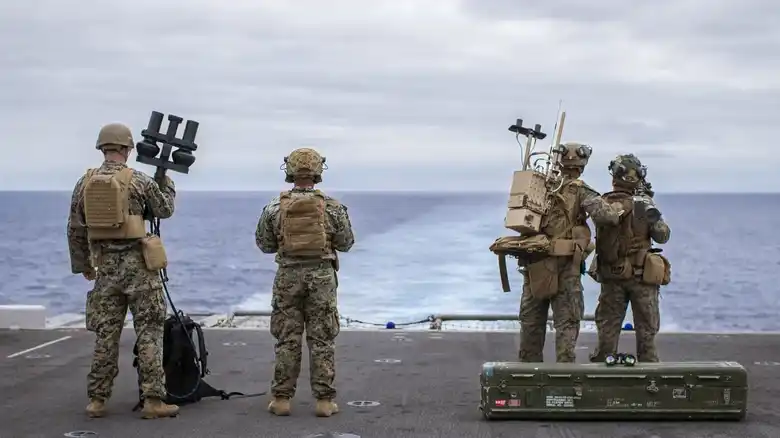
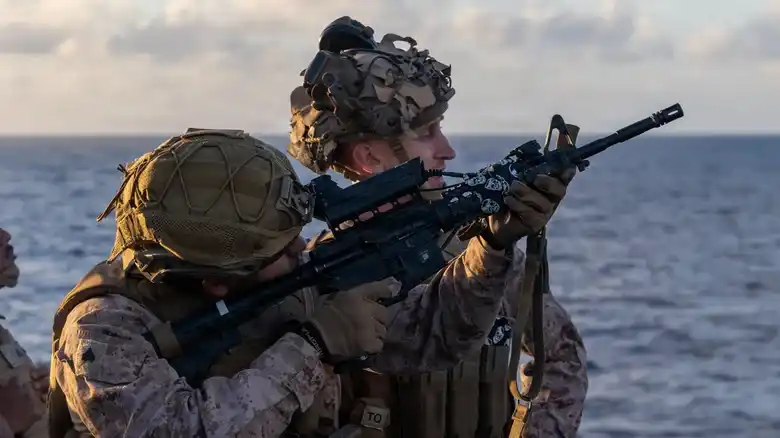
Recent Marine training imagery has shown troops using these scopes aboard amphibious warships, including exercises at sea. That detail is important. Naval formations are vulnerable to surveillance drones and one-way attack UAVs, especially in congested littoral zones.
A rifle-based anti-drone option aboard ships gives Marines and sailors another fast-response tool when seconds matter. If a small drone slips through outer defenses or appears suddenly near the vessel, nearby personnel can react immediately rather than waiting for heavier systems to engage.
For expeditionary units landing on islands, beaches, or temporary forward bases, the same logic applies. Portable defenses win when logistics are thin and movement is constant.
What This Means for Future Warfare
The arrival of the SMASH 2000L signals a deeper transformation in military thinking. Infantry rifles were once primarily anti-personnel weapons. Now they are being adapted into counters for robotic aerial threats. That shift reflects how fast warfare is changing.
Tomorrow’s Marine may need to detect a drone, jam a signal, fire at an aircraft, relay sensor data, and maneuver under electronic attack — all within minutes. Tools like the smart scope help bridge the gap between traditional infantry skills and emerging battlefield realities.
The U.S. Marine Corps is not betting on one miracle weapon. It is building a network of practical solutions that can be scaled quickly. The SMASH 2000L stands out because it turns an ordinary rifle into something far more relevant for the drone age.
And in modern combat, relevance can be the difference between vulnerability and survival.