The U.S. Air Force has quietly delivered one of its clearest demonstrations of wartime readiness in years, launching eight C-17 Globemaster III transport aircraft in rapid succession during a deployment-focused exercise designed to mirror the pressures of a real conflict. Conducted at Joint Base Lewis-McChord (JBLM), Washington, the event was not built for spectacle or ceremony. It was built to answer a single, unforgiving question: how fast can American airpower turn parked aircraft into a combat-ready mobility surge when the clock is already ticking?
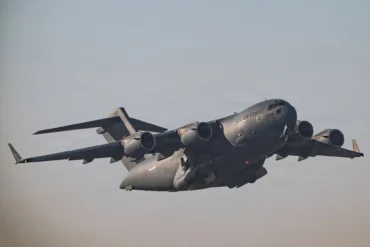
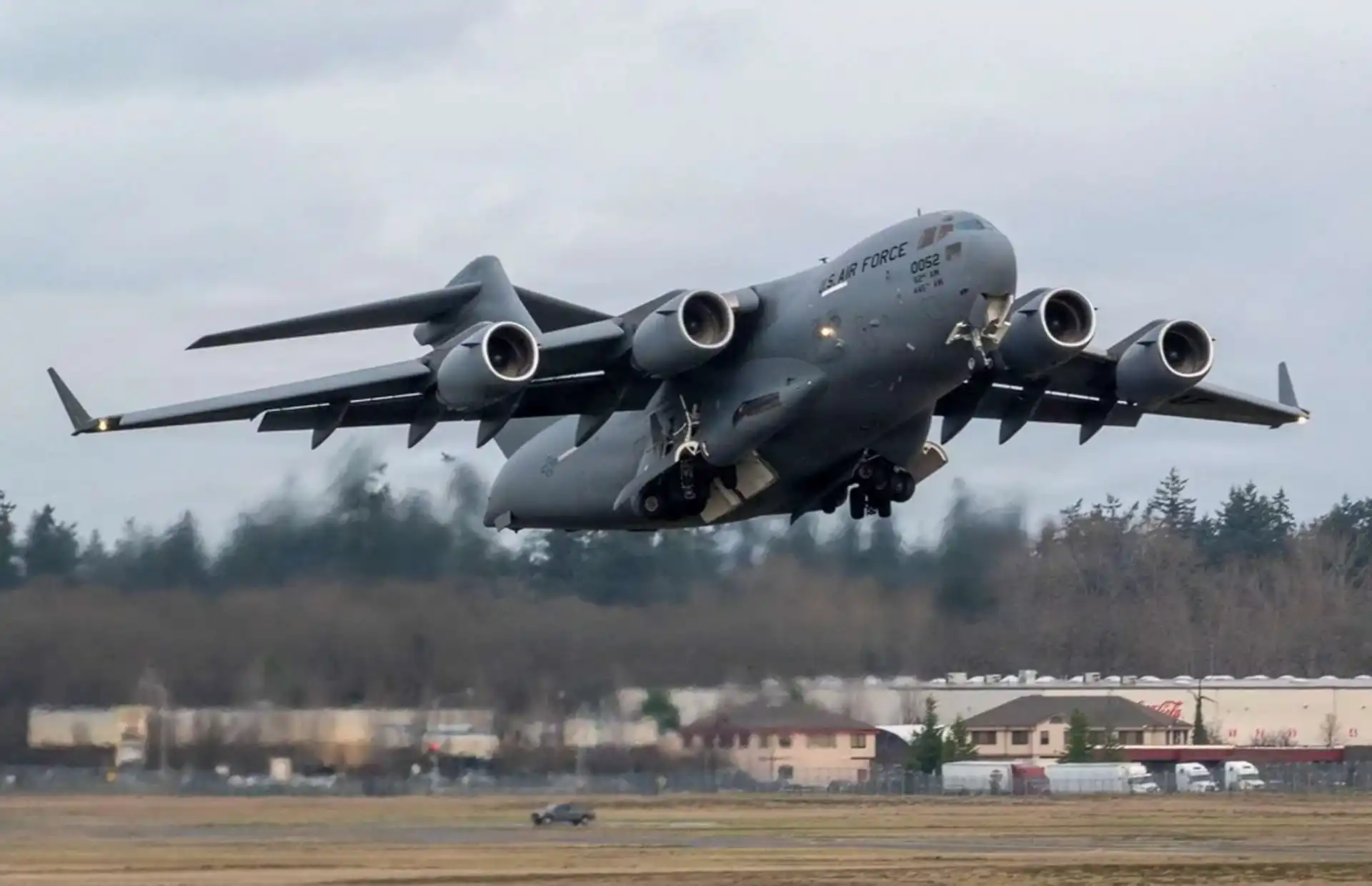
Imagery released by the U.S. Department of Defense through the Defense Visual Information Distribution Service captures the moment succinctly. One after another, the massive gray airlifters roll, rotate, and lift into the cold January sky during exercise Kraken Reach 2026, compressing what would normally be hours of preparation into a tightly choreographed launch window. The message is implicit but unmistakable. Strategic airlift is not theoretical. It is operational, practiced, and increasingly treated as a front-line combat enabler rather than a background logistics function.
Unlike highly visible “elephant walk” displays often used to showcase airpower, Kraken Reach focused on something far more demanding. Aircraft were not pre-staged for optics. They were generated from parked status, crewed, loaded, cleared, and launched under time pressure meant to replicate the uncertainty and friction of real-world deployment orders. This distinction matters, because wars are not announced with rehearsals. They begin with urgency, ambiguity, and the expectation that systems already in place must perform immediately.
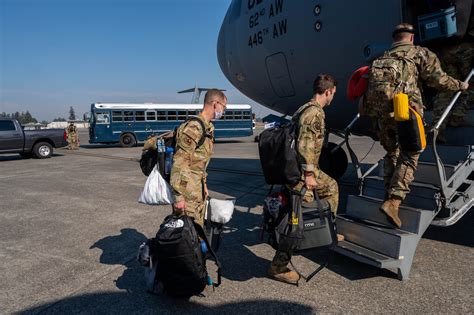
At the center of the exercise was McChord Field, a location whose strategic relevance far exceeds its geographic footprint. As one of the United States’ most important power-projection hubs on the Pacific axis, JBLM serves as a bridge between political decision-making and physical force movement. The base hosts the 62d Airlift Wing, paired with its Air Force Reserve partner, the 446th Airlift Wing, together operating a formidable fleet of around 40 C-17s. That concentration allows national leadership to translate intent into mass movement with minimal warning, a capability that has become increasingly central as planning shifts toward contested, near-peer environments.
The 62d Airlift Wing’s mission language reflects this reality with unusual clarity. Its focus on enabling joint and coalition multi-domain operations signals that airlift is no longer viewed as a passive support arm. It is a decisive layer in modern warfare, especially in scenarios where access, distance, and survivability all constrain traditional force flow. Kraken Reach did not invent that logic. It tested whether the system can live up to it under pressure.
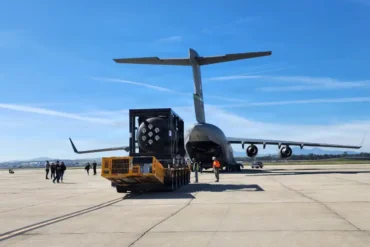
The aircraft itself remains the indispensable tool of that system. The C-17 Globemaster III occupies a rare and valuable space in the U.S. inventory, bridging strategic reach and tactical access in a way few platforms can. Powered by four Pratt & Whitney F117-PW-100 turbofan engines, each producing more than 40,000 pounds of thrust, the aircraft pairs raw power with engineering choices tailored for hostile operating environments. Its high-lift wing, externally blown flaps, and robust landing gear allow it to operate where other heavy transports cannot, including short, austere, or damaged runways.
Numbers only tell part of the story, but they are still revealing. The Air Force lists a maximum payload of 170,900 pounds, spread across 18 pallet positions, with space for 102 troops or paratroopers when configured for personnel movement. At a maximum takeoff weight of 585,000 pounds, the C-17 is designed not for efficiency in peacetime air commerce, but for relevance in war. Its cargo bay, roughly 88 feet long, 18 feet wide, and more than 12 feet high, is built to swallow outsized military equipment without apology.
Critically, that includes hardware that changes the balance on the ground. The C-17 is capable of carrying a 69-ton M1 Abrams main battle tank, along with the fuel, ammunition, and support vehicles that allow heavy forces to fight rather than merely arrive. This is where strategic airlift crosses into operational effect. An aircraft that can deliver armor directly into a contested theater is not just moving cargo. It is shaping options for commanders before the first engagement begins.
Access under constraint is where the Globemaster’s design philosophy pays dividends. The aircraft can land on runways as short as 3,500 feet and as narrow as 90 feet, perform tight three-point turns on limited pavement, and even reverse under its own power using thrust reversers. These capabilities are not aviation trivia. They are responses to a battlefield where large, pristine air bases are increasingly vulnerable to long-range fires, cyber disruption, and political denial. Being able to use smaller, less predictable airfields complicates an adversary’s targeting calculus and keeps deployment timelines intact.
Kraken Reach also underscored that rapid airlift is a team sport. Launching eight heavy transports in quick succession stresses every layer of the mobility enterprise simultaneously. Maintenance crews must clear aircraft discrepancies at speed. Aerial porters must configure and load cargo without error. Security forces must protect movement corridors, while command-and-control elements sequence departures safely without sacrificing tempo. Failure in any one of these areas slows the entire machine. Success turns airlift into a synchronized weapon system rather than a collection of airplanes.
For U.S. Army units stationed at and around Joint Base Lewis-McChord, the implications are immediate and concrete. Many of these formations are designed to deploy early in a crisis, reinforcing allies or deterring escalation through presence. Their effectiveness depends not on arriving piecemeal, but on arriving as complete, coherent packages, with sensors, sustainment, and protection assets intact. A tight launch window for multiple C-17s increases the likelihood that a unit’s critical enablers arrive together, preserving combat credibility from the moment boots hit the ground.
At a doctrinal level, Kraken Reach fits neatly into a broader shift in U.S. thinking about deterrence. Speed is no longer just a convenience. It is a strategic variable. In both the Indo-Pacific, where distances are vast and basing options contested, and Europe, where reinforcement timelines are measured in days rather than weeks, the ability to generate airlift quickly influences whether deterrence holds or fractures. Mobility forces sit at the hinge of that equation, enabling deployment, sustainment, and, if necessary, rapid redeployment under fire.
What makes Kraken Reach noteworthy is not that the Air Force can launch eight aircraft. It is that the service is deliberately testing its ability to do so without choreography, under conditions meant to feel uncomfortable rather than impressive. That choice reflects an understanding that future conflicts will reward organizations that can execute fundamentals under stress, not those that look polished in controlled demonstrations.
In that sense, the image of eight C-17s climbing away from McChord is less about aircraft and more about time. Every minute shaved off a deployment sequence compresses an adversary’s decision space and expands America’s. Before ground forces maneuver, before ships reposition, before negotiations harden or collapse, mobility sets the board. Kraken Reach 2026 was a reminder that in modern warfare, the first decisive movement may happen not on land or sea, but on a runway, measured in seconds between takeoffs and the quiet confidence that the system will hold when it matters most.