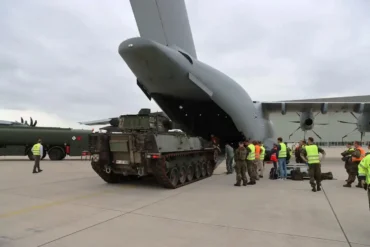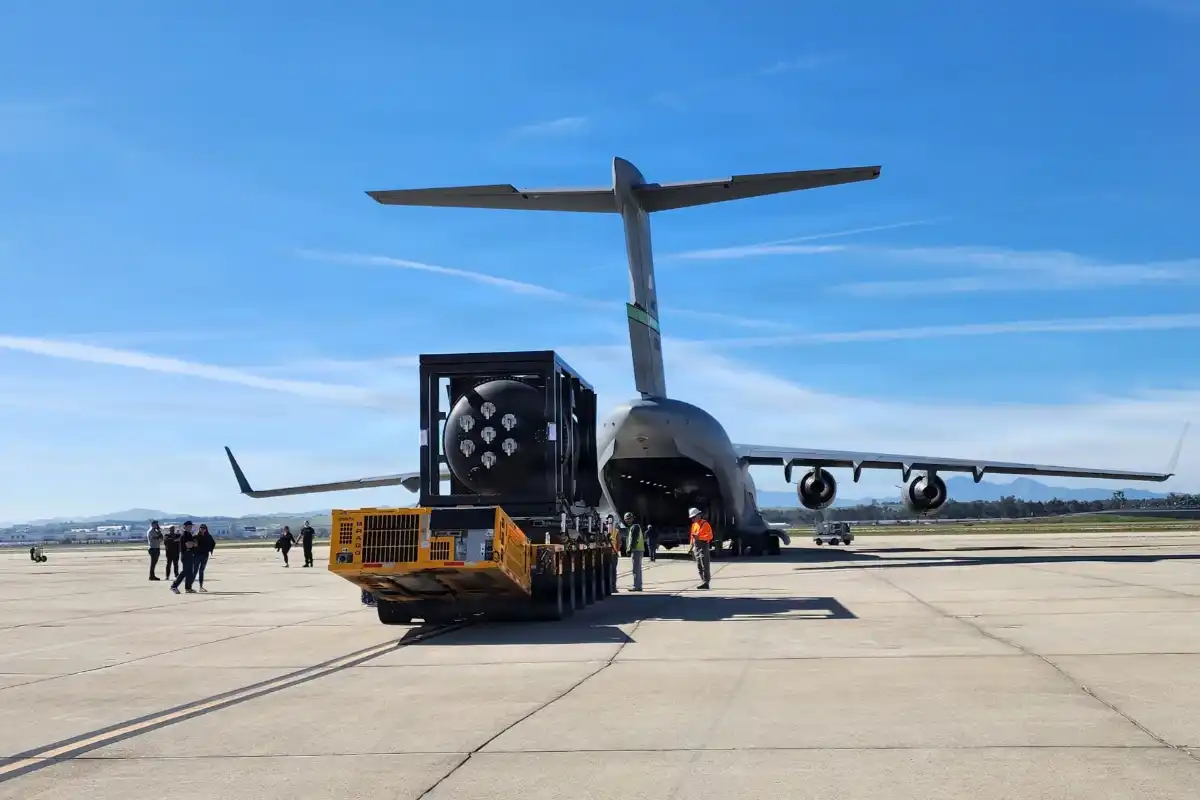
The U.S. Air Force has completed a landmark airlift of a next-generation compact nuclear reactor from March Air Reserve Base in California to Hill Air Force Base in Utah, marking a decisive shift from policy ambition to physical deployment in America’s push to accelerate advanced nuclear capability. The February 15, 2026 mission, executed aboard a C-17 Globemaster III, is the first operational demonstration of rapid reactor mobility under Executive Order 14301, which directs federal agencies to achieve domestic reactor criticality by July 4, 2026. The flight compresses years of planning into a single, visible action: proving that advanced nuclear systems can move at the speed of modern airpower.
The reactor, a WardZero prototype developed by Valar Atomics, embodies a design philosophy aimed at resilience, portability, and passive safety. Unlike conventional light-water reactors anchored to fixed civilian sites, this compact high-temperature reactor is engineered for modular transport, swift assembly, and integration into secure military microgrids. The Department of War, working in close coordination with the Department of Energy, is using Hill Air Force Base as a staging and testing hub to validate end-to-end deployment: from airlift and ground handling to site integration and pre-criticality systems checks. The move reframes advanced nuclear power as an operational capability rather than a distant infrastructure project.
The airlift was conducted as part of Operation Windlord, with personnel from the 452nd Logistics Readiness Squadron Aerial Port Flight overseeing loading and loadmaster coordination. The C-17’s ability to move heavy, sensitive payloads intercontinentally with aerial refueling provides the logistical backbone for this concept of operations. With a payload capacity of roughly 77 metric tons, the aircraft enables reactor modules, shielding assemblies, and auxiliary systems to move in a single sortie, reducing exposure time and minimizing the footprint required at departure and arrival airfields. The result is a practical demonstration that nuclear energy assets can be woven into existing military mobility frameworks without bespoke transport solutions.
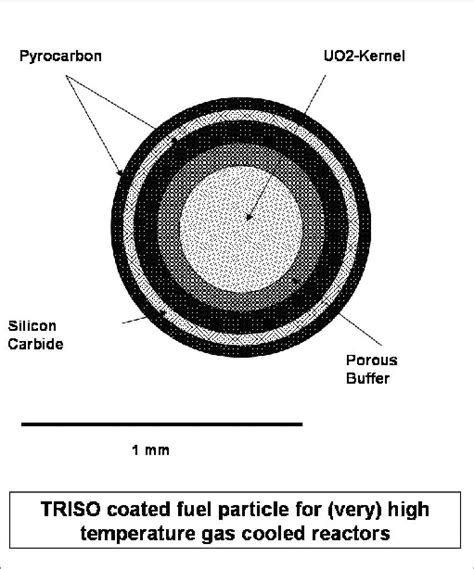
At the heart of WardZero’s safety case is TRISO fuel, short for tri-structural isotropic particle fuel. Each microscopic fuel kernel is wrapped in successive ceramic and carbon-based layers designed to retain fission products even under extreme heat. These coatings are built to tolerate temperatures above 1,600°C without structural failure, while the reactor’s nominal operating regime exceeds 750°C in a high-temperature configuration. This wide thermal margin underpins passive safety features that reduce dependence on active cooling and complex emergency systems, a critical attribute for deployment in austere or remote locations. In practical terms, it lowers the probability of significant radioactive release under accident scenarios and simplifies containment requirements for temporary or expeditionary installations.
The reactor underwent months of heat and pressure testing in Los Angeles prior to transport, a qualification phase intended to validate materials performance, fuel integrity, and thermal management systems. While precise electrical output figures remain undisclosed, reactors in this class typically deliver power in the tens of megawatts electric, enough to sustain a large military installation, hardened command facilities, and energy-intensive sensors. Extended refueling intervals are a core design objective, reducing the frequency of fuel movements and the logistical exposure associated with resupply. Modular architecture allows reactor components to be shipped separately and assembled on a prepared pad, tightening timelines from arrival to grid integration.
Energy resilience is the strategic driver behind this program. Modern bases depend on uninterrupted electricity for radar arrays, encrypted communications, data centers, and maintenance depots. Diesel generators and fuel convoys remain vulnerable to disruption, whether by cyber intrusion into grid controls, physical sabotage along supply routes, or extreme weather events. A compact reactor delivering continuous baseload power shrinks the logistical attack surface and stabilizes operations during grid outages. The high-temperature output also enables industrial heat applications, including hydrogen production for clean fuels and limited desalination for water-stressed sites, expanding utility beyond electricity alone.
Hill Air Force Base’s role as a staging and testing site reflects a broader federal effort to compress regulatory and engineering timelines without diluting safety oversight. Executive Order 14301 directs agencies to synchronize certification pathways, security planning, and site preparation so that reactor assembly and pre-criticality milestones can proceed in parallel rather than in sequence. This approach mirrors modern aerospace acquisition practices, where concurrency accelerates capability delivery while rigorous test gates manage risk. The July 4 target is symbolic, but the operational intent is concrete: demonstrate that the United States can field advanced nuclear infrastructure on timelines that match strategic urgency.
The partnership between federal agencies and private industry is central to the program’s momentum. Valar Atomics’ WardZero prototype is framed as a commercial-first model supported by military logistics, security, and certification expertise. This hybrid approach seeks to avoid the slow, bespoke build cycles that have historically burdened nuclear projects. By proving transportability, rapid assembly, and safe operation in a controlled military environment, the program aims to de-risk future civilian deployments of compact high-temperature reactors for remote communities, disaster recovery hubs, and industrial clusters where grid reliability is fragile.
The international implications ripple outward from Utah. As competitors invest heavily in small modular reactors and export-driven nuclear diplomacy, a credible U.S. demonstration of deployable compact reactors resets the conversation on standards for safety certification, transport security, and nonproliferation controls. Allies facing energy constraints at Arctic installations, Indo-Pacific bases, and remote radar chains are watching closely. A validated model for air-transported reactors could shape procurement pathways and interoperability standards across partner nations, while reinforcing norms around fuel handling, waste management, and end-of-life decommissioning for mobile nuclear systems.
Strategically, the program reintroduces energy autonomy as a core variable in defense planning. Contested logistics, fragile civilian grids, and climate-driven disruptions have exposed the vulnerability of centralized power architectures. A reactor that can be flown in, installed on a hardened pad, and tied into a microgrid within weeks changes the calculus for sustaining operations under pressure. It also complicates adversary planning by reducing the leverage of energy interdiction. The Utah test campaign therefore functions as both a technical proof point and a signal of intent: advanced nuclear power is being repositioned from long-term infrastructure to near-term operational capability.
As pre-criticality checks proceed at Hill Air Force Base, the program’s success will hinge on disciplined integration of safety culture with accelerated timelines. The physics of fission do not bend to schedules, but engineering process can. The Air Force’s airlift of WardZero has already answered a crucial logistical question. The next phase will determine whether rapid deployment can coexist with the stringent controls that define responsible nuclear stewardship, setting the template for how compact reactors may power the next generation of resilient defense infrastructure.