In the quiet city of Lindon, Utah, far from traditional battlegrounds and defense hubs, a revolution in modern warfare is unfolding. At the heart of this transformation is Fortem Technologies, a company at the forefront of autonomous drone defense systems. As geopolitical tensions rise and drone warfare reshapes combat strategies from Eastern Europe to the Middle East, Fortem’s innovations are becoming central to national security — not just conceptually, but in concrete, operational terms.

A New Frontier in Drone Warfare
The increasing prevalence of drones in modern military engagements — such as Ukraine’s surgical strikes deep into Russian territory and Israel’s use of small UAVs to disrupt Iranian air defenses — underscores an irrefutable truth: unmanned aerial systems are redefining warfare. But the other side of that evolution is the growing threat posed by hostile drones targeting homeland infrastructure, military installations, and civilian populations.
According to Adam Robertson, Chief Technology Officer of Fortem Technologies, “The threat of dangerous drones is very real.” He cites recent events as cautionary examples. In Ukraine, small drones carrying explosives infiltrated secure Russian airspace, damaging strategic bombers and bypassing traditional air defenses. In Iran, similar tactics allowed Israel to temporarily neutralize a major portion of its opponent’s aerial capabilities.
Yet what is happening overseas today could happen domestically tomorrow. As Robertson starkly puts it, “A similar attack in the U.S. homeland is not a question of if, but when and how extensive it will be.”
DroneHunter F700: America’s Airborne Interceptor
Enter the DroneHunter F700, Fortem’s flagship autonomous counter-drone platform. More than just a piece of hardware, this system represents the culmination of years of military-grade R&D tailored for real-world deployments. Costing approximately $160,000 per unit, the DroneHunter has logged more than 4,500 successful captures, often in operational theaters where precision and discretion are paramount.
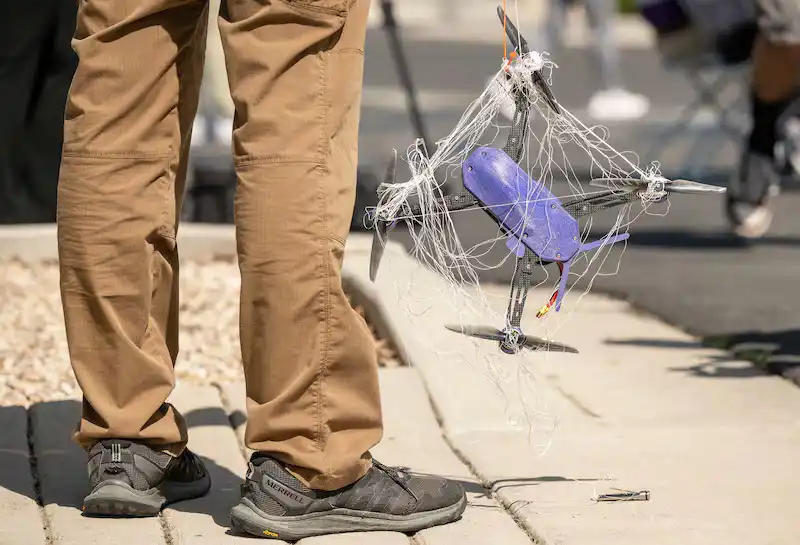
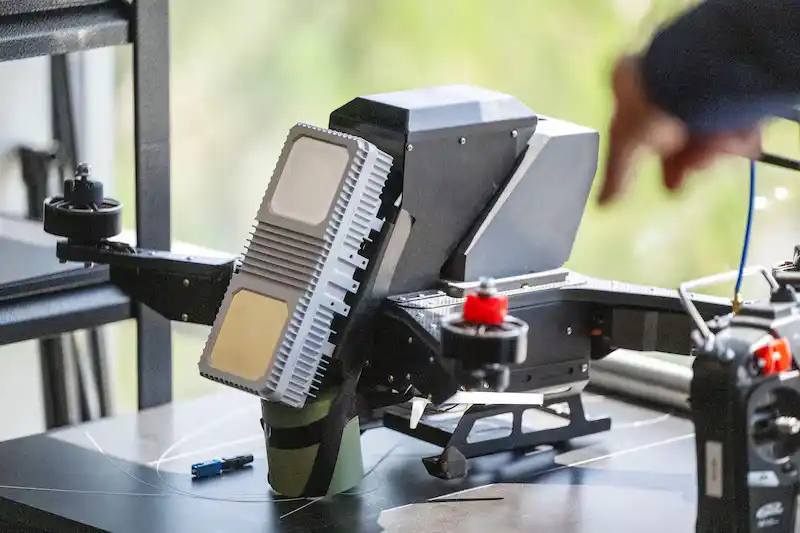
The F700 operates without kinetic weaponry — no missiles, no explosions. Instead, it employs jet fighter-grade radar systems to locate enemy drones mid-flight. Once identified, the DroneHunter intercepts its target and deploys a high-tensile Dyneema net, 15 times stronger than steel, to entangle and neutralize the threat mid-air. The captured drone is then guided safely to the ground.
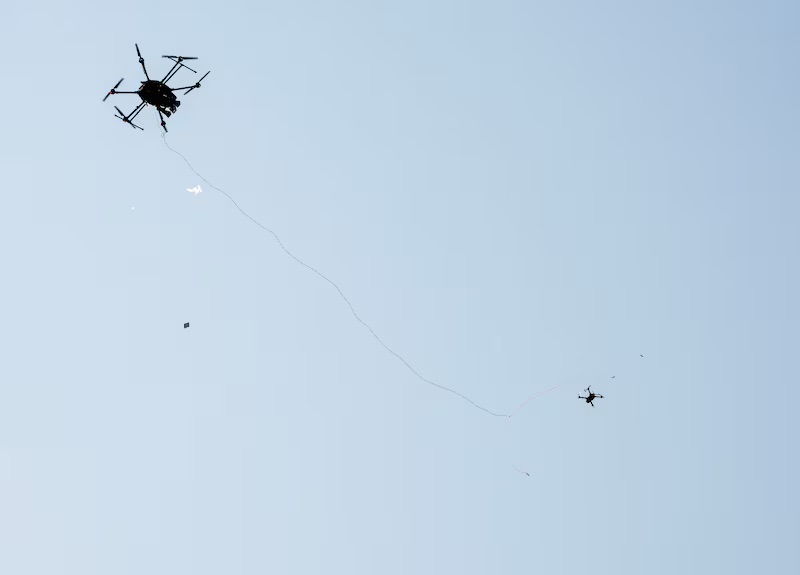
The advantages of such a system are manifold. Not only does it minimize collateral damage, but it also preserves the target for forensic analysis — a crucial intelligence asset. Investigators can extract fingerprints, electronic signatures, and metadata, determining the drone’s origin, manufacture, and deployment chain. This data feeds into wider security frameworks used by the Department of Defense, Homeland Security, and allied partners.
Precision, Probability, and Performance Metrics
Performance-wise, the DroneHunter F700 consistently delivers. Jim Housinger, Fortem’s Chief Operating Officer, reports that depending on engagement parameters, the capture success rate exceeds 75%, and in less complex encounters, can climb to 95%. This makes it one of the most reliable autonomous defense platforms in the world — a standard few, if any, competitors can claim.
The system’s radar suite is adapted from technologies found in modern fighter jets, offering real-time tracking and precision targeting in dense electronic environments. More impressively, the F700 can operate in complete autonomy once launched — it scans, identifies, tracks, intercepts, and neutralizes enemy drones with zero manual input required.
Lindon, Utah: The New Arsenal of Democracy
While Silicon Valley garners global attention for consumer tech, Lindon, Utah is quickly becoming a fortress of next-gen military innovation. Fortem’s newly inaugurated headquarters and advanced manufacturing center represent a significant investment not just in production capability, but also in national resilience.
The state-of-the-art facility was designed with speed and scalability in mind. From prototyping to deployment, the entire supply and assembly chain is managed in-house. This ensures rapid turnaround during conflict escalations — a critical need when time-sensitive deployments can determine the fate of missions.
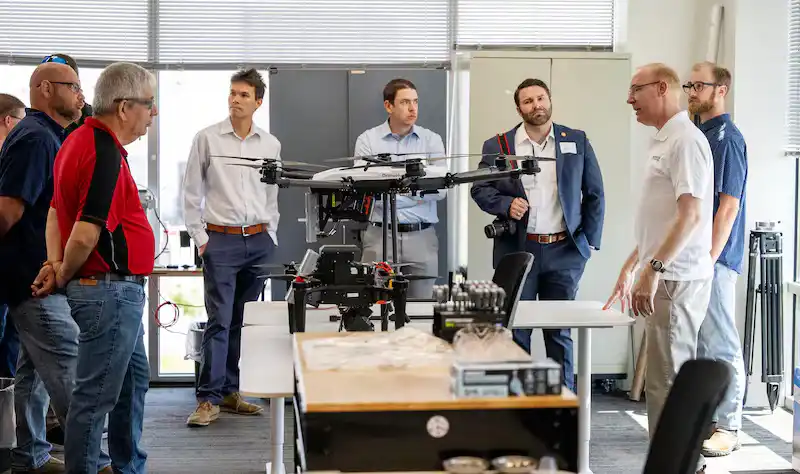
Fortem is not operating in a vacuum. It collaborates closely with all branches of the U.S. military, as well as with the Department of Homeland Security, aerospace defense commands, and foreign allies. Their goal is unified and urgent: to develop defense platforms that outmatch and outmaneuver evolving drone threats in any theater, at any time.
The Drone Threat Landscape: Domestic Vulnerabilities Exposed
Beyond international conflict zones, domestic drone surveillance by foreign adversaries has already breached critical perimeters. Fortem executives reveal that enemy actors know precise locations of fuel depots, power grids, aircraft storage, and defense emplacements on U.S. soil. Alarmingly, they also point out that hostile individuals and entities have purchased land adjacent to military installations — a direct challenge to homeland defense.
This silent form of infiltration through small commercial drones and unassuming surveillance equipment is eroding traditional perimeter defenses. America’s adversaries are mapping vulnerabilities, rehearsing access points, and gathering logistical data without ever setting foot inside government facilities. Fortem’s systems provide the only scalable deterrent, able to intercept, investigate, and neutralize these drones before they deliver payloads or broadcast intelligence.
Fortem’s Strategic Vision: Beyond Defense, Toward Deterrence
Fortem’s leadership envisions their technology not just as defensive, but proactively deterrent. By making it exponentially harder and riskier for enemy drones to succeed, Fortem’s systems raise the cost of attempted intrusion. It’s a classic arms race — but in this case, the advantage lies with the company that can most efficiently merge autonomy, analytics, and airspace control.
Unlike kinetic defense systems that rely on destruction, Fortem is changing the narrative to one of information capture. Every intercepted drone becomes a source of intelligence, feeding into broader databases, enhancing predictive models, and informing security protocols across defense departments. This shift is especially valuable when dealing with nation-states employing proxy warfare and asymmetric drone tactics.
U.S. Defense Doctrine Adapts to Autonomous Realities
As drone warfare becomes cheaper, faster, and more precise, U.S. defense doctrine is evolving to meet autonomy with autonomy. Manual defense systems can’t respond fast enough to saturation attacks, where dozens or hundreds of drones swarm in coordinated patterns. Fortem’s tech is specifically engineered for autonomous response at scale — capable of protecting entire bases, urban centers, or convoys without latency.
This makes Utah not just a manufacturing hub but a testing ground for the future battlefield, where decisions are made in milliseconds by machine learning systems trained on thousands of threat patterns. From hardware to AI, Fortem’s integrated systems are designed for the zero-mistake environments modern conflicts now demand.
Conclusion: Vigilance in the Age of Unseen Warfare
While the average citizen may not yet grasp the scale of the threat, decision-makers at the Pentagon and defense agencies are taking notice. Fortem’s work represents more than innovation — it symbolizes the new normal in defense readiness. As attacks increasingly come not from fleets of tanks but from drones the size of a suitcase, technology like DroneHunter F700 is what will decide the difference between security and catastrophe.
The message from Lindon, Utah, is clear: America will not wait to be caught off guard. In a world where warfare is changing faster than treaties or diplomacy can react, Fortem Technologies is building the tools to defend not just borders, but the very airspace above our cities and soldiers.
As Adam Robertson put it, with chilling clarity: “The threat is real and it is here today.” The only question left is: will America be ready? Thanks to Fortem — the answer may well be yes.