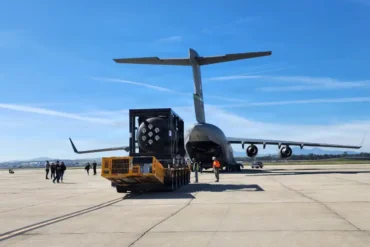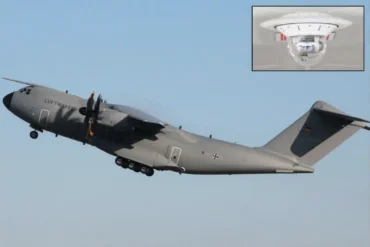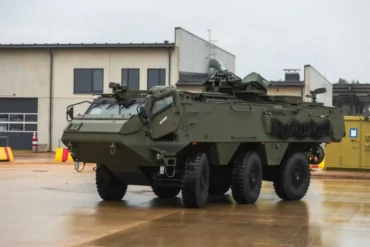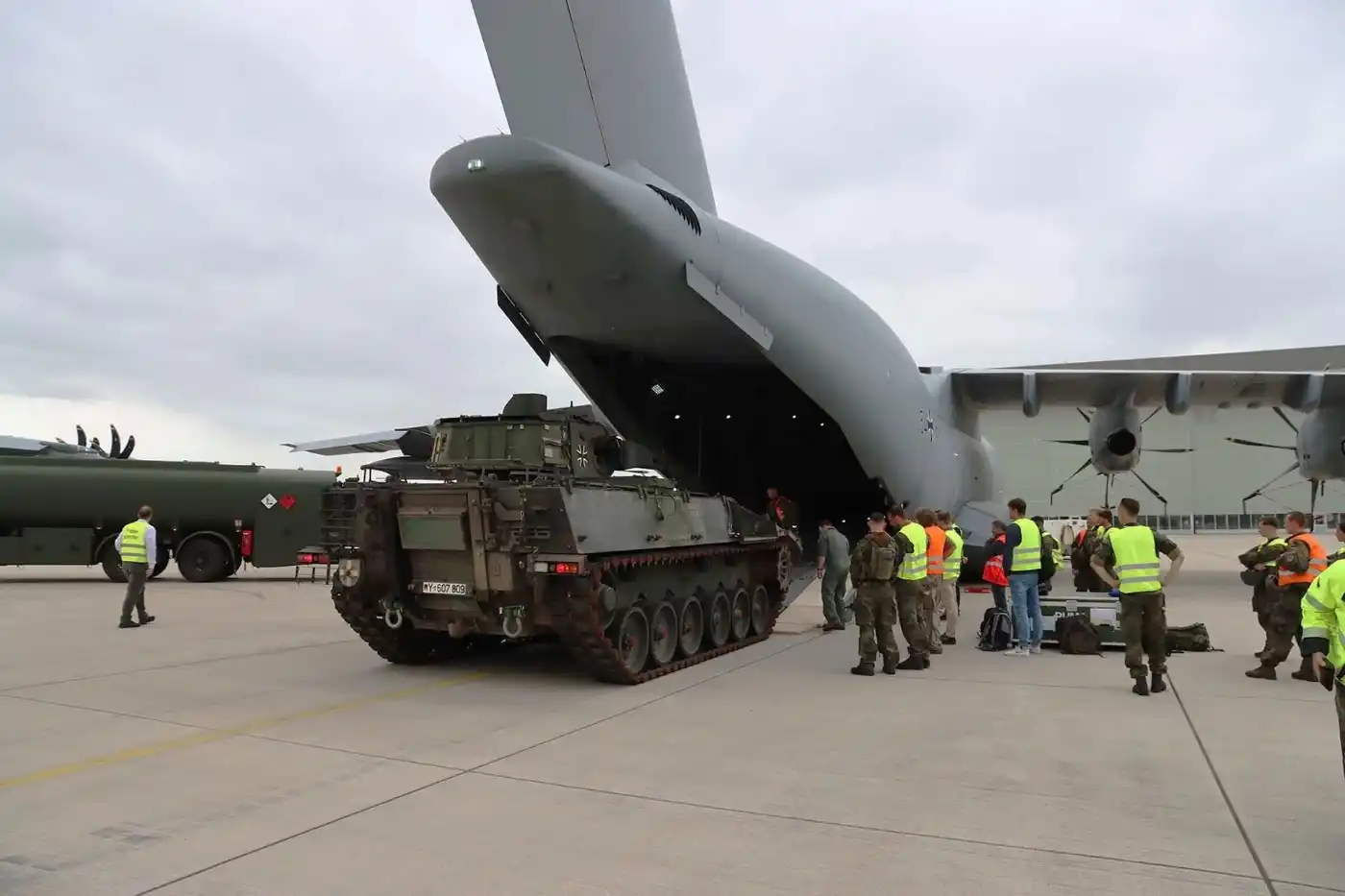
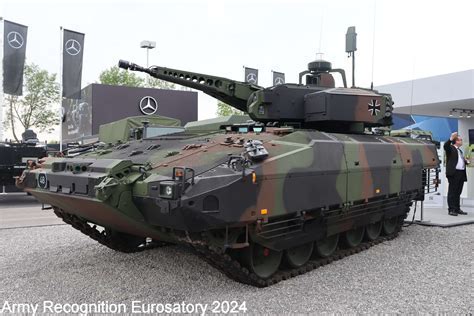
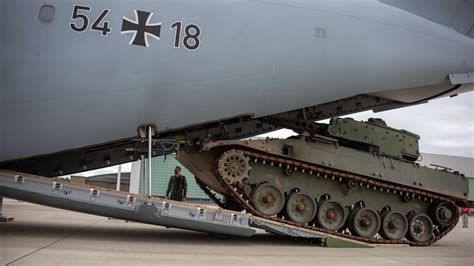
On July 9, 2025, the German Armed Forces (Bundeswehr) achieved a defining milestone in modern military logistics as a Puma infantry fighting vehicle (IFV) was successfully airlifted using the Airbus A400M Atlas. This historic operation—conducted with meticulous coordination among the German Army, Air Force, procurement agency BAAINBw, and defense contractors—marks a transformative advancement in Germany’s force projection strategy.
This event not only reflects the technical feasibility of transporting heavy tracked vehicles via strategic airlift but also underlines a strategic reorientation toward expeditionary readiness. In an increasingly unpredictable European security landscape, Germany is signaling its preparedness to respond swiftly with armored reinforcements in regions where conventional transport routes may be compromised.
The Strategic Leap: From Railroads to Runways
Historically, the Puma IFV—a critical replacement for the legacy Marder fleet—was restricted to rail and heavy ground transport due to its weight, tracked design, and high protection standards. The ability to now airlift the Puma redefines the Bundeswehr’s strategic mobility. Rail and road, while cost-effective, are vulnerable to disruption, logistical delays, and enemy interdiction—challenges that are compounded in forward deployment scenarios or during NATO exercises along the alliance’s eastern flank.
This airlift capability not only boosts operational speed but also enhances Germany’s interoperability within NATO. Where once the movement of armored assets could take days across central Europe, the A400M allows critical fighting platforms to be repositioned across the continent—or beyond—within hours.
Engineering Precision: Fitting the Puma Into the A400M
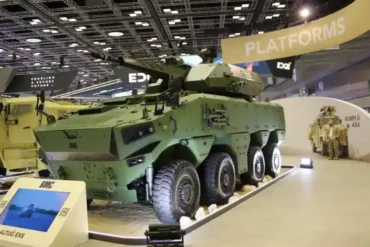
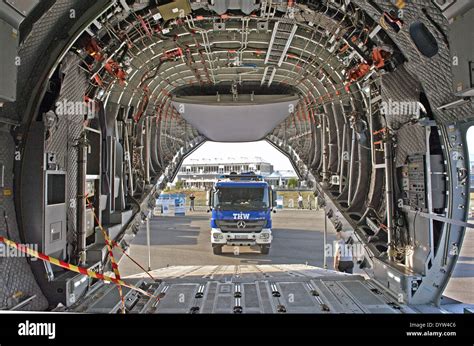
The Airbus A400M Atlas, designed to carry up to 37 tons, has already airlifted a variety of tactical platforms including the GTK Boxer. However, the Puma IFV, weighing approximately 31.5 tons in combat configuration, presented a unique challenge. Unlike wheeled vehicles, the Puma’s tracked design, modular armor, and digital subsystems required a partial disassembly and exact weight calibration to meet the A400M’s cargo specifications.
During the operation, the vehicle was methodically winched into the aircraft using the A400M’s onboard hydraulic winch system. Hydraulically extendable stabilizers were deployed to keep stress levels on the landing gear within safe tolerances—an essential factor in maintaining the aircraft’s structural integrity during the critical phases of loading, takeoff, and flight.
Operational Testing and Procedure Development
The test flight, which lasted two days, went beyond mere loading and unloading. It served as a comprehensive validation exercise, establishing new standard operating procedures (SOPs) for:
- Center-of-gravity adjustments to balance the Puma within the A400M’s cargo hold
- Securing mechanisms using reinforced lashing points
- Tank driver integration and communication with the aircraft’s crew
- Deployment of two loadmasters trained specifically for armored cargo configurations
These newly validated protocols ensure that future Puma airlifts can be executed in under two hours, reducing time on ground and enabling near real-time deployment to forward-operating bases. This also expands potential mission profiles for the A400M fleet, which is now being considered for even heavier or modular configurations as Airbus studies payload upgrades.
Tactical Advantages: Redefining Rapid Reaction
With NATO’s defense perimeter expanding, particularly after the inclusion of Finland and Sweden, the need for agile deployments has become more urgent. The ability to airlift the Puma, which boasts active protection systems (APS), automated fire control, and enhanced survivability features, brings a new dimension to German expeditionary operations.
Unlike wheeled platforms that offer speed but limited protection, the Puma combines high survivability, lethality, and now strategic air mobility. This trio of capabilities allows the Bundeswehr to:
- Deploy a full mechanized platoon with minimal logistical footprint
- Support multinational battlegroups in NATO’s Enhanced Forward Presence (eFP)
- React quickly to Article 5 scenarios, particularly in the Baltic or Black Sea regions
Synergy with NATO Airlift Doctrine
This milestone positions Germany alongside other NATO nations—such as the United States and United Kingdom—that have long relied on the C-17 Globemaster III and C-5 Galaxy for transporting heavy armored assets. Although the A400M does not match those aircraft in payload volume, its modular flexibility, short-field performance, and European supply chain offer advantages tailored to intra-theater movements.
For NATO planners, this increases the pool of available options when orchestrating joint exercises or responding to threats. The Puma-A400M combination may soon be integrated into NATO’s Very High Readiness Joint Task Force (VJTF), making Germany a more dynamic contributor to rapid response contingents.
The Road Ahead: Infrastructure, Doctrine, and Readiness
Germany’s Wunstorf Air Base, where the loading trial was conducted, has already undergone infrastructure upgrades to support armored airlift operations. Hangars, loading ramps, and airfield services are being adapted for faster turnaround, while training programs are being expanded to include loadmasters, aircraft engineers, and armored crew specialists.
Further developments are anticipated in three primary areas:
- Digital mission planning, integrating 3D vehicle models with cargo bay schematics
- Doctrine updates, reflecting new air deployment scenarios for armored brigades
- Platform integration, allowing A400M upgrades to accommodate heavier or combined payloads
Strategic Signaling: A Message to Allies and Adversaries
Germany’s decision to invest in air-mobile armored capabilities is more than a tactical evolution—it is a clear strategic message. To allies, it reaffirms Berlin’s commitment to NATO’s readiness initiatives and reinforces trust in Germany’s capacity to defend the alliance’s eastern flank. To potential adversaries, it signals that German forces can no longer be assumed to arrive by rail days after a crisis begins—they may already be on station before tensions escalate.
The move comes at a time when Russia’s actions in Ukraine, instability in the Western Balkans, and tensions in the Arctic demand a rapid, coordinated Western military posture. Germany’s A400M-Puma combination serves as a model of responsive, modular, and scalable deterrence.
Looking Forward: A Template for Modern Military Mobility
The success of this mission sets the stage for wider implementation. Defense analysts expect this airlift capability to influence:
- Future procurement, prioritizing air-mobility compatibility in next-gen armored platforms
- Multinational force planning, allowing shared use of A400M assets in joint missions
- Doctrinal revisions, shifting from linear deployments to modular, mission-based configurations
Germany’s initiative not only enhances national capability but sets a pan-European benchmark for rapid armor deployment. With other European nations operating the A400M—including France, Spain, and the UK—the groundwork is being laid for an integrated European airlift doctrine that can deliver combat-ready armored units across theaters without reliance on U.S. assets.
Conclusion: The First Flight of Many
The successful airlift of the Puma IFV by the A400M is more than a technical achievement—it is a strategic milestone that reshapes how Germany envisions the deployment of its most potent ground forces. By combining cutting-edge armored technology with air mobility, the Bundeswehr has taken a critical step toward a future-ready military posture capable of meeting both national and alliance-level demands.
As the procedures become standardized and infrastructure adapts, it is likely that this is only the first of many Puma airlifts. The message is clear: Germany’s armed forces are mobile, modernized, and ready to move—fast.