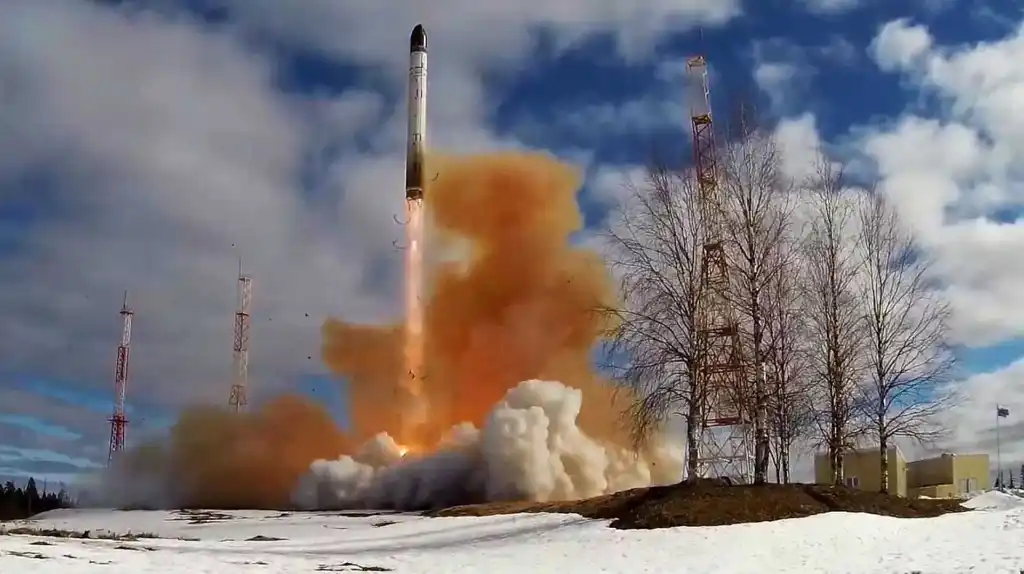
Russia is moving closer to operational deployment of its next-generation RS-28 Sarmat intercontinental ballistic missile, with final flight tests expected to take place in 2026, according to Russian media reports citing defense industry sources. The completion of these trials would mark the final technical milestone before the missile’s formal acceptance into service and its introduction into the arsenal of the Russian Strategic Missile Forces, beginning with deployment at the Uzhur missile base in Krasnoyarsk Krai. The program represents one of the most ambitious modernization efforts within Russia’s strategic nuclear forces, aimed at replacing aging Cold War-era systems while preserving established silo-based infrastructure.
The RS-28 Sarmat is designed to succeed the R-36M2 Voevoda, a heavy, liquid-fueled intercontinental ballistic missile that has served as one of the cornerstones of Russia’s nuclear deterrent since the late Soviet period. By retaining the silo-based concept and upgrading nearly every internal system, Russian planners seek to modernize a critical leg of the country’s strategic triad without fundamentally altering its force structure. The final phase of flight testing scheduled for 2026 is therefore not merely a technical formality but a decisive step in validating years of design, industrial coordination, and doctrinal planning.
The expectation of final tests comes after a protracted and sometimes troubled development and testing campaign. While Russia has repeatedly signaled confidence in the Sarmat program, the limited number of publicly confirmed successful launches underscores why the upcoming test phase carries such weight. For Moscow, completing these trials would allow the retirement of increasingly fragile Voevoda missiles while demonstrating that Russia retains the industrial and technological capacity to field heavy intercontinental missiles despite sanctions and supply chain constraints.
Strategic Context Behind the RS-28 Sarmat Program
The origins of the RS-28 Sarmat lie in a convergence of strategic, technical, and political pressures that emerged in the late 2000s and early 2010s. The R-36M2 Voevoda, though formidable, was approaching the limits of its service life. Its continued operation relied on life-extension programs and industrial cooperation rooted in the Soviet-era defense ecosystem, parts of which were no longer fully accessible to Russia. At the same time, evolving global missile defense systems prompted Russian planners to reassess the long-term survivability and credibility of their silo-based deterrent.
Rather than abandon the heavy missile concept, Russia opted to preserve it. Heavy liquid-fueled ICBMs offer unique advantages, including high throw weight, payload flexibility, and the ability to carry complex penetration aids. The Sarmat was therefore conceived not as a radical departure but as an evolutionary replacement, one that would fit into existing silos while offering significantly improved performance, resilience, and adaptability.
This approach reflects a broader Russian strategic philosophy that values continuity and redundancy. By maintaining a mix of silo-based heavy missiles, lighter silo-based systems, and mobile launchers, Russia seeks to complicate adversary planning and ensure that no single technological breakthrough can neutralize its deterrent.
Industrial Foundations and Development Architecture
Responsibility for the Sarmat’s development was assigned to the Makeyev Rocket Design Bureau, a firm with deep experience in both submarine-launched and land-based ballistic missile systems. Propulsion development involved NPO Energomash, while serial production was entrusted to the Krasnoyarsk Machine-Building Plant, creating a largely domestic production chain intended to minimize reliance on foreign suppliers.
A central design choice was the use of a modernized derivative of the RD-264 liquid-fuel rocket engine, previously employed on the R-36M2. This decision reduced technical risk by building on a proven propulsion family while allowing the integration of updated digital control systems and materials. Ground testing and so-called “throw tests” at the Plesetsk Cosmodrome validated the cold-launch mechanism, first-stage ignition, and initial guidance behavior before full flight tests began.
From the outset, the program was designed to support multiple payload options. These included traditional multiple independently targetable reentry vehicles (MIRVs) as well as maneuvering hypersonic glide vehicles associated with the Avangard system. This dual-capability design philosophy significantly increased the complexity of development and testing, as each payload type imposes distinct requirements on guidance, staging, and flight dynamics.
Flight Testing: Progress, Setbacks, and the Road to 2026
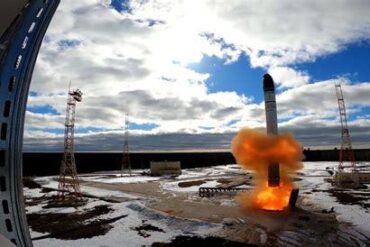
Despite high expectations, the Sarmat’s flight test program has unfolded more slowly than initially projected. The only publicly confirmed successful full-range flight test occurred on April 20, 2022, when a missile launched from Plesetsk successfully reached the Kura test range in Kamchatka, demonstrating basic intercontinental flight capability.
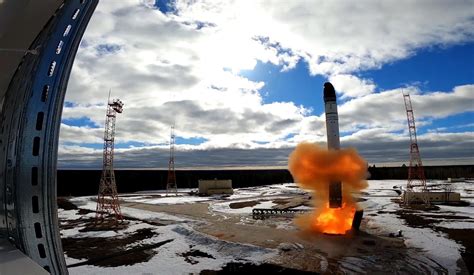
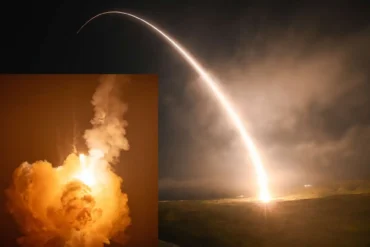
While this test validated core aspects of the missile’s design, it represented only one step in a broader validation process. Subsequent launches were intended to test reliability, payload deployment sequences, and performance under varied flight profiles. Reports of unsuccessful tests, including a September 2024 incident that reportedly destroyed a launch silo at Plesetsk, highlighted unresolved technical challenges and the inherent risks of testing such a massive and complex system.
These setbacks help explain why Russian sources now point to 2026 as the year for final flight tests rather than immediate service entry. The upcoming phase is expected to focus on confirming consistent performance across multiple launches, validating different payload configurations, and ensuring compatibility with operational silos at deployment sites such as Uzhur.
Technical Profile of the RS-28 Sarmat Heavy ICBM
The RS-28 Sarmat stands among the heaviest intercontinental ballistic missiles ever developed. With a launch mass of approximately 208 tonnes, a length of around 35.5 meters, and a diameter of 3 meters, it rivals its Soviet predecessor in scale while surpassing it in sophistication. The missile employs a three-stage liquid-fueled architecture and uses a cold-launch system, in which a gas generator ejects the missile from its silo before engine ignition, reducing stress on the silo structure and improving survivability.
The missile’s stated range of up to 18,000 kilometers allows it to reach targets across the globe, including via non-traditional trajectories. Guidance relies on a combination of inertial and astro-inertial navigation, enabling high accuracy without dependence on external signals such as satellite navigation systems, which could be disrupted in wartime.
A key metric is throw weight, and here the Sarmat excels. With an estimated capacity of up to 10 tonnes, it can carry a wide array of payloads, including heavy MIRV configurations and advanced penetration aids. This capability underpins its role as a strategic system designed not merely to deliver warheads but to defeat sophisticated missile defense networks.
Payload Flexibility and Penetration Capabilities
In its conventional configuration, the Sarmat is assessed to carry 10 to 14 MIRVs, each with yields in the hundreds of kilotons. Alternatively, it can be equipped with a smaller number of maneuvering hypersonic glide vehicles, commonly cited as three Avangard units. These vehicles are designed to separate from the booster and glide through the atmosphere at speeds reportedly reaching Mach 15, performing sustained maneuvers that complicate interception.
Beyond warheads, the missile deploys a suite of penetration aids, including decoys and other countermeasures released during the midcourse phase of flight. Combined with the option to fly along unconventional trajectories, including potential routes over the Southern Hemisphere, these features are intended to stretch and overwhelm existing and future missile defense systems.
Deployment Plans and Role Within Russia’s Nuclear Forces
Initial deployment of the RS-28 Sarmat is expected to begin with a single regiment at the Uzhur missile base, replacing Voevoda missiles on a one-for-one basis. This incremental approach reflects both practical constraints and strategic caution. Rather than transforming the force overnight, Russia appears intent on integrating the Sarmat gradually, allowing operational experience to accumulate while maintaining overall readiness.
Within the broader structure of the Strategic Missile Forces, the Sarmat is not intended to replace all other ICBMs. Instead, it will operate alongside systems such as the RS-24 Yars and mobile launchers, preserving a diversified force mix. Its specific niche is to sustain the heavy missile category, providing payload capacity and trajectory flexibility that lighter systems cannot match.
Strategic Implications of Successful Final Tests
If the final flight tests in 2026 proceed as expected, the RS-28 Sarmat will represent a significant renewal of Russia’s silo-based deterrent. From a military perspective, it allows the orderly retirement of aging Voevoda missiles without sacrificing capability. From a strategic standpoint, it reinforces Moscow’s message that its nuclear forces remain credible, adaptable, and technologically advanced.
The long development timeline and technical challenges also illustrate the complexity of modern strategic weapons programs. Heavy ICBMs sit at the intersection of propulsion engineering, materials science, guidance technology, and strategic doctrine. The Sarmat’s journey from concept to deployment underscores how even established nuclear powers face formidable hurdles when modernizing their most sensitive systems.
As 2026 approaches, the final flight tests will be closely watched not only by Russian planners but by defense analysts worldwide. Their outcome will shape assessments of Russia’s strategic trajectory for decades to come, anchoring one of the most powerful components of its nuclear deterrent firmly in the post-Soviet era.