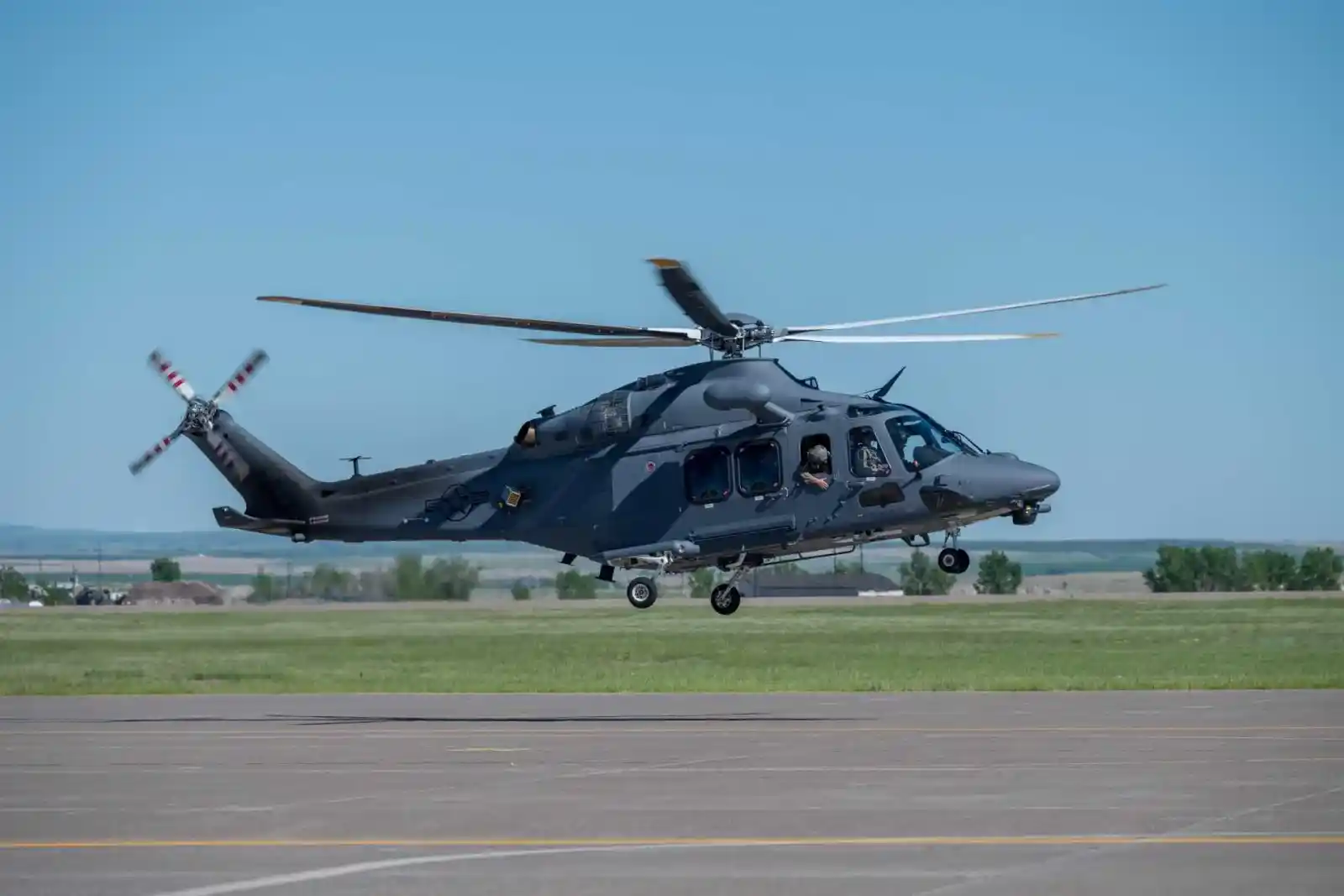
The U.S. Air Force has officially concluded the final Initial Operational Test and Evaluation (IOT&E) flight of the MH-139A Grey Wolf, marking a decisive leap forward in the modernization of America’s strategic deterrent support infrastructure. This milestone, announced by Boeing on July 16, 2025, completes a rigorous six-month test campaign that validated the aircraft’s operational effectiveness, maintainability, and mission suitability across a wide spectrum of defense scenarios.
MH-139A Grey Wolf: A Next-Generation Helicopter for Nuclear Security
The MH-139A Grey Wolf, a militarized derivative of the Leonardo AW139, is a product of a strategic partnership between Boeing and Leonardo. Designed as a successor to the venerable UH-1N Huey, the Grey Wolf is purpose-built to defend Minuteman III ICBM missile sites and to fulfill a wide array of rapid-response national security missions.
The helicopter introduces a transformative leap in air mobility and survivability. Offering 50% greater speed, 50% more range, and a 30% roomier cabin than the UH-1N, it also carries an increased payload capacity of 5,000 pounds. These enhancements ensure that the MH-139A can respond faster, carry more personnel or equipment, and operate over longer distances—capabilities essential for modern-day missile field security and rapid deployment of security forces.
Rigorous Testing Campaign Validates Performance and Readiness
The IOT&E phase subjected the MH-139A to realistic and demanding mission scenarios, simulating everything from convoy escort and airfield patrols to logistics operations and security force transport. These evaluations took place under operational conditions similar to those encountered during actual nuclear security incidents.
The testing campaign verified not only the aircraft’s aerodynamic and combat performance, but also its system maintainability, support structure reliability, and logistics sustainability. The results confirmed that the MH-139A meets and exceeds the stringent operational requirements set by the Air Force Global Strike Command. Additionally, the sustainment testing phase focused on developing and validating robust maintenance systems designed to maximize uptime and lifecycle efficiency—vital for continuous readiness in strategic defense operations.
Enhanced Survivability and Tactical Systems
The MH-139A Grey Wolf is outfitted with a comprehensive suite of advanced technologies to increase battlefield survivability and mission flexibility. Among its notable features:
- Ballistic protection for critical components and crew
- Crashworthy fuel systems designed for operational resilience
- Full autopilot capability for low-visibility and complex maneuvers
- Integrated missile warning sensors and electronic countermeasures
- Capability to be equipped with externally mounted M240 machine guns for added force protection
These systems collectively give the Grey Wolf the edge in contested environments, allowing it to operate in potentially hostile territories while maintaining mission assurance.
Mission Scope: Securing the Minuteman Missile Infrastructure
The primary mission of the MH-139A is to provide armed escort and rapid airlift for the protection of the United States’ Minuteman III LGM-30 intercontinental ballistic missile infrastructure, particularly across strategic bases including:
- Malmstrom Air Force Base, Montana
- Minot Air Force Base, North Dakota
- F.E. Warren Air Force Base, Wyoming
These missile fields form the backbone of America’s land-based nuclear deterrent. The Grey Wolf’s capability to deploy tactical response teams, conduct persistent aerial surveillance, and rapidly react to potential security threats reinforces the operational integrity of the nation’s most sensitive and powerful assets.
Expanding Mission Portfolio Beyond Nuclear Security
While missile field security remains its core purpose, the MH-139A is also designed for a range of secondary missions that add to its value as a multi-role aircraft. These include:
- VIP transport for high-ranking officials
- Medical evacuation (MEDEVAC) during emergencies
- Aircrew survival training support
- Disaster response in domestic crisis scenarios
- Conventional airlift and support operations
The helicopter will serve under a diverse mix of commands such as the Air Force District of Washington, Air Education & Training Command, Air Force Materiel Command, and Pacific Air Forces. At the forefront of training efforts is the 908th Flying Training Wing at Maxwell AFB, operating through the 703rd and 24th Helicopter Squadrons, which have been designated to lead MH-139 mission readiness and aircrew qualification programs.
Strategic Procurement and Production Timeline
The Air Force’s journey toward MH-139A acquisition began with a $285 million contract in September 2018 for the first 13 helicopters, along with simulators and ground support systems under Low-Rate Initial Production (LRIP) Lot 1.
Following successful testing and initial delivery benchmarks:
- LRIP Lot 2 was approved in April 2023, adding 13 more helicopters to be stationed at Malmstrom and Maxwell AFB
- In April 2024, Boeing secured an additional $178 million contract for seven more MH-139As, including training systems and sustainment support
To date, a total of 33 helicopters have been ordered under the initial program phase. The total acquisition plan encompasses up to 84 units, with a projected program value of approximately $2.38 billion.
This modular acquisition strategy ensures flexibility, enabling the Air Force to scale production in alignment with evolving mission demands and budgetary considerations.
Next Phase: Transitioning to Full-Rate Production
With the conclusion of the IOT&E campaign, the U.S. Air Force is now preparing a final operational data review to support a formal recommendation for full-rate production. Once approved, the program will shift from limited delivery batches to high-throughput manufacturing, accelerating deployment across all operational theaters and enhancing overall force readiness.
This transition underscores the Grey Wolf’s position as a cornerstone platform in the Air Force’s 21st-century strategic aviation arsenal. Its combination of speed, survivability, advanced systems, and mission versatility ensures that the MH-139A is uniquely suited to the complex demands of nuclear security and rapid response operations.
As threats evolve and strategic deterrence remains paramount, the MH-139A Grey Wolf stands as a crucial asset in the United States’ commitment to defending its most vital military infrastructure. Its successful IOT&E completion sets the stage for broad implementation, reinforcing both the immediate and long-term capability of America’s nuclear command and control architecture.