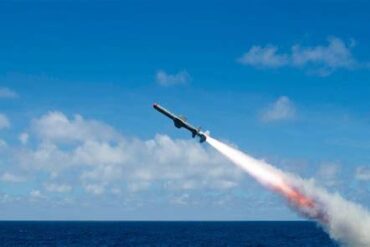
The U.S. Navy has closed a decisive chapter in the evolution of one of its most recognizable strike weapons, confirming that the Harpoon Block II Update (HIIU) can still thrive in the unforgiving reality of modern coastal warfare. With the final planned flight test successfully completed, the program demonstrates how a mature missile design—when intelligently modernized—can remain operationally relevant in an era dominated by dense sensors, layered air defenses, and contested littorals.
This achievement matters because the maritime battlefield has shifted. Naval forces increasingly operate close to shore, where geography compresses timelines and threats arrive from multiple directions at once. The littoral zone is cluttered, crowded, and electronically noisy. In that environment, survivability and flexibility matter just as much as raw speed or range. The Harpoon Block II Update, validated through rigorous testing, proves that a subsonic, GPS-aided, sea-skimming missile can still deliver decisive effects against both ships and land targets when upgraded with modern electronics and flight-control logic.
The final test, announced by Naval Air Systems Command in early February 2026, was not simply a formality. It was a carefully designed stress test meant to answer a blunt question: can this missile, originally conceived decades ago, still execute complex attack profiles against defended coastal targets? The answer, delivered over the ranges of California, was an unambiguous yes.
Final Flight Test Confirms Coastal Suppression Capability
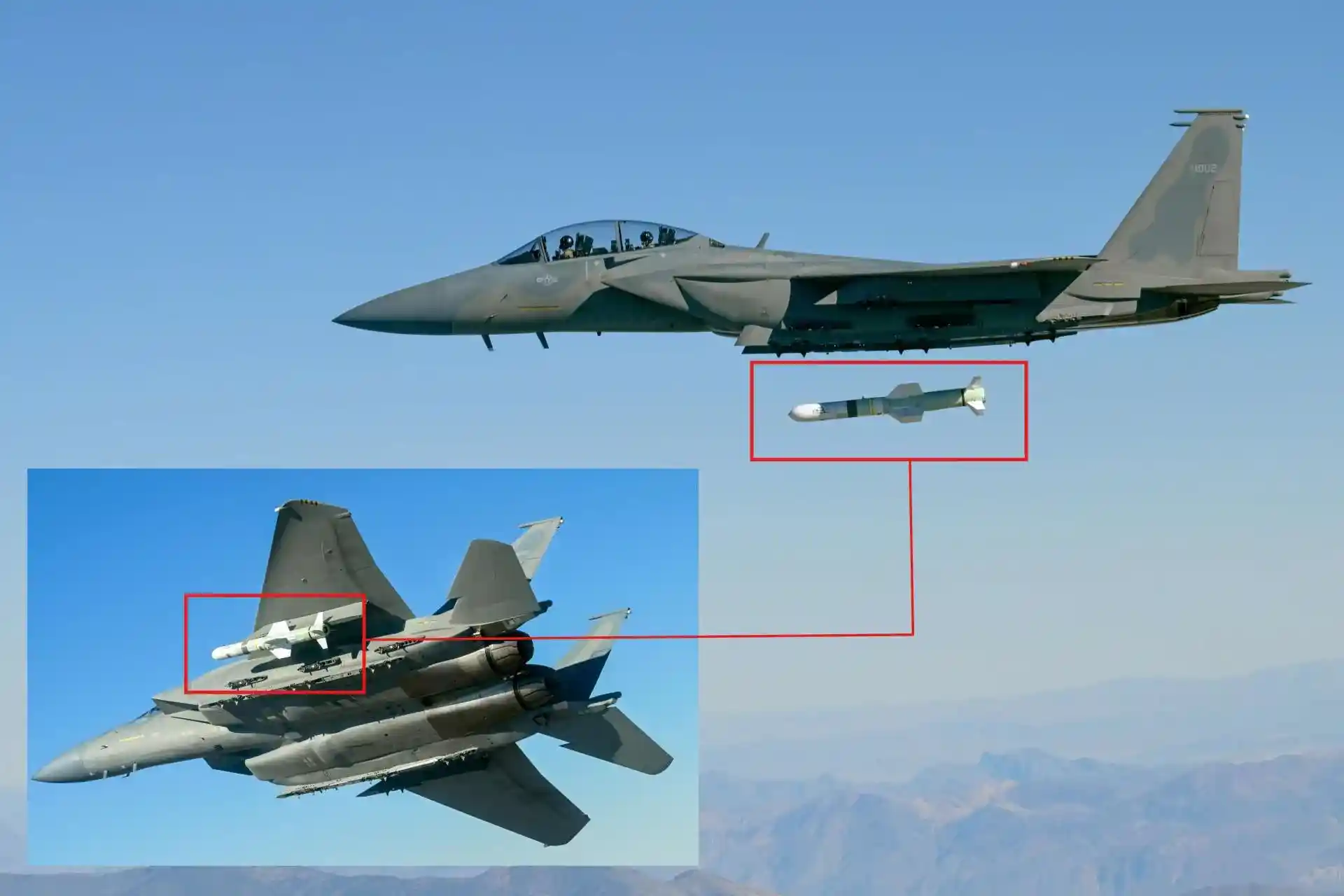
The concluding flight test took place on January 16, 2026, across the Naval Air Weapons Station China Lake and the Point Mugu Sea Range, two of the Navy’s most demanding test environments. Launched from an F-15 at approximately 12,000 feet above ground level, the Harpoon Block II Update executed a multi-phase trajectory designed to replicate a realistic coastal suppression mission against a representative land target.
After release, the missile descended to an intermediate waypoint around 5,000 feet, transitioned across complex terrain, and then executed a steep terminal dive onto the target. This profile is tactically significant. Coastal targets are rarely isolated or exposed; they are often embedded among hills, buildings, and civilian infrastructure, with air defenses positioned to exploit radar coverage gaps. The ability to manage altitude precisely, follow programmed waypoints, and arrive at the correct angle of attack is essential for penetrating such defenses.
According to preliminary Navy assessments, all test objectives were met. The missile demonstrated stable flight, accurate navigation, and proper execution of terminal guidance, validating both the updated hardware and the revised software architecture introduced under the HIIU program. Equally important, the test confirmed seamless integration between the missile and the launch aircraft, an often-overlooked but critical element of real-world combat effectiveness.
A Three-Test Campaign Designed to Retire Risk
The January firing was the final event in a three-test series deliberately structured to retire technical and operational risk across the Harpoon Block II Update mission envelope. The first test focused on aerodynamic behavior and guidance performance, ensuring that the updated missile could follow planned trajectories and respond correctly to navigation inputs. This step was essential to confirm that new electronics did not introduce instability or unexpected flight characteristics.
The second test returned the missile to its maritime roots, engaging a moving surface target at sea. That firing validated the continued effectiveness of the active radar seeker and confirmed that the missile could still prosecute ships underway, even as surface combatants increasingly rely on electronic countermeasures and maneuver to defeat incoming threats.
The third and final test shifted the spotlight ashore, proving the missile’s land-attack credibility. Together, the trio of tests confirmed that the Harpoon Block II Update remains a true dual-role weapon, capable of striking both ships and fixed land targets in the same operational framework. For commanders, that versatility translates into flexibility, reduced logistical burden, and more options during the critical opening stages of a conflict.
Modernizing a Proven Design Through the HIIU Program
At the heart of this success lies the Harpoon Block II Update Obsolescence Update program, an effort aimed less at reinvention than at intelligent renewal. The original Harpoon design dates back to the 1970s, but its basic concept—a standoff, sea-skimming missile with autonomous terminal guidance—remains sound. What threatened its longevity was not obsolescence of the idea, but obsolescence of the components.
Under HIIU, aging electronics and hard-to-source parts have been replaced with modern equivalents, and critical subsystems have been re-architected to support continued production and sustainment. Boeing, the prime contractor, has emphasized that the update touches nearly every major system within the missile, from processing hardware to interfaces with launch platforms. The result is a configuration that supports extended service life, improved reliability, and greater compatibility with current and future operational flight programs.
Naval Air Systems Command has described the effort as building on a 50-plus-year legacy while preparing the weapon for renewed production worldwide. That global dimension matters. More than 30 countries operate Harpoon variants, and many rely on the missile as a cornerstone of their naval strike capability. Ensuring that the system remains supportable is therefore not just a U.S. concern, but a strategic consideration across allied fleets.
What Harpoon Block II Brings to the Fight
Operationally, the Harpoon Block II Update remains a subsonic, over-the-horizon strike missile equipped with a GPS-aided inertial navigation system and an active radar seeker for terminal guidance. This combination allows it to navigate complex routes, strike fixed coordinates on land, and then autonomously acquire and engage targets in the final phase of flight.
The missile carries a blast-fragmentation warhead of roughly 220–230 kilograms, designed to inflict severe damage with a single impact. Programmable waypoints enable planners to route the missile around terrain, islands, or defended areas before committing to the final attack run. In congested littoral environments, where radar clutter and line-of-sight limitations complicate detection, this capability is particularly valuable.
The January test profile illustrated these advantages in practice. By launching from medium altitude, the missile gained initial energy and range. Descending toward the surface reduced its radar cross-section and exploited ground clutter. Intermediate altitude changes allowed it to clear terrain while shaping the approach azimuth, and the steep terminal dive increased lethality against hardened or partially concealed targets. This is not theoretical capability; it is now flight-proven.
Enabling Littoral Suppression Without Closing the Distance
One of the most important implications of the final test is the confirmation that Harpoon Block II Update can support coastal target suppression without forcing launch platforms into the envelope of shore-based defenses. For aircrews and ship commanders alike, standoff distance equals survivability. Coastal anti-ship missile batteries, surface-to-air systems, and radar sites are often integrated into layered defenses designed to punish any platform that ventures too close.
By approaching from over water, transitioning inland, and striking from a steep angle, the Harpoon can neutralize these sites while the launching aircraft or ship remains at a safer distance. This capability is especially relevant in scenarios involving narrow seas, archipelagos, and contested straits, where geography compresses engagement zones and reaction times are short.
For naval task groups, such strikes can help open sea lanes, degrade enemy sensing, and create windows of opportunity for follow-on operations. For air forces, the missile provides a credible land-attack option that complements other precision-guided munitions, particularly against targets near the coast.
Strategic Value for the U.S. and Allied Fleets
Sustaining Harpoon Block II through the HIIU program delivers strategic value well beyond the missile itself. It preserves a large, interoperable inventory of anti-ship and land-attack weapons that can be launched from aircraft, surface combatants, submarines, and coastal defense batteries. That breadth of launch options complicates adversary planning and supports distributed operations across wide maritime spaces.
The update also underpins broader alliance efforts, particularly in the Indo-Pacific, where several partners are fielding Harpoon Coastal Defense Systems under U.S. Foreign Military Sales arrangements. For these nations, a modernized Harpoon provides a credible sea-denial capability that can deter hostile surface forces and protect critical maritime approaches.
From Washington’s perspective, the program offers a cost-effective way to reinforce deterrence while next-generation missiles are introduced. Developing entirely new systems is expensive and time-consuming. By contrast, updating a proven design allows the Navy to maintain combat power and inventory depth without waiting for future programs to mature.
Industry, Integration, and Operational Readiness
The successful completion of the final test also reflects the strength of the government–industry partnership behind the program. The Precision Strike Weapons program office, PMA-201, has overseen requirements definition, testing, and integration, while Boeing and its supplier network have invested in production readiness and long-term support infrastructure.
Program officials have highlighted the coordinated efforts of engineers, logisticians, test crews, aircrews, and range personnel. Such integration is not glamorous, but it is decisive. A missile that cannot be produced, supported, or integrated across platforms is a theoretical capability at best. The HIIU program demonstrates that modernization can be executed without disrupting operational readiness.
With system-level flight testing complete, initial deliveries of the updated missile are expected later in 2026, transitioning the program from validation to operational fielding. For fleet operators, this means continued access to a familiar, reliable weapon—now refreshed for contemporary threats.
A Legacy Weapon With Modern Relevance
The completion of the final Harpoon Block II Update test sends a clear signal about the Navy’s approach to modernization. Not every challenge requires a clean-sheet design. Sometimes, the smartest move is to extend and enhance what already works, especially when time, cost, and alliance interoperability matter.
In a security environment defined by contested littorals, gray-zone pressure, and proliferating anti-ship threats, the ability to strike decisively from standoff range remains indispensable. By proving that the Harpoon Block II Update can execute demanding coastal and land-strike missions, the U.S. Navy has ensured that this long-serving missile will continue to play a meaningful role alongside newer systems.
Legacy, in this case, is not a limitation. It is a foundation—one that, with the right investments and testing, still supports credible combat power in some of the world’s most challenging maritime environments.