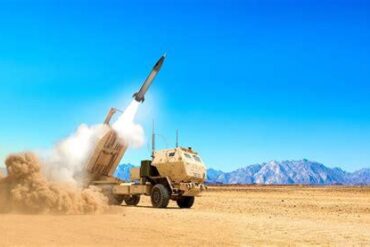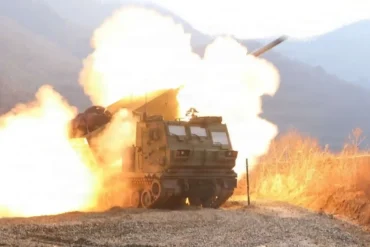
The United States Army has taken a significant step in expanding its long-range strike capabilities with the successful test of the Precision Strike Missile Increment 2 (PrSM Inc. 2). Conducted on March 12, 2026, the test marked the first flight of the new missile variant from an M142 High Mobility Artillery Rocket System (HIMARS) launcher. Designed to strike both moving land targets and maritime threats, the new missile introduces a multi-mode seeker that fundamentally changes the operational role of the Army’s next-generation ballistic missile family.
The test flight demonstrated the missile’s ability to travel approximately 350 kilometers while validating onboard guidance and seeker systems. Unlike earlier variants that relied primarily on preprogrammed coordinates, the PrSM Increment 2 incorporates advanced sensors capable of detecting and tracking targets that are actively maneuvering. This technological shift opens the door to a new capability for the U.S. Army: engaging warships from land using a mobile rocket artillery platform.
Lockheed Martin, the prime contractor behind the program, confirmed that the missile deployed protective covers during flight while internal instrumentation collected data for analysis. The information gathered during this early test phase will support further development as the system moves through technology maturation and preliminary design review.
The Precision Strike Missile Program and Its Strategic Purpose
The Precision Strike Missile (PrSM) program represents the centerpiece of the U.S. Army’s Long Range Precision Fires modernization initiative, a program intended to dramatically extend the range and lethality of ground-based artillery systems. The missile family was designed to replace the aging MGM-140 Army Tactical Missile System (ATACMS), which had been a core long-range strike weapon since the early 1990s.
While ATACMS provided critical battlefield strike capabilities, its range and payload limitations increasingly constrained modern operational requirements. As adversaries developed more sophisticated anti-access and area-denial (A2/AD) systems, the U.S. Army needed a missile capable of striking deeper targets while remaining compatible with existing launch platforms.
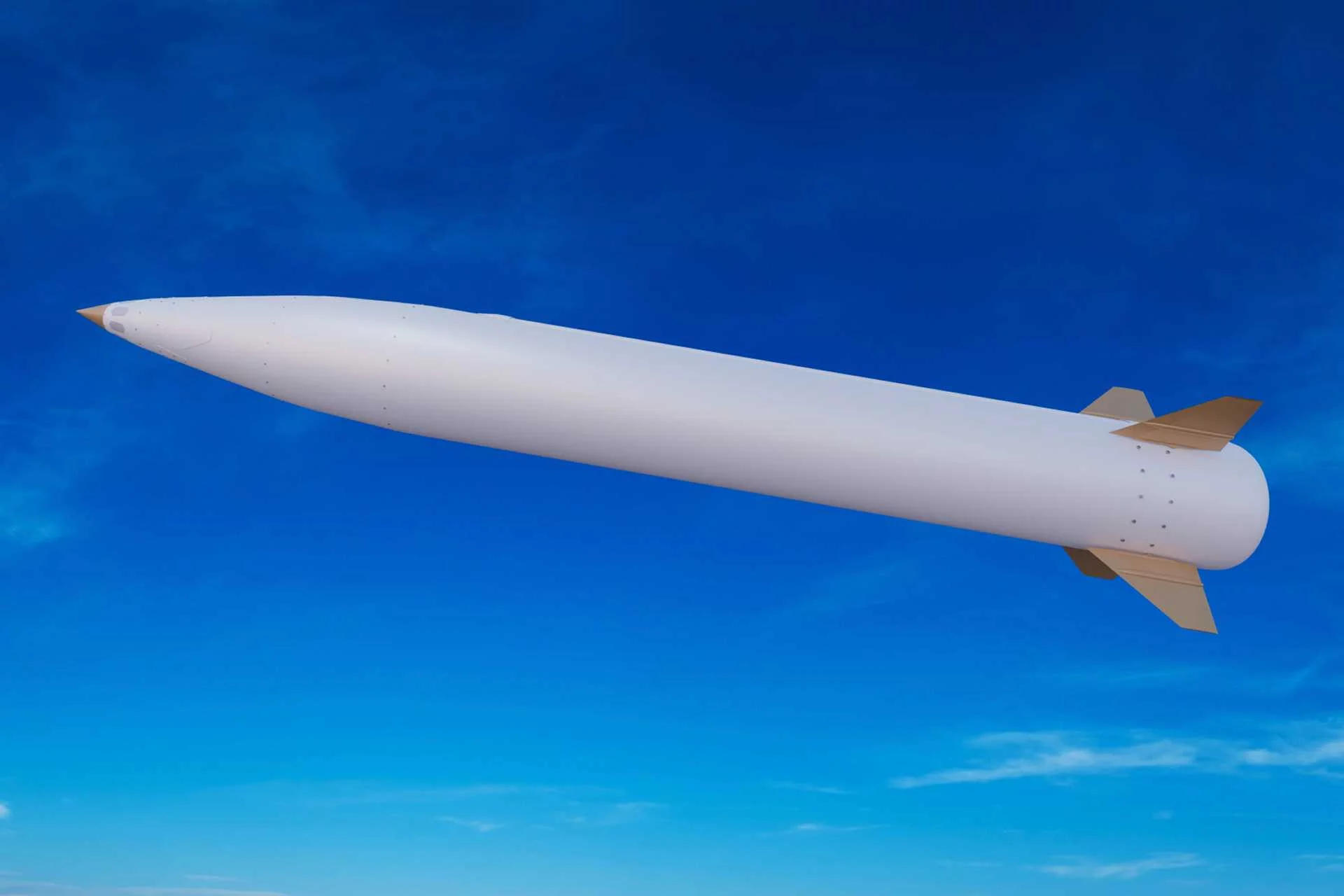
The PrSM was therefore designed with a slimmer airframe measuring approximately 4 meters in length and 430 millimeters in diameter, powered by a solid-fuel rocket motor. This smaller diameter compared with the 610-millimeter ATACMS allowed engineers to redesign the launch pod configuration. Instead of carrying one missile per pod, two PrSM missiles can now fit into the same launcher module.
This modification effectively doubles the missile capacity of both the M142 HIMARS and the tracked M270A2 Multiple Launch Rocket System (MLRS). A standard HIMARS launcher equipped with two pods can now carry four PrSM missiles, dramatically increasing strike density during a single firing mission.
First Operational Variant: Precision Strike Missile Increment 1
The first operational variant of the missile family, PrSM Increment 1, entered service after deliveries began in December 2023. This initial configuration was designed to target fixed infrastructure and stationary military assets, relying on a combination of inertial navigation and GPS guidance to maintain accuracy over long distances.
With a maximum range of at least 500 kilometers, the missile significantly exceeds the capabilities of most ATACMS variants, which typically operated within 165 to 300 kilometers. The missile carries a 200-pound blast-fragmentation warhead, optimized to destroy hardened military installations such as radar facilities, air defense batteries, command centers, airfields, and logistics hubs.
The Increment 1 configuration was developed primarily as a deep strike weapon for high-value fixed targets. Once the coordinates of a target were entered prior to launch, the missile followed a ballistic trajectory to its designated location. Although extremely effective against static targets, this method had limitations when dealing with relocating vehicles or maneuvering ships, which could change position before the missile arrived.
PrSM Increment 2 Introduces a Multi-Mode Seeker for Moving Targets
The PrSM Increment 2 represents a substantial technological leap within the missile program. The most significant enhancement is the integration of a multi-mode seeker designed to identify and track moving targets during the missile’s terminal phase of flight.
This seeker integrates two complementary sensing technologies:
- Passive radio-frequency detection capable of identifying radar emissions from military vehicles or ships
- Imaging infrared sensors used for final target recognition and precise aimpoint selection
During the early portion of the flight, the missile continues to navigate toward a target area using inertial navigation combined with GPS updates. As it approaches the final engagement zone, the onboard seeker activates and begins scanning for targets that match the expected electronic and thermal signatures.
Once a target is detected, the missile can lock onto the moving object and adjust its trajectory, ensuring that the warhead impacts even if the target changes direction or speed. This capability transforms the missile from a coordinate-guided weapon into a dynamic hunter of mobile threats.
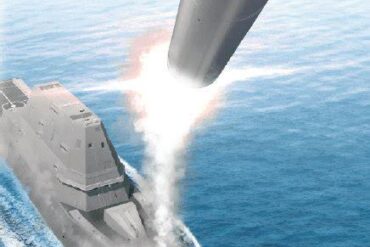
Perhaps the most strategically significant outcome of this upgrade is the missile’s ability to strike naval vessels at sea. Warships rely heavily on radar systems, making them detectable by the missile’s passive RF sensors. When combined with infrared imagery, the missile gains the ability to discriminate among targets and guide itself toward a specific vessel.
A Land-Based Anti-Ship Ballistic Missile
With these new capabilities, the PrSM Increment 2 effectively becomes a land-based anti-ship ballistic missile. This development adds an entirely new dimension to the U.S. Army’s role in maritime warfare.
Traditionally, anti-ship missions were the responsibility of naval aviation, surface combatants, or submarines. The addition of a land-based missile capable of engaging ships from hundreds of kilometers away introduces a new operational dynamic in contested maritime environments.
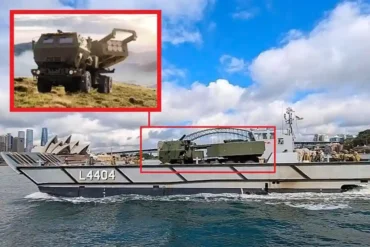
Ground-based launchers equipped with PrSM Increment 2 missiles could be deployed along coastlines or on allied territory near critical sea lanes. From these positions, they would be able to threaten hostile warships without requiring naval assets to be present in the immediate area.
The system’s mobility also enhances survivability. HIMARS launchers can relocate quickly, fire from dispersed positions, and integrate with a broader network of sensors that may include:
- reconnaissance aircraft
- unmanned aerial systems
- surveillance satellites
- naval radar platforms
Through this networked targeting architecture, the missile can be directed toward targets beyond the line of sight of the launcher, dramatically expanding the reach of ground forces into the maritime domain.
Range Expansion and Future PrSM Variants
While Increment 2 focuses primarily on seeker technology and moving target engagement, the broader PrSM program includes several future increments designed to expand the missile’s capabilities even further.
Increment 3 will introduce a modular payload architecture that allows the missile to carry different types of warheads depending on mission requirements. These may include submunition dispensers for attacking armored formations, penetrating warheads designed to destroy reinforced bunkers, or payloads capable of releasing loitering munitions and small drones during flight. Such a configuration would allow a single missile to affect multiple targets over a wide area.
Increment 4, currently under conceptual development, aims to dramatically extend the missile’s range beyond 1,000 kilometers. Achieving this goal would push the weapon into the category of medium-range ballistic missiles, enabling ground units to strike strategic targets far beyond traditional battlefield distances. Engineers are studying improvements in propulsion efficiency and aerodynamics, including potential hybrid propulsion concepts combining rocket boosters with air-breathing engines such as ramjets.
These developments could allow land-based missile units to target air bases, logistics hubs, command facilities, and naval infrastructure deep inside adversary territory without requiring aircraft or naval cruise missiles.
Autonomous Launch Platforms and the Vision for Increment 5
Looking even further ahead, PrSM Increment 5 explores the integration of the missile into autonomous launch platforms. This concept aligns with the Army’s broader push toward robotic and remotely operated systems capable of operating in highly contested environments.
Under this concept, future launch vehicles may be unmanned variants of the HIMARS platform, sometimes referred to as the Autonomous Multi-Domain Launcher. Without a crew cabin or driver compartment, these launchers could accommodate longer missile bodies, increasing both range and payload capacity.
Autonomous launchers could be dispersed across large areas, hidden in remote terrain, and activated remotely when a target is detected. Such an architecture would significantly reduce risk to personnel while enabling rapid missile strikes from concealed positions.
The combination of long-range missiles and robotic launch systems suggests a future battlefield where distributed missile batteries operate as part of a networked strike grid, capable of engaging targets across land and sea with minimal warning.
Operational Use and the Expanding Role of Long-Range Fires
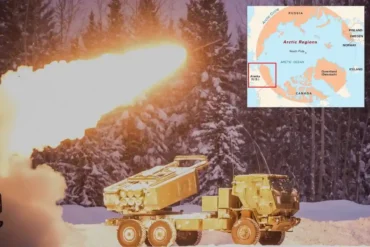
The PrSM missile family has already begun demonstrating its operational value. In 2026, the missile saw its first confirmed combat use during a regional conflict involving Iran. Images released by U.S. Central Command showed HIMARS launchers firing PrSM missiles from two-cell pods, confirming the system’s deployment in active operations.
Ballistic missiles in this class travel at speeds exceeding Mach 3, allowing them to strike distant targets within minutes. This rapid response capability is particularly valuable when dealing with time-sensitive targets, such as mobile missile launchers or command posts that may relocate quickly.
Unlike aircraft that must penetrate enemy airspace, ground-based missile units can operate hundreds of kilometers away from the target zone, reducing exposure to air defenses. The ability to deliver precise strikes without relying on vulnerable forward bases or carrier groups significantly enhances operational flexibility.
As the Precision Strike Missile continues to evolve through its successive increments, it is increasingly clear that the weapon will play a central role in the future architecture of U.S. long-range strike operations. With the addition of moving target engagement and maritime strike capabilities in Increment 2, the missile is transforming from a traditional artillery asset into a multi-domain strategic weapon capable of influencing both land and naval battlespaces.
The March 2026 test represents more than a routine weapons trial. It signals the arrival of a new generation of mobile, networked ballistic missiles that extend the reach of ground forces far beyond the conventional battlefield, reshaping how modern militaries think about long-range precision warfare.