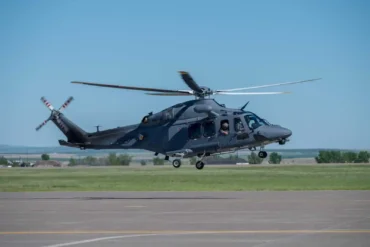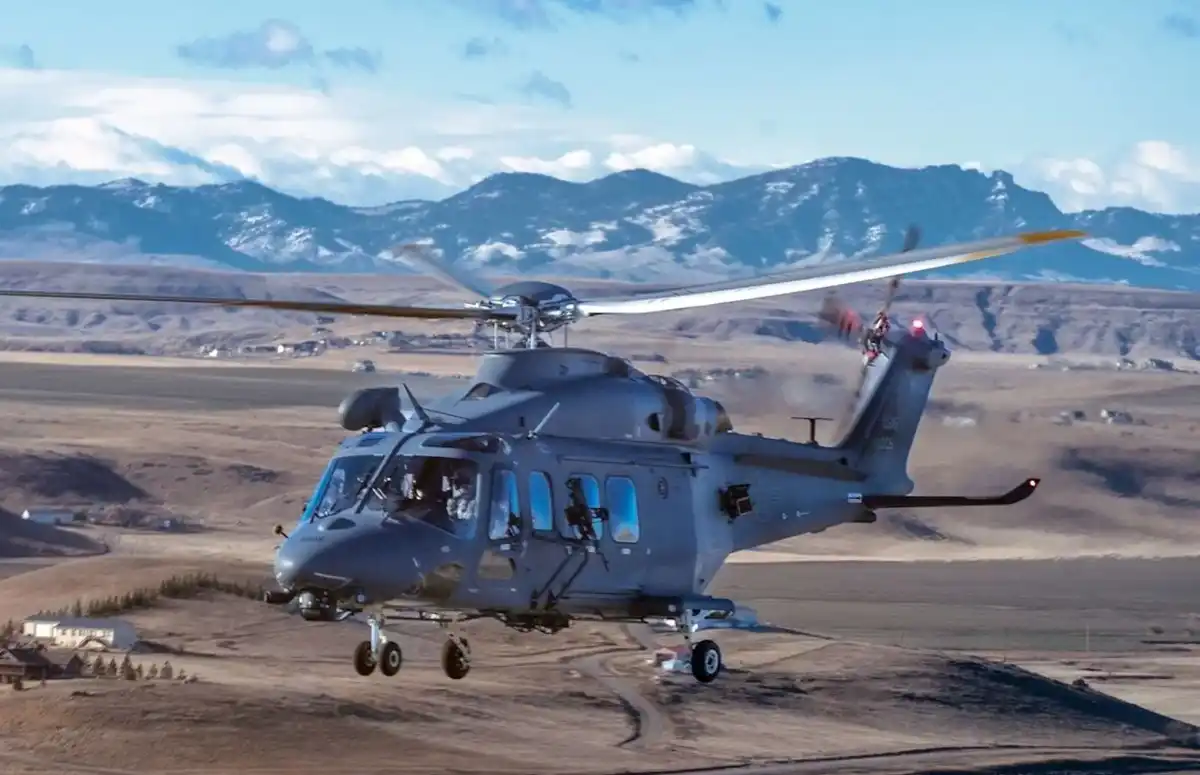
The U.S. Air Force has quietly crossed a major threshold in the modernization of its nuclear security enterprise with the first operational deployment of the MH-139A Grey Wolf helicopter in support of a Minuteman III intercontinental ballistic missile convoy. Conducted at Malmstrom Air Force Base, the mission represents more than the introduction of a new aircraft into service; it marks a structural shift in how America protects its most sensitive land-based nuclear assets across vast and unforgiving terrain.
Confirmed by Air Force Global Strike Command on January 13, 2026, the mission took place five days earlier when two MH-139A helicopters from the 40th Helicopter Squadron provided airborne security for a Minuteman III convoy moving through Montana’s dispersed missile fields. For the crews involved, the task was deceptively simple: maintain overwatch, remain on station for hours, and stay aligned with the pace and security needs of the ground force. In practice, the flight validated years of planning aimed at replacing the aging UH-1N Huey with a platform designed specifically for modern nuclear security demands.
The escort of an ICBM convoy is one of the most exacting aviation missions in the Air Force inventory. Unlike training sorties or base-support flights, these operations unfold far from immediate reinforcement, across remote landscapes where distance, weather, and limited infrastructure shape every tactical decision. At Malmstrom alone, the missile complex covers roughly 13,800 square miles and includes more than 100 hardened launch facilities linked by narrow roads and gravel access routes. In this environment, airborne security is not optional; it is the connective tissue that allows commanders to see, decide, and respond faster than any potential threat.
By completing the mission without the need for an en route refueling stop, the MH-139A demonstrated a capability the nuclear enterprise has long sought but rarely enjoyed. Continuous airborne presence means uninterrupted situational awareness, sustained command and control, and immediate response capacity, all without forcing crews into a cycle of fuel-driven gaps. For convoy commanders, that persistence translates into confidence that the aerial layer will not disappear at the moment it is needed most.
A Purpose-Built Helicopter for Nuclear Security
The MH-139A Grey Wolf is not a generic utility helicopter pressed into a sensitive role. Based on the Leonardo AW139 airframe, it was selected and modified specifically to meet the security, survivability, and endurance requirements of the U.S. nuclear enterprise. Its design philosophy reflects a clear understanding of the convoy escort mission, where long hours at low altitude, rapid retasking, and constant coordination with ground forces are the norm rather than the exception.
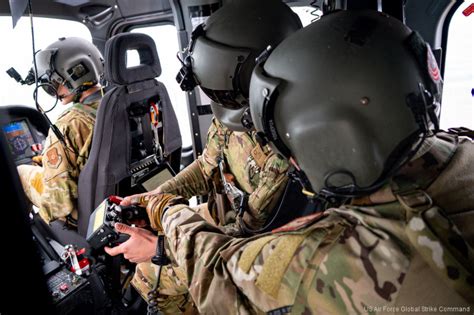
A modern glass cockpit and four-axis autopilot reduce crew workload during extended sorties, allowing pilots to focus on tactical awareness rather than mechanical management. This matters deeply in nuclear security operations, where fatigue can erode judgment long before fuel or airframe limits are reached. Automation and digital systems are not luxuries in this context; they are safeguards for decision-making quality during prolonged overwatch.
The helicopter’s electro-optical and infrared sensor suite fundamentally changes how airborne crews monitor convoy routes and surrounding terrain. Enhanced forward-looking infrared systems allow for early detection of heat signatures in tree lines, concealed vehicles near access points, or anomalous movement along roads leading toward launch facilities. Instead of reacting to incidents as they unfold, crews can identify and track potential threats at greater distances, buying precious time for ground forces to reposition or escalate response measures.
Survivability, Firepower, and Deterrence from Above
Nuclear convoy escort planning assumes worst-case scenarios, and the MH-139A’s defensive architecture reflects that reality. An armored cockpit and cabin protect crews against small-arms fire, while missile warning systems and countermeasures address more sophisticated threats. Self-sealing fuel tanks further enhance survivability, ensuring that a single hit does not immediately remove the aircraft from the fight or force a premature withdrawal.
Firepower is deliberately integrated into this defensive posture. Crew-served M240 machine guns mounted on the MH-139A provide suppressive capability and a visible deterrent, reinforcing the message that any hostile interference with a nuclear convoy will be met with immediate and decisive force. The combination of sensors, armor, and weapons allows the helicopter to operate closer to potential engagement areas, using terrain masking and low-level flight profiles without sacrificing protection.
Speed, Reach, and Rapid Response
One of the most consequential improvements the Grey Wolf brings is raw performance. Compared to the UH-1N it replaces, the MH-139A is approximately 50 percent faster and capable of carrying nearly twice as many personnel. In convoy operations, speed is not about urgency alone; it is about options. Faster transit times mean the helicopter can reposition along a route, respond to developing incidents, or insert security forces at critical points before a situation escalates.
The aircraft’s ability to carry up to nine fully equipped personnel enables rapid buildup of Tactical Response Force elements without multiple shuttle flights. This reduces exposure during troop movements and preserves the helicopter’s availability for continued overwatch. With endurance approaching three hours at cruise speeds near 135 knots, the MH-139A can maintain a protective umbrella over convoys while retaining flexibility to respond elsewhere in the missile field.
Reinforcing the Land-Based Leg of the Nuclear Triad
The significance of this mission extends beyond aviation modernization. It directly supports the credibility of the land-based leg of the U.S. nuclear triad, anchored by the Minuteman III force. With 400 deployed missiles across Malmstrom, Minot, and F.E. Warren Air Force Bases, the system relies on geographic dispersion and hardened infrastructure to complicate adversary attack planning. That dispersion, however, places extraordinary demands on daily security operations.
Convoys moving personnel and equipment are essential to maintaining the safety, security, and reliability of the force. They must operate under stringent nuclear surety standards, free from disruption or uncertainty. By providing a dedicated, purpose-built airborne security layer, the MH-139A reduces operational risk and strengthens confidence in the system’s day-to-day resilience.
A Foundation for the Sentinel Era
While the mission focused on the Minuteman III, its implications are forward-looking. The Grey Wolf is expected to play a central role in supporting the future LGM-35A Sentinel ICBM force, which will inherit and expand upon the dispersed basing concept. Establishing proven procedures, crew proficiency, and command relationships now ensures a smoother transition as the nuclear enterprise evolves.
The first operational MH-139A convoy escort at Malmstrom Air Force Base is therefore best understood as a strategic signal rather than a simple milestone flight. It shows that Air Force Global Strike Command is aligning platforms, missions, and doctrine around the realities of modern nuclear security. By pairing advanced aviation capability with one of the nation’s most sensitive missions, the U.S. Air Force has added a resilient and responsive layer to the protection of its land-based nuclear deterrent, reinforcing stability through preparedness and visible control.