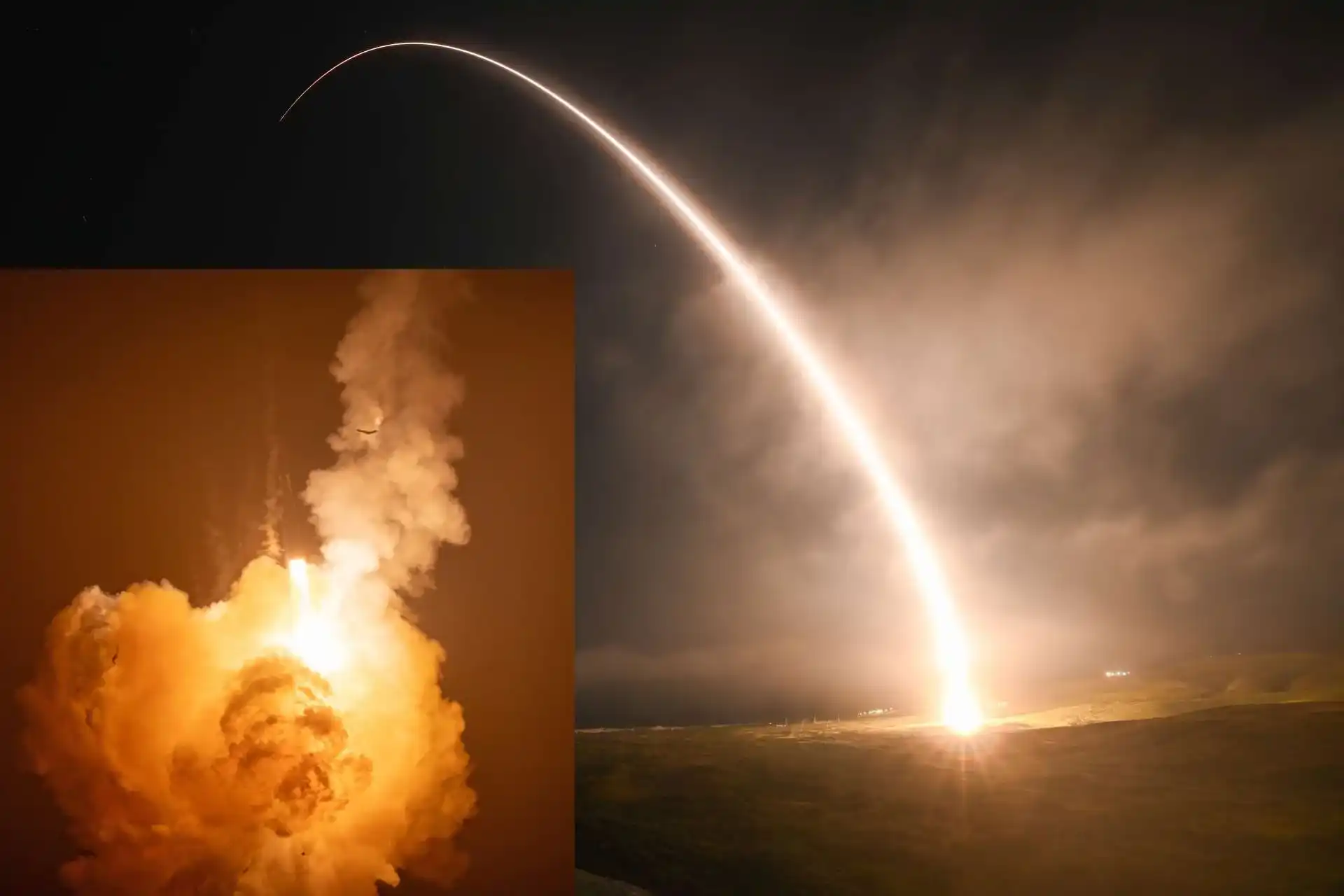
The United States Air Force conducted a high-profile intercontinental ballistic missile test as part of the ongoing Glory Trip test campaign, launching an unarmed Minuteman III ICBM equipped with two reentry vehicles from Vandenberg Space Force Base in California. The mission, officially designated Glory Trip 255 (GT-255), sent the missile on a long-range trajectory across the Pacific Ocean toward the Kwajalein Atoll test range in the Marshall Islands, where advanced tracking systems recorded the missile’s performance.
The launch served as a technical validation of long-range missile reliability and payload deployment capability, reinforcing confidence in the land-based component of the United States’ nuclear triad. Although military officials emphasized that the event was scheduled years in advance and not linked to any specific geopolitical crisis, the test inevitably unfolded amid rising global tensions and increasing nuclear signaling among major powers.
Strategic missile tests like Glory Trip are designed to stress every element of the nuclear strike chain. From ignition and boost phase dynamics to post-boost vehicle operations and final reentry accuracy, each stage generates telemetry used to evaluate missile performance, system reliability, and command-and-control integration across the U.S. strategic forces network.
Glory Trip 255: Demonstrating Multi-Vehicle Payload Deployment
The most notable technical feature of the GT-255 launch was the deployment of two test reentry vehicles. In routine reliability tests, Minuteman III missiles often carry a single test payload, making the dual-vehicle configuration particularly significant.
The deployment sequence validated the post-boost vehicle system, commonly known as the payload bus, which maneuvers in space after the main rocket stages burn out. This system positions and releases reentry vehicles toward their designated targets with extremely precise timing.
For engineers and strategic planners, this phase is among the most technically demanding aspects of ballistic missile operations. Even small timing deviations in the separation events or targeting algorithms could produce significant errors over intercontinental distances.
Testing multiple reentry vehicles therefore allows the Air Force to verify that the complex choreography of space-based targeting, separation, and trajectory shaping still performs as intended decades after the missile system first entered service.
Minuteman III: The Backbone of U.S. Land-Based Nuclear Deterrence
Despite its Cold War origins, the LGM-30G Minuteman III remains one of the most important strategic weapons in the U.S. arsenal. First deployed in the 1970s, the missile has undergone continuous modernization programs that upgraded propulsion, guidance electronics, and warhead systems.
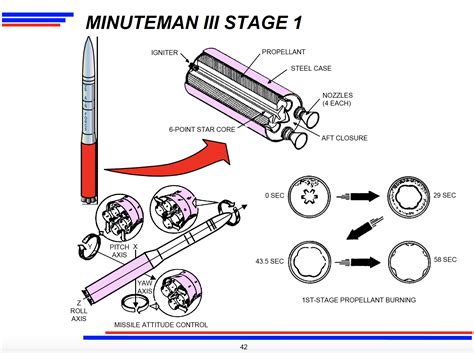
The missile itself is a three-stage, solid-fuel intercontinental ballistic missile, designed for rapid launch from hardened underground silos distributed across the American Midwest.
Key performance characteristics illustrate why the system remains relevant:
- Range exceeding 6,000 miles, enabling global strike capability
- Maximum speed approaching 15,000 mph during midcourse flight
- Apogee of roughly 700 miles depending on trajectory profile
- Total missile weight of approximately 79,000 pounds
The propulsion stages deliver enormous thrust during the boost phase, accelerating the missile beyond the atmosphere in just minutes. After burnout, the payload bus takes over, guiding the reentry vehicles toward their targets thousands of miles away.
Reentry Vehicles and Strategic Targeting Precision
Reentry vehicles represent the final component of a ballistic missile’s strike chain. These compact, heat-shielded payload carriers must survive intense atmospheric reentry temperatures exceeding several thousand degrees Celsius, while maintaining stability and trajectory accuracy.
During tests like GT-255, instrumented test vehicles replace nuclear warheads, allowing engineers to collect data on:
- Atmospheric reentry dynamics
- Thermal protection performance
- Guidance stability during terminal descent
- Accuracy relative to designated impact points
The Kwajalein Atoll test range plays a critical role in this process. Located thousands of miles from California, it provides a highly instrumented impact zone equipped with radar arrays, telemetry receivers, and optical tracking systems.
By measuring the precise landing coordinates and trajectory data of each test vehicle, analysts can evaluate whether the missile system maintains intercontinental targeting accuracy within extremely narrow tolerances.
Command and Control: The Human Element Behind ICBM Launches
An intercontinental ballistic missile launch is not simply a technological exercise—it is also a complex command-and-control operation involving multiple layers of military authority and infrastructure.
The Minuteman III force is distributed across hundreds of hardened silos connected to underground launch control centers staffed by two-officer crews operating around the clock. These crews are responsible for maintaining immediate readiness to execute launch orders if directed by the President of the United States.
Multiple redundant communication systems exist to guarantee that orders can reach missile crews even during large-scale conflict scenarios. These systems include:
- Hardened ground communication networks
- Satellite-based transmission paths
- Airborne Launch Control Systems, which can assume command if ground facilities are compromised
During the GT-255 test, personnel from all three operational missile wings participated in the launch process, ensuring that operational procedures across the entire missile enterprise remain synchronized.
Strategic Significance After the Expiration of New START
The timing of the GT-255 test also carries strategic meaning within the broader international arms control landscape. In February 2026, the New START treaty expired, ending the final legally binding limits on deployed strategic nuclear forces between the United States and Russia.
Under New START, many U.S. Minuteman III missiles were configured to carry a single nuclear warhead, even though the missile was originally designed for Multiple Independently Targetable Reentry Vehicles (MIRVs).
Periodic tests using multiple reentry vehicles serve an important strategic function: they demonstrate that the technical capability to deploy more than one warhead remains viable, even if operational policy currently limits deployment.
This distinction matters in strategic deterrence calculations. Adversaries must assume that the United States retains the ability to rapidly increase payload capacity if geopolitical conditions demand it.
Global Security Context Surrounding the Launch
Although American officials insist the test was routine, global security conditions have intensified significantly in recent months.
In Europe, France has signaled a stronger nuclear posture, with President Emmanuel Macron advocating expanded cooperation between European partners and France’s nuclear deterrent. Meanwhile, Russia has criticized these developments as destabilizing.
At the same time, tensions in the Middle East have escalated dramatically. The United States and Israel entered a direct military confrontation with Iran in late February, leading to regional strikes, retaliatory attacks, and increased deployment of advanced military systems across the Mediterranean.
Against this volatile backdrop, the launch of a U.S. intercontinental ballistic missile inevitably sends a signal—not of imminent use, but of strategic readiness and technological reliability.
Transition Toward the Next-Generation Sentinel ICBM
While Minuteman III continues to perform reliably, the system is nearing the end of its operational lifespan. The U.S. Air Force is preparing to replace it with the next-generation LGM-35A Sentinel ICBM, a program designed to modernize the land-based nuclear deterrent for the coming decades.
Sentinel will involve a complete overhaul of missile hardware, launch infrastructure, and command-and-control architecture. Unlike previous upgrades, which extended Minuteman’s life through incremental modernization, the Sentinel program represents a full generational transition.
The Air Force currently expects:
- Program restructuring completion by late 2026
- First Sentinel test launch planned for 2027
- Initial operational capability targeted for the early 2030s
As this transition progresses, tests like Glory Trip 255 become increasingly important. They provide real-world performance data confirming that the aging Minuteman III fleet can continue fulfilling its strategic role until the Sentinel system becomes operational.
Proof of Credible Deterrence Through Testing
At its core, the GT-255 launch represents a measured demonstration of strategic credibility. Nuclear deterrence depends not merely on possessing weapons, but on proving that the systems behind them remain functional, precise, and immediately deployable.
Every telemetry packet collected during the launch, every trajectory measurement recorded at Kwajalein, and every command-and-control step rehearsed during the operation contributes to that assurance.
In an era where geopolitical tensions are rising and long-standing arms control agreements are fading, data-driven testing of strategic systems has become an essential pillar of deterrence stability. The Glory Trip series, including GT-255, provides that proof—demonstrating that even decades after its introduction, the Minuteman III remains a tested and operational cornerstone of the United States’ nuclear defense architecture.