The U.S. Air Force is pushing the LGM-35A Sentinel intercontinental ballistic missile into its most consequential engineering phase while deliberately keeping one strategic variable unresolved: how many nuclear warheads each missile may ultimately carry. With the New START arms control treaty expired and no successor framework in force, that choice has shifted from a distant policy abstraction to a live design and deterrence question. Sentinel is being built to replace Minuteman III for decades of continuous alert duty from hardened silos, and the payload decisions made now will quietly shape U.S. prompt-strike capacity, crisis stability dynamics, and the workload of the nuclear weapons production complex well into the middle of the century.
At the center of the debate is a tension as old as the ICBM age itself. Single-warhead silo missiles are widely regarded as more stabilizing because each silo presents a less concentrated payoff for an adversary’s first strike. Multiple-warhead, or MIRVed, missiles compress more warheads into the same number of launchers, increasing deployed numbers without building additional missiles, but they also make every silo a higher-value target and intensify pressure in crises. For decades, successive U.S. and Russian arms-control agreements nudged both sides toward single-warhead land-based missiles precisely to lower incentives for rapid escalation. With treaty ceilings gone, the United States is choosing to keep the technical door open rather than locking in a single answer before the strategic environment clarifies.
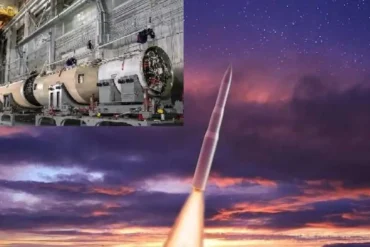
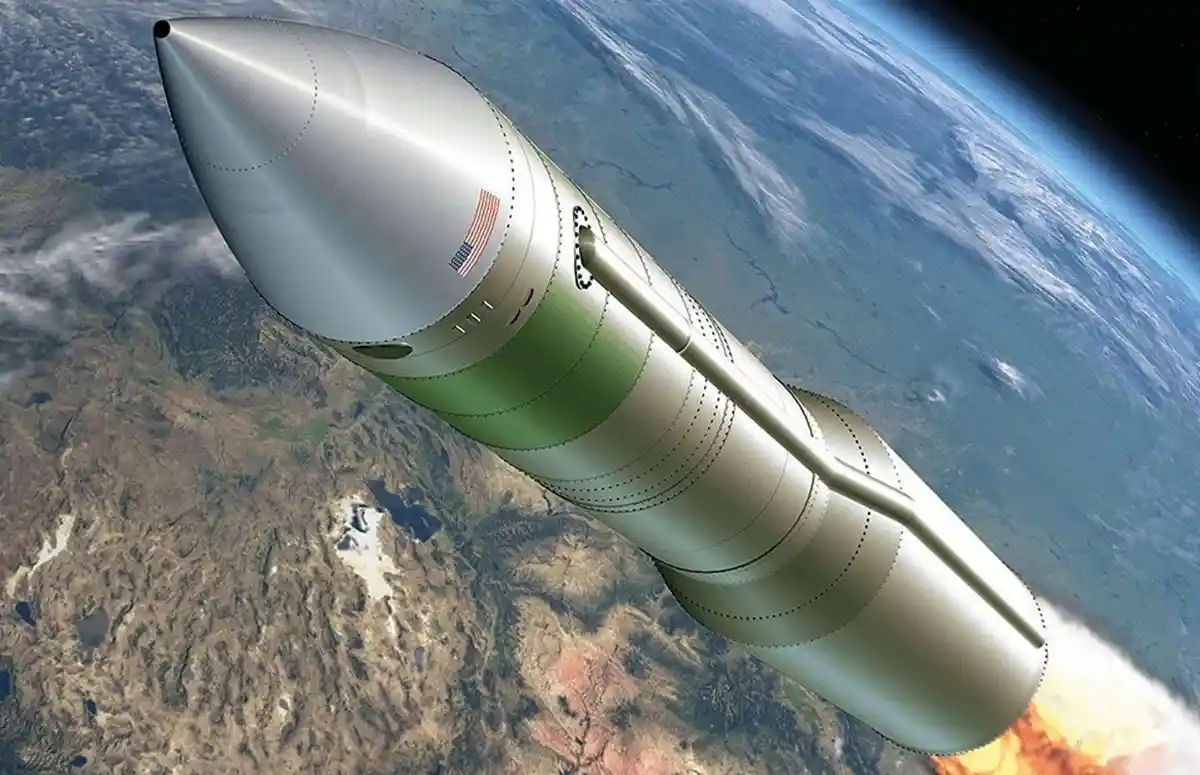
Sentinel’s architecture is what makes that flexibility real rather than rhetorical. The three-stage solid-fuel missile is paired with a liquid-propulsion post-boost vehicle, often called the payload bus, that precisely orients and releases reentry vehicles and any accompanying penetration aids. That bus is the mechanical heart of a MIRV system. Even if Sentinel deploys with a single warhead in its initial configuration, the bus allows the Air Force to alter the payload mix later without redesigning the missile from scratch. Northrop Grumman has emphasized that this stage improves placement accuracy through refined maneuvering and guidance, one of the few performance levers that can be discussed publicly without revealing classified accuracy metrics. In practice, it also future-proofs the missile against shifts in missile defense and countermeasure requirements.
Sentinel’s Design Keeps Strategic Options Alive
The Air Force’s official baseline remains one warhead per missile, aligning with the long-standing preference for a more stabilizing posture. The initial deployment is expected to carry the W87-0 warhead currently used on part of the Minuteman III force, transitioning to the newly manufactured W87-1 as production ramps. The Sentinel’s greater throw-weight compared to Minuteman III means it could, if directed by national leadership, accommodate multiple warheads or a richer suite of penetration aids. That latent capacity matters because it gives policymakers a reversible option: deployed warhead counts could be surged within existing launcher numbers without a crash program to build new missiles.
Senior military leaders have been careful not to prejudge that policy choice. Public comments have framed any return to multiple-warhead ICBMs as a presidential-level decision, not an engineering default. The Air Force’s refusal to specify a final loadout during the critical design phase is therefore a signal of intent to preserve maneuver room. In a strategic environment defined by Russia’s modernization of its silo and mobile forces and China’s rapid expansion of missile fields and warhead production, flexibility itself becomes a form of deterrent leverage.
Warhead Modernization and the Industrial Base Constraint
The missile’s payload question cannot be separated from the warhead enterprise behind it. The W87-1 program is intended to deliver the first newly manufactured U.S. nuclear warhead in decades, with modern safety and security features and a design optimized for producibility. That ambition forces a reconstitution of dormant industrial skills, from plutonium pit fabrication to high-explosive component production and advanced non-nuclear parts manufacturing. The National Nuclear Security Administration’s recent completion of a fully qualified pit for the W87-1 is a pivotal milestone because pit production capacity ultimately caps how quickly the deployed stockpile can grow, regardless of how many warheads a missile could theoretically carry.
The W87-1 will be paired with Lockheed Martin’s Mk21A reentry vehicle, an updated aeroshell derived from the Mk21 used on Minuteman III. The Mk21A has completed unarmed environmental flight testing, validating its ability to endure the violent thermal and mechanical stresses of reentry while protecting sensitive fuzing and safety systems. Together, the W87-1 and Mk21A define the physical envelope of Sentinel’s payload options. Even if policy shifts toward MIRVs, the pace of any upload would be governed by how quickly the production complex can deliver certified warheads and reentry vehicles at scale.
What the Land-Based Leg Brings to Deterrence
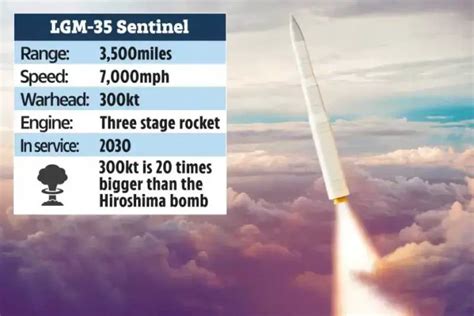
Sentinel’s role in the nuclear triad is about assured, prompt reach rather than flexibility of employment. Land-based ICBMs sit on continuous alert and can reach targets across the globe in roughly half an hour once authorized, complicating an adversary’s planning and compressing decision time in a crisis. The current Minuteman III force consists of 400 deployed missiles carrying one warhead each, either the W87 at roughly 300 kilotons or the W78 at roughly 335 kilotons, with technical “upload” potential on some missiles that has remained largely theoretical under treaty limits. Sentinel’s contribution is to improve reliability, cybersecurity, and sustainment while preserving the payload architecture to adapt as threats evolve.
Accuracy improvements, while classified in detail, matter for deterrence logic. Better placement confidence allows a smaller number of warheads to hold hardened targets at risk, which supports arguments for restraint in warhead counts. At the same time, the ability to add penetration aids or additional warheads provides insurance against future missile defense improvements. This duality is why the Air Force is treating payload configuration as a strategic variable rather than a fixed design parameter.
Infrastructure, Cost Pressure, and Program Reality
The payload debate is unfolding alongside a massive infrastructure overhaul. Sentinel is not just a missile program; it is a recapitalization of 450 silos and more than 600 associated facilities spread across tens of thousands of square miles. In 2024, cost growth triggered a Nunn-McCurdy breach that forced a restructuring, shifting plans toward more new construction rather than refurbishing aging Minuteman III silos. That reset acknowledged the physical reality of 1960s-era concrete and wiring reaching the limits of safe life extension.
Oversight bodies have pressed the Air Force to use the restructuring window to mature software and integrate schedules more tightly, warning that delays push additional risk onto the aging Minuteman III force. The program is aiming for a late-decade pad launch as an early flight milestone and early-2030s initial operational capability, timelines that keep pressure on both the missile prime contractor and the warhead production complex. Payload flexibility is being preserved even as the program tightens scope elsewhere to control cost and schedule risk.
Post-Treaty Strategy in a Crowded Nuclear Landscape
The expiration of New START has changed the strategic conversation even without an immediate numerical buildup. In a world without binding ceilings, transparency and predictability erode, and worst-case planning becomes more attractive. Russia’s fielding of modern silo-based and mobile systems and China’s construction of large missile fields and diversification of delivery systems are reshaping U.S. threat assessments. Keeping Sentinel’s warhead loading open is a hedge against that uncertainty. It signals that the United States can remain at a stabilizing single-warhead posture while retaining the technical capacity to respond if the strategic balance tilts unfavorably.
This approach also carries risks. The mere existence of upload potential can influence adversary perceptions and planning, even if the United States does not exercise it. Stability in nuclear deterrence is as much about expectations as about hardware. The Air Force’s emphasis on presidential-level decision authority for any MIRV shift reflects an understanding that payload configuration is not a technical tweak but a strategic signal with global consequences.
A Missile Built for Strategic Maneuver Space
Sentinel is being engineered for decades of service in a world where arms control may wax and wane, missile defenses will evolve, and geopolitical competition will remain intense. The choice to preserve multiple-warhead flexibility is less about an imminent return to MIRVs and more about refusing to hard-code today’s strategic assumptions into hardware that will still be on alert in the 2070s. The missile’s payload bus, warhead integration pathway, and reentry vehicle modernization together form a quiet toolkit for future presidents facing unknowable threat environments.
The near-term reality remains conservative. Initial Sentinel deployments are expected to mirror today’s single-warhead posture, aligning with long-standing stability preferences and the pace of warhead production. Yet the deliberate ambiguity surrounding ultimate loadout is itself a strategic message. In the post-New START era, the United States is designing its next-generation ICBM not just to replace an aging system, but to preserve strategic maneuver space in a world where rules are fewer and the margins for miscalculation are thinner.