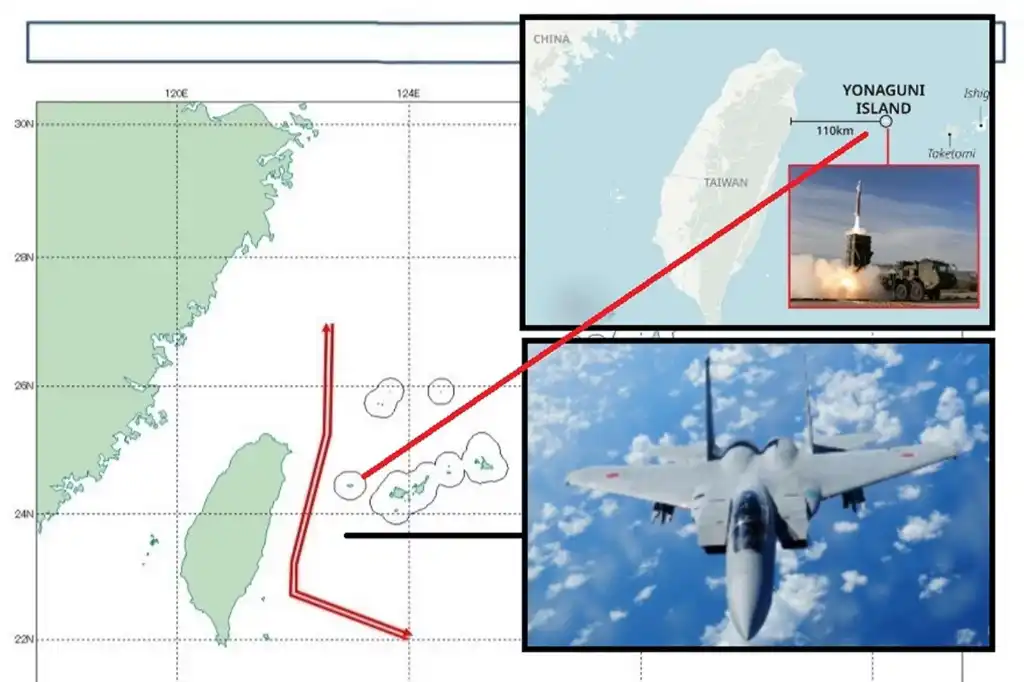
The sudden appearance of a presumed Chinese high-altitude surveillance drone slicing through the narrow corridor between Taiwan and Yonaguni Island on November 24, 2025 thrust one of the most geopolitically sensitive seams of the first island chain into sharp relief. The flight triggered an immediate response from the Japan Air Self-Defense Force, whose Southwest Air Defense sector ordered fighters into the air to intercept and monitor the unmanned platform as it moved from the East China Sea toward the Philippine Sea. The incident unfolded as Tokyo prepared to station a new Type 03 Chu-SAM air-defense unit on the island, linking real-time operational tension with a broader military transformation already reshaping Japan’s southwestern frontier.
While Japan’s Ministry of Defense has not disclosed the drone’s precise designation, officials made clear it was believed to be of Chinese origin, part of a pattern of increasingly bold unmanned reconnaissance flights threading the gaps between the Ryukyu Islands and Taiwan. The incursion came shortly after public remarks by Prime Minister Sanae Takaichi on Taiwan security issues—comments that Beijing predictably condemned—heightening the political charge around any unexpected movement near Japan’s outer islands. With Chinese air and naval patrols already rising around the Yaeyama and Sakishima chains, even a single drone weaving through Yonaguni’s airspace corridor telegraphed how easily the region could be pulled into a Taiwan contingency.
Drone Flight Through a Strategic Bottleneck
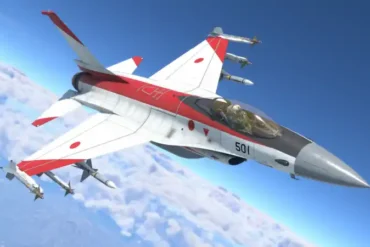
The narrow ten-mile passage separating Yonaguni from Taiwan has become a favored route for reconnaissance aircraft seeking to map radar signatures, response times, and air-defense coverage. Japan’s detection networks tracked the drone as it approached from the northeast, cutting across one of the most heavily monitored maritime chokepoints in Asia. Though officials did not confirm which specific fighters were scrambled, it is widely understood that Mitsubishi F-15J/DJ aircraft based at Naha form the backbone of the sector’s alert squadron. Their dispatch underscored how seriously Tokyo regards any unmanned platform entering the gateway between Taiwan’s ADIZ and the Philippine Sea.
The JASDF response unfolded in parallel with the final preparations for deploying the Type 03 Chu-SAM, a domestically developed medium-range air-defense system that will cement Yonaguni as a forward node in Japan’s layered missile shield. This pairing of live air-policing with ongoing force buildup illustrated a shift in Japanese defense thinking: deterrence is no longer confined to the home islands but projected outward across the entire Ryukyu arc.
Type 03 Chu-SAM: Reinforcing the First Island Chain
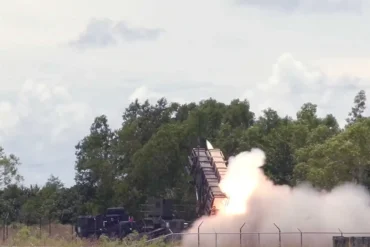
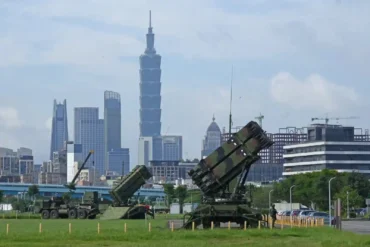
The Type 03 Chu-SAM represents a decades-long investment in Japan’s autonomous air-defense capabilities, the outcome of research led by the Technical Research and Development Institute and Mitsubishi Electric Corporation. The system’s truck-mounted launcher carries six vertically-launched interceptors paired with a multifunction AESA radar capable of tracking roughly one hundred targets while engaging about a dozen at once. With a range of 50–60 km and a ceiling near 10 km, the system is optimized for countering fighter aircraft, cruise missiles, and unmanned vehicles—precisely the types of threats now appearing across the East China Sea.
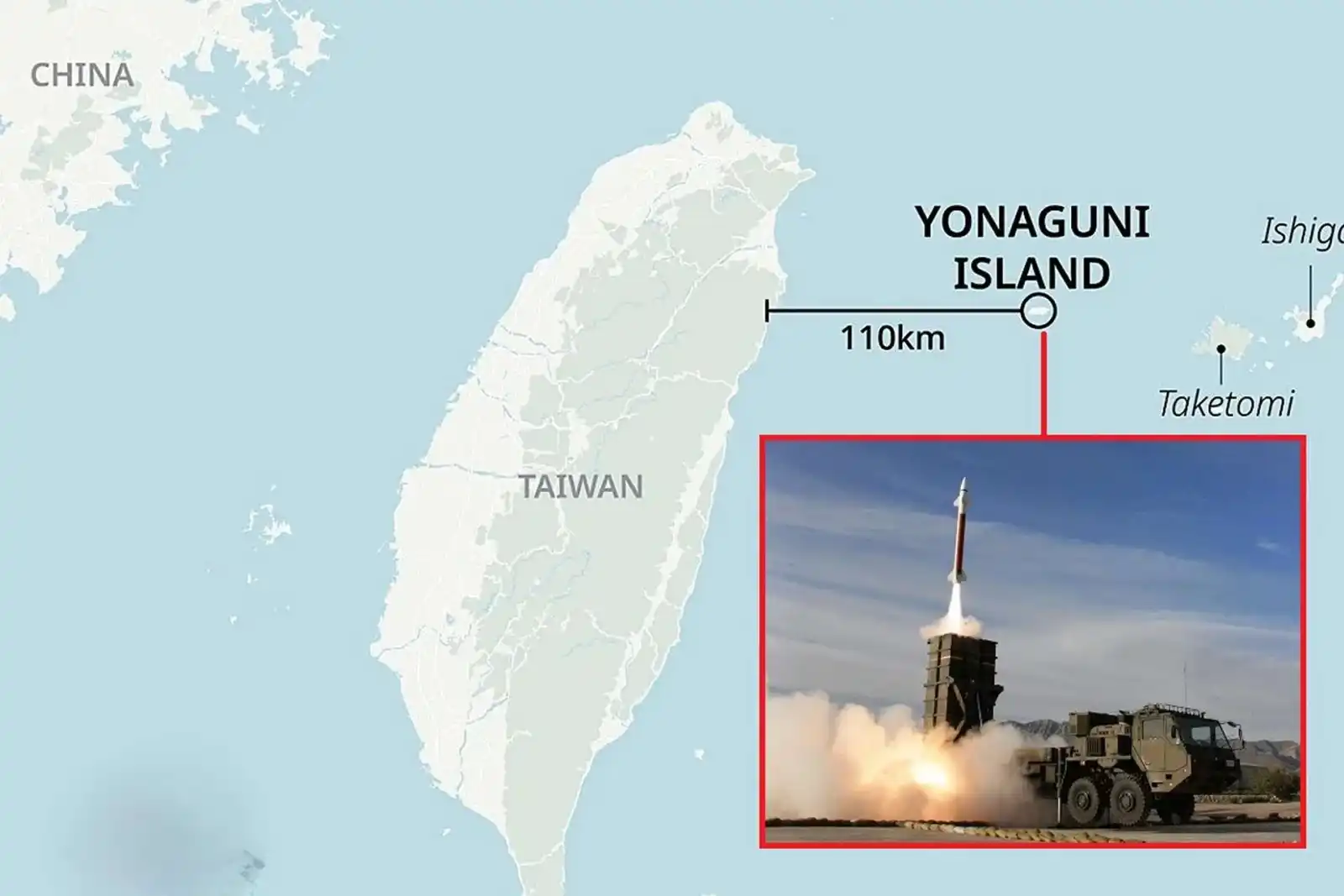
Unlike Patriot PAC-3 units focused on ballistic missile defense, Chu-SAM fills the middle layer of Japan’s protective architecture: wide-area coverage against aerodynamic threats. On Yonaguni, its sensors and launchers will integrate into the JADGE network, syncing information with ground-based radars, airborne early-warning aircraft, and U.S. systems positioned throughout Okinawa and the Philippine Sea. This tight integration creates overlapping engagement zones stretching from Taiwan’s northern flank to the open waters east of the Yaeyama chain.
The improved Chu-SAM Kai, already entering service, adds enhanced seekers, upgraded software, and greater resilience against low-flying cruise missiles. Its evolution mirrors global medium-range systems such as NASAMS and the Chinese HQ-16, yet Japan’s version is uniquely embedded into a dense, island-based radar lattice shaped for the tight maritime geography of the Ryukyus.
A Frontier Transformed Into a Forward Line
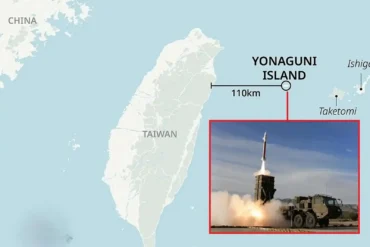
Yonaguni, once regarded mainly as a remote outpost, is now becoming a fulcrum for Japan’s southwestern defense strategy. The island’s proximity to Taiwan—just 110 kilometers away—makes it a natural early-warning and intercept point for monitoring Chinese aircraft pushing into the western Pacific. Tokyo has already expanded the island’s radar station and introduced electronic-warfare teams, supplementing them with logistics drills and joint U.S.–Japan exercises to harden the island against isolation in a crisis.
For Beijing, these deployments form part of what it sees as a U.S.–Japan “anti-access” shield along the first island chain. Chinese analysts routinely warn that such a network could impede PLA Air Force and Navy breakout routes into the Pacific. For communities in Okinawa Prefecture, meanwhile, each new scramble and each new missile battery fuels debate about whether increased defense equals increased risk, especially if the islands become early targets in any clash over Taiwan.
Where Deterrence Meets Escalation
The drone’s brief flight between Yonaguni and Taiwan crystallized a tension long building below the surface: every upgrade designed to strengthen defenses also creates conditions for quicker escalation. Tokyo’s rapid scramble demonstrated readiness; Beijing’s unmanned probe demonstrated reach. Both events occurred in an environment thick with sensors, overlapping missile arcs, and political narratives that can shift public sentiment with a single unexpected radar track.
Japan’s strategy now blends fighter-alert missions with a domestically produced missile shield that covers the Ryukyus from the ground up. The message is unmistakable: any future crisis over Taiwan will not stay confined to the Strait. It will ripple across Yonaguni, the East China Sea, and the U.S.–Japan alliance architecture shaped to respond instantly. In that sense, the November 24 intrusion was not simply a drone flight but a preview of how contested—and how fragile—the first island chain has become. The region moves forward under heightened vigilance, where the boundaries between routine surveillance, deterrence, and confrontation grow thinner with each passing sortie.