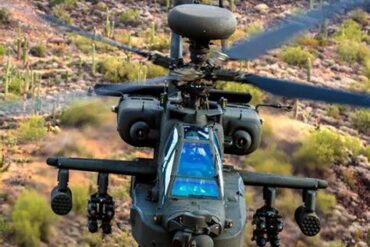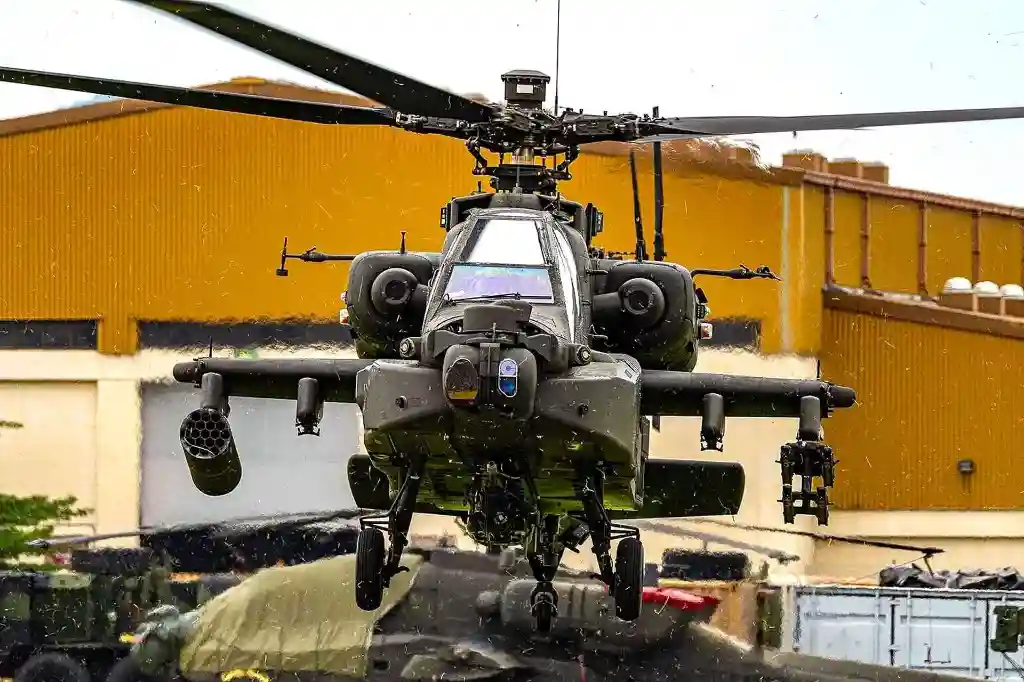
The U.S. Army has intensified its focus on forward-deployed combat readiness by putting AH-64 Apache attack helicopter crews through demanding live-fire precision engagements on the Korean Peninsula. Conducted under Eighth Army oversight, the training placed aviators in tightly timed, graded scenarios designed to replicate the stress, ambiguity, and speed of real combat, not the comfort of scripted exercises.
These live-fire aerial gunnery events, completed by Apache crews assigned to the 2nd Combat Aviation Brigade, were executed at ranges south of the Demilitarized Zone. The location itself matters. Operating within sight of one of the world’s most militarized borders injects a realism that no simulation can fully reproduce. Crews launched multiple sorties, each engineered to test rapid target acquisition, weapons selection discipline, and seamless coordination between pilot and gunner under pressure.
Unlike routine proficiency flights, this qualification forced Apache teams to engage a spectrum of targets in quick succession while meeting strict performance metrics. Crews were evaluated on accuracy, response time, communications clarity, and their ability to adapt when engagement priorities changed mid-mission. The emphasis was not merely on hitting targets, but on doing so while maintaining tactical survivability in a contested battlespace.
The Apache’s full weapons suite was brought into play. Crews employed the 30 mm M230 chain gun for close and moving targets, Hydra 70 rockets for area suppression, and AGM-114 Hellfire missiles for precision strikes against hardened or high-value threats. Each engagement required disciplined fire control and constant crew dialogue, reinforcing the Apache’s core strength as a two-person weapons system rather than a solo platform.
At the heart of these trials was the AH-64E Guardian, the most advanced operational variant of the Apache. Powered by twin GE T700-GE-701D engines, the aircraft delivers the speed, lift, and endurance required for rapid response missions across Korea’s mountainous terrain. Its combat radius and agility allow commanders to project precision firepower quickly, a decisive factor in scenarios where minutes can define outcomes.
The Guardian’s sensor suite is equally critical. The AN/APG-78 Longbow fire control radar, paired with the Target Acquisition Designation Sight and Pilot Night Vision Sensor, enables crews to detect, classify, and engage multiple targets day or night, even in degraded weather or obscured environments. During the gunnery qualification, these systems were not treated as conveniences but as lifelines, pushing crews to rely on fused sensor data rather than visual cues alone.
This level of proficiency is essential to the U.S. Army’s “Fight Tonight” posture on the peninsula. Forward-deployed aviation units must be capable of immediate combat operations without a lengthy ramp-up period. The gunnery qualification ensures Apache crews are not only current on procedures, but psychologically conditioned to make lethal decisions quickly while managing aircraft survivability and mission flow.
The broader strategic context gives this training added weight. North Korea’s continued missile development, artillery modernization, and forward positioning of conventional forces demand that U.S. and allied units maintain a credible deterrent. Apache helicopters, with their ability to hunt armor, disrupt formations, and provide responsive close support, remain a cornerstone of that deterrence framework.
These exercises also strengthen combined operational readiness with the Republic of Korea. While the reported gunnery focused on U.S. Army crews, such training feeds directly into integrated planning and interoperability across allied forces. In any contingency, Apache units would operate as part of a layered response that blends air, ground, and intelligence assets into a unified combat system.
Despite the Army’s long-term transition toward next-generation vertical lift platforms, the Apache continues to prove its relevance. Its survivability, lethality, and adaptability have been refined through decades of combat, from desert warfare to counterinsurgency and now high-end peer competition scenarios. Live-fire qualifications like those conducted in South Korea ensure that experience is not diluted by complacency.
By pushing Apache crews to operate under genuine combat pressure, the U.S. Army is signaling a clear message. Readiness is not a slogan but a condition that must be earned repeatedly, under stress, with real weapons and real consequences. On the Korean Peninsula, that standard remains uncompromising.