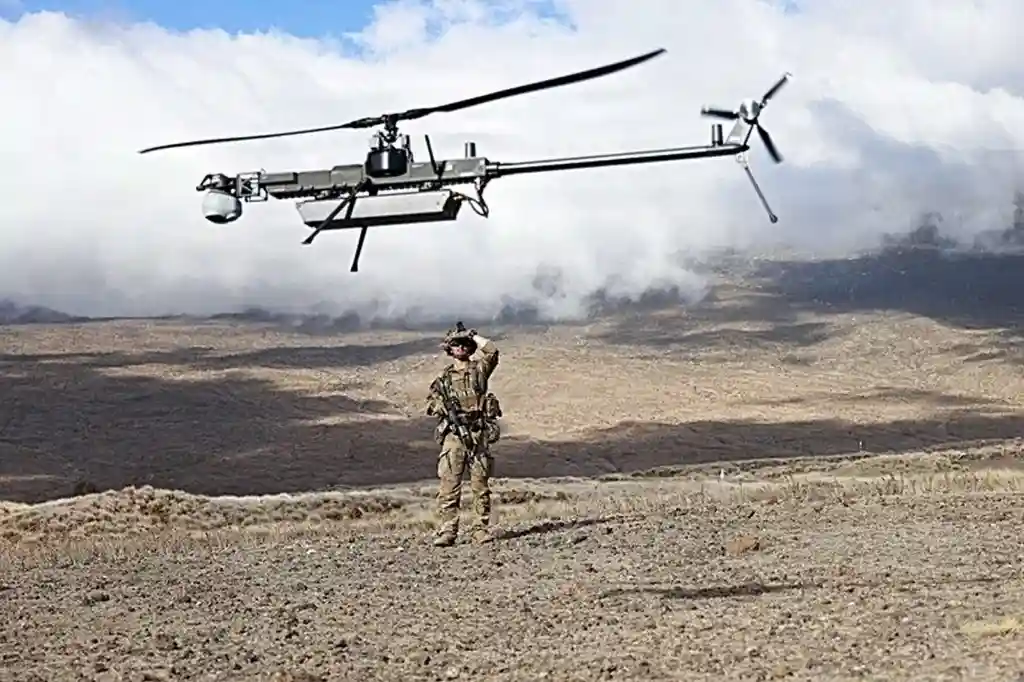
The U.S. Army’s Ghost X reconnaissance drone is rapidly redefining how small land units detect, track, and strike targets across complex Indo-Pacific terrain. During Joint Pacific Multinational Readiness Center (JPMRC) Rotation 26-01 in Hawaii, soldiers of the 25th Infantry Division pushed the medium-range autonomous system through high-tempo scenarios designed to mirror real archipelagic conflict. Across jungle corridors, volcanic ridges, and dispersed island positions, Ghost X repeatedly demonstrated its ability to locate enemy elements and pass targeting data directly into precision-fires chains, enabling HIMARS strikes in minutes rather than hours.
This acceleration of the kill chain is not a theoretical upgrade. On November 13, 2025, a Ghost X sortie at the Pohakuloa Training Area directly cued a long-range strike during a live exercise, validating the Army’s push to embed advanced autonomous reconnaissance at the company level. The shift marks a significant break from traditional reliance on higher-echelon assets, giving small maneuver elements sensor reach and decision-making speed tailored to Indo-Pacific distances.
Ghost X’s emergence at JPMRC carries wider implications. The rotation integrates U.S. forces with multinational partners—perfectly suited for observing how compact autonomous systems might function in a real Indo-Pacific contingency. The drone’s role in bridging jungle patrols, precision artillery, and long-range fires offers a preview of a battlefield where small uncrewed systems operate not as novelties, but as essential battlefield tools.
Ghost X’s Next-Generation Design for Expeditionary Reconnaissance
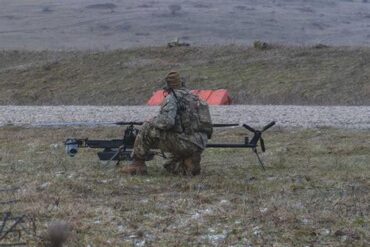
Ghost X, built by Anduril Industries, departs from the quadcopter norm with a helicopter-style airframe using a main rotor and tail rotor. This configuration unlocks aerodynamic efficiency and significantly longer endurance than most multirotor drones of similar size. Weighing under 55 pounds, Ghost X is classed as a Group 2 small uncrewed aircraft system (SUAS), able to be packed into a slim rifle case, assembled in minutes, and launched from rough, improvised zones by a two-person team.
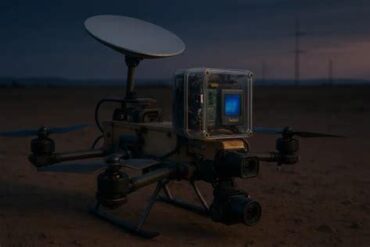
Its performance envelope—80–90 minutes of flight time, 15-mile operational range, and payload capacity around 11 kilograms—supports a variety of mission kits including electro-optical sensors, infrared cameras, laser designators, and communications relays. The drone is controlled using Lattice, Anduril’s autonomy-driven software suite that automates mission planning, airspace deconfliction, and navigation, minimizing operator workload and dramatically reducing training demands.
Ghost X reflects the latest evolution in Anduril’s Ghost family, building on the Ghost 4 lineage while incorporating hardware and autonomy upgrades sought by both the Army and Air Force. Autonomy enhancements funded in 2023 introduced advanced vision and navigation algorithms, allowing Ghost X to fly and sense with greater independence. By 2024, the Army selected it for its Company-Level Small UAS program, placing it at the center of tactical modernization efforts.
From Hawaii to Europe and the Philippines: A Global Operational Track Record
What makes Ghost X distinct in the SUAS field is not only the technology, but the variety of environments in which it has already proven itself. The system has been deployed or tested in:
- Hawaii, during JPMRC 26-01, in dense jungle and volcanic terrain.
- Germany, during Combined Resolve 25-1, supporting operations across forests and urban corridors.
- The Philippines, during Balikatan 25, where it supported multinational forces across maritime and littoral terrain.
- Ukraine, where combat use since 2022 has accelerated real-world feedback loops and software refinement.
This mosaic of operational exposure—European forests, Pacific islands, urban battlespaces, and contested front lines—has pushed Ghost X through more realistic and stressful environments than most fielded Group 2 drones. Continuous updates through software iteration and spiral deployment give the system a maturity curve more akin to rapidly evolving commercial tech than legacy military UAVs.
A New Tactical Niche Between Quadcopters and Legacy UAVs
Ghost X occupies a sweet spot in the Army’s drone fleet. It is larger and more capable than backpack-size quadcopters like the Skydio X2, yet far more compact and agile than older tactical UAVs such as the RQ-7 Shadow, which require runways and extensive support. Its helicopter-style propulsion allows for heavier payloads and longer time on station than most quadcopters, although with slightly increased mechanical complexity.
During JPMRC 26-01, Ghost X operated alongside the Skydio X2 and other short-range drones, demonstrating a layered ISR approach: small quadcopters mapping immediate surroundings while Ghost X pushed deeper into the battlespace, enabling reconnaissance traditionally controlled at battalion or brigade levels.
Historically, company-level units depended on hand-launched fixed-wing drones like the RQ-11 Raven. Ghost X surpasses that model with vertical takeoff, heavier sensors, greater endurance, and seamless integration with digital command and control networks. This transforms a company’s tactical footprint—allowing frontline leaders to collect and act on precise targeting data in near real time.
Indo-Pacific Deterrence and the Shift Toward Distributed Kill Chains
The operational debut of Ghost X at JPMRC ties directly into the broader strategic landscape. The training center was designed to reflect Indo-Pacific conflict realities: dispersed islands, jungle canopies, mountainous ridges, long overwater approaches, and contested electromagnetic terrain. The Army’s training rotations in the Philippines have already signaled that future high-end conflicts—particularly involving China—will demand survivable, company-level ISR assets capable of supporting widely distributed operations.
Ghost X supports this strategic demand by enabling dispersed units to sense farther, survive longer, and strike faster. In high-threat environments, where electronic warfare can blind or disrupt centralized systems, a medium-range autonomous drone at the company level becomes essential to preserving tempo.
This direction is underscored by significant U.S. defense investments, including:
- $14.4 million for the Company-Level Small UAS program.
- Nearly $1 billion for the Pentagon’s Replicator initiative, focused on mass-producing autonomous systems.
- $642 million in Marine Corps counter-UAS contracts for Anduril.
- $99.6 million in Army command-and-control prototype contracts.
These funds signal a multi-service shift toward integrating reconnaissance drones, counter-drone systems, and digital fires into a unified, scalable ecosystem.
A New Baseline for Future Land Warfare
The performance of Ghost X at Pohakuloa marks more than a successful training rotation—it indicates the Army’s pivot toward a battlefield where vertical-takeoff, modular, autonomous systems form the backbone of company-level ISR and targeting. The lessons gathered in Hawaii, alongside multinational partners, will influence procurement timelines, training pipelines, and digital fires doctrine across Indo-Pacific forces.
As programs like Replicator and Next-Generation Command and Control advance, Ghost X is emerging not only as a drone, but as a critical component of a distributed reconnaissance-strike ecosystem. The system’s ability to give small units first-move advantage across archipelagic terrain may shape how U.S. and allied forces secure deterrence in the Indo-Pacific over the coming decade.