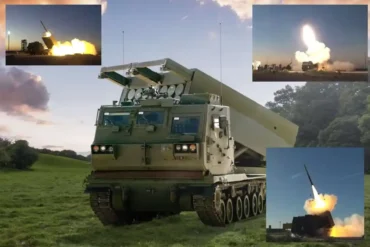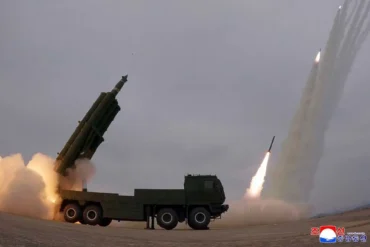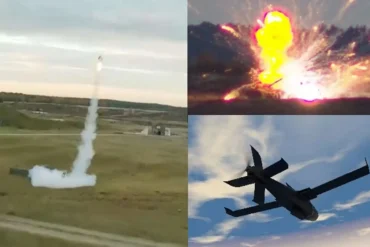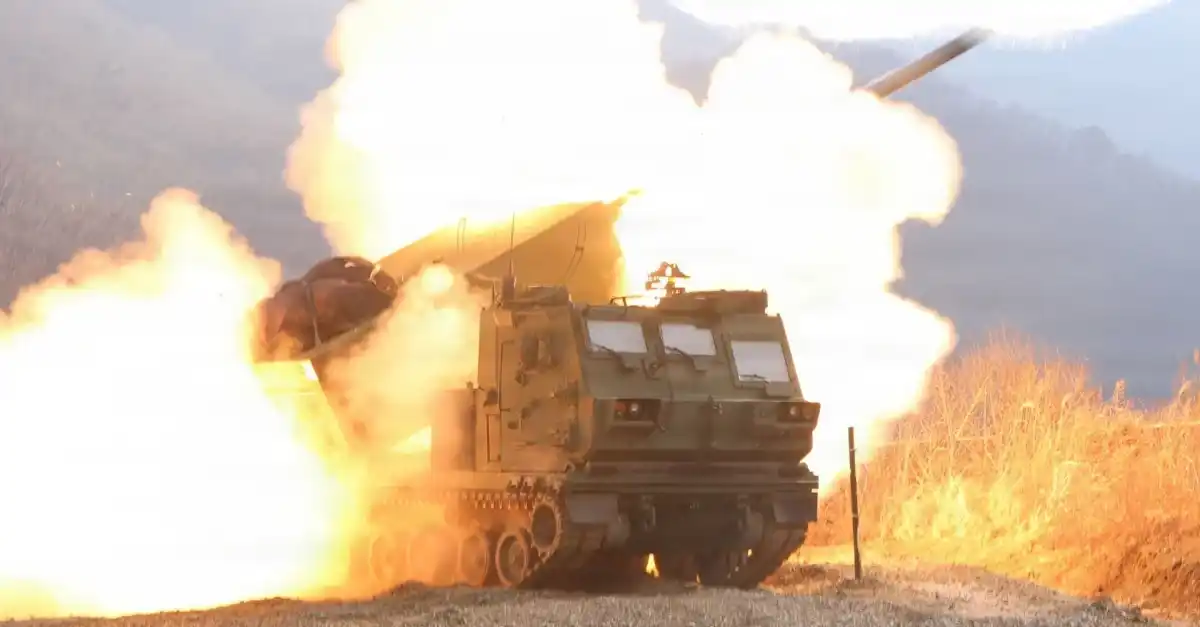
The British Army has marked a significant milestone in its long-range firepower modernization with the arrival of its first upgraded M270A2 Multiple Launch Rocket Systems on home soil. Delivered to the United Kingdom after completing demanding live-fire trials in the United States, the new launchers signal a decisive step forward in the Army’s Deep Fires transformation and its ability to deliver precise, long-range strike effects within a modern NATO battlespace.
The first two M270A2 systems were transported aboard a military roll-on-roll-off vessel that docked at Marchwood Military Port, a key logistics hub for British armed forces movements. From there, the launchers began onward movement to Larkhill, the historic home of the Royal Artillery. Their arrival follows the successful conclusion of operational testing conducted alongside US Army units, confirming the launchers’ readiness for integration into frontline British service.
This delivery reflects months of coordinated industrial, military, and logistical effort between the United Kingdom and the United States. British defense officials familiar with the program describe the handover as a tangible demonstration of progress rather than a symbolic milestone. With the hardware now in-country, attention is shifting rapidly toward crew training, doctrine adaptation, and full operational exploitation of the upgraded system.
A New Generation of British Rocket Artillery
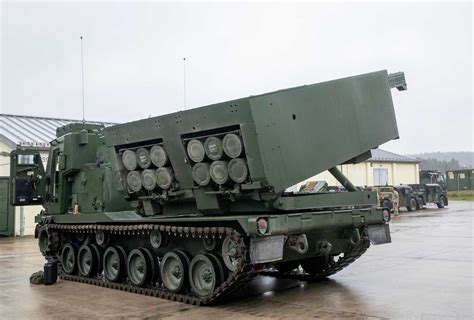
The M270A2 represents the most advanced evolution of the tracked Multiple Launch Rocket System that has served the British Army for decades. Developed by Lockheed Martin as part of the US Army’s fleet-wide modernization initiative, the A2 configuration is far more than a routine life-extension. It combines a redesigned armored crew cab, a new powertrain, upgraded suspension components, and the Common Fire Control System, bringing the launcher fully into the digital era of networked warfare.
Unlike earlier variants, the M270A2 is built around interoperability. Its digital fire control architecture mirrors that of US Army systems, allowing British units to plug seamlessly into allied command-and-control networks during coalition operations. This alignment is critical for NATO, where shared targeting data, synchronized fires, and rapid decision-making define operational advantage in high-intensity conflict.
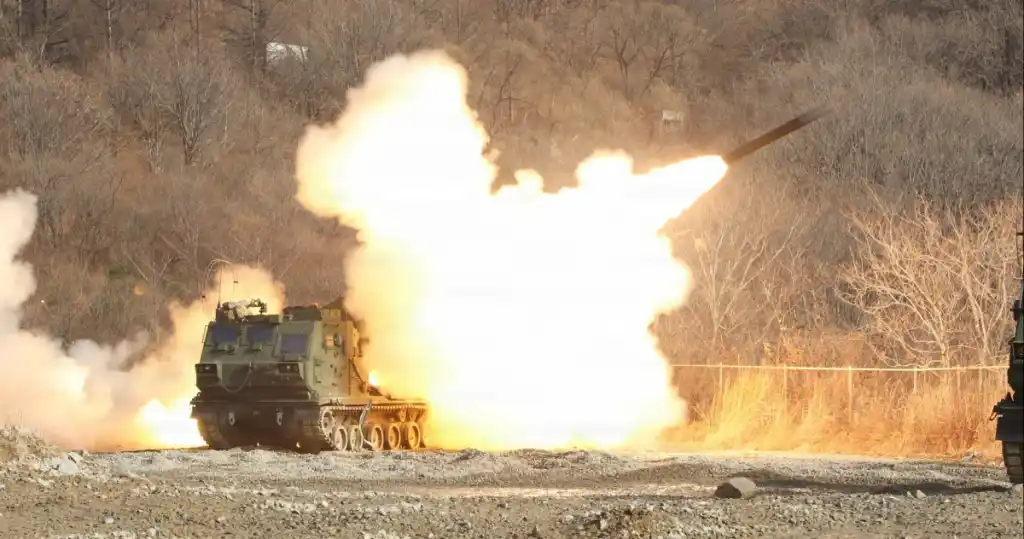
Despite its extensive modernization, the launcher retains the proven dual-pod configuration that defines the MLRS family. Each vehicle can fire twelve 227 mm guided rockets or two tactical missiles in a single mission, maintaining the flexibility that has made the system indispensable across multiple theaters and conflict types.
Extended Range and Precision Strike Capability
Operationally, the M270A2 dramatically expands the British Army’s reach. Through the Common Fire Control System, the launcher is compatible with existing and future precision munitions that redefine what land-based fires can achieve. Standard Guided Multiple Launch Rocket System (GMLRS) rounds already deliver accurate effects at ranges exceeding 90 kilometers, while the Extended Range GMLRS pushes that envelope toward 150 kilometers.
Looking ahead, eventual integration of the Precision Strike Missile (PrSM) is expected to extend strike distances well beyond 400 kilometers, placing deep operational and strategic targets within reach of land forces. For UK planners, this capability underpins a renewed ability to hold adversary command nodes, logistics hubs, and air defense systems at risk without relying exclusively on airpower.
Accuracy is equally transformative. Advanced navigation systems combining GPS and inertial guidance allow the M270A2 to deliver concentrated effects with minimal collateral damage. This precision is central to modern deterrence, where credible long-range fires must be both militarily effective and politically sustainable.
Proven Through US Live-Fire Trials
Before shipment to the United Kingdom, the launchers underwent comprehensive firing and acceptance trials in the United States. Conducted alongside operational US Army units, these tests allowed British crews to validate system performance under realistic conditions. The trials focused on digital mission processing, launcher reliability, navigation accuracy, and sustained firing at operational tempo.
Royal Artillery personnel involved in the trials have described the A2 as a fundamentally different system compared to the legacy M270B1. Faster mission planning, reduced crew workload, and improved responsiveness were consistently highlighted. These gains translate directly into survivability on the modern battlefield, where speed and precision often determine success or failure.
Testing overseas also reinforced confidence in allied interoperability. British crews operated within US firing architectures, demonstrating the practical benefits of shared standards and common software baselines across NATO rocket artillery units.
Survivability and Mobility in Contested Environments
The M270A2’s modernization places heavy emphasis on survivability. Its newly designed armored cab provides enhanced protection against artillery fragments, small-arms fire, and blast effects, allowing crews to operate closer to contested areas. This protection supports the launcher’s shoot-and-scoot doctrine, enabling rapid displacement after firing to evade counter-battery threats.
Mobility improvements are equally significant. Powered by a 600-horsepower diesel engine and supported by a reinforced torsion-bar suspension derived from the Bradley family of vehicles, the launcher offers improved acceleration and mechanical reliability. With a road speed of approximately 64 kilometers per hour and an operational range near 480 kilometers, the M270A2 can reposition quickly across dispersed battlespaces.
These characteristics are vital in environments saturated with surveillance drones, counter-battery radars, and long-range precision weapons, where static artillery assets are increasingly vulnerable.
Training and the Land Deep Fires Transition
Alongside the physical arrival of the launchers, the British Army is activating critical training infrastructure. At Larkhill, three Tactical Capability Trainers are being brought online at the Royal School of Artillery. These high-fidelity simulators replicate the M270A2’s digital fire control environment, allowing crews and command teams to train collectively without expending live munitions.
Program officials view the early availability of these trainers as essential to accelerating operational readiness. They enable mission rehearsal, joint fires coordination, and integration with higher-level command elements, ensuring that the new capability is embedded across the force rather than isolated within specialist units.
The M270A2 sits at the heart of the Army’s Future Soldier concept and its contribution to NATO’s collective deterrence posture. As peer adversaries continue to invest heavily in long-range fires and layered defenses, the upgraded launcher restores a credible British land-based deep strike capability aligned with allied doctrine and technology.
With additional upgraded systems expected to arrive through 2026, the delivery of the first M270A2 launchers marks not an endpoint, but the beginning of a decisive new phase in British long-range precision fires.