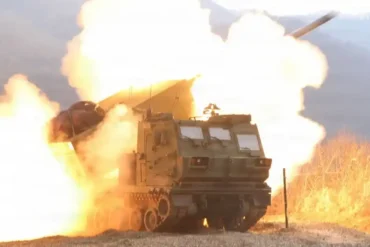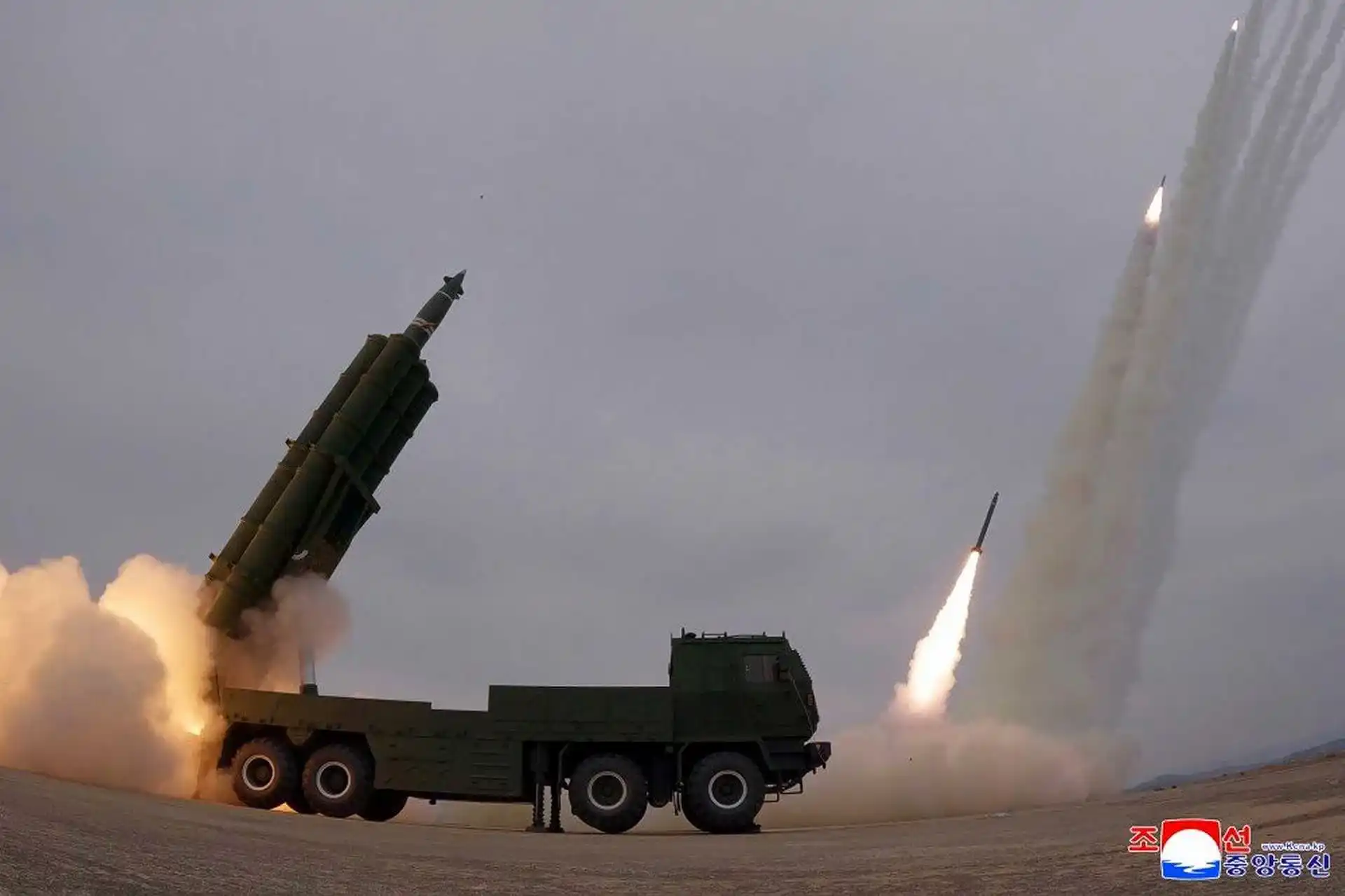
North Korea has conducted a major long-range strike exercise involving twelve KN-25 600mm ultra-large caliber multiple rocket launch systems, signaling an intensification of the country’s pursuit of long-range precision artillery capable of striking high-value military targets across the Korean Peninsula. The test highlights Pyongyang’s continued investment in hybrid rocket-missile weapons that blur the line between traditional artillery systems and short-range ballistic missiles.
According to publicly released information from North Korean sources and independent defense analysts, the drill showcased a coordinated firing capability designed to deliver rapid, concentrated long-range strikes. The KN-25 system has become one of the most closely watched weapons in the Korean People’s Army (KPA) arsenal due to its unusually large rocket caliber, guided flight capability, and extended range.
Unlike conventional rocket artillery, which generally emphasizes area bombardment, the KN-25 is widely believed to incorporate advanced guidance technologies allowing it to strike targets with significantly improved accuracy. Military analysts increasingly view the system as a quasi-ballistic precision weapon designed to complement North Korea’s expanding family of tactical missiles.
North Korea Expands the Role of the KN-25 Precision Rocket System
North Korea officially describes the KN-25 as an “ultra-large caliber multiple rocket launcher.” Yet the system’s characteristics place it in a category that is difficult to define using traditional military classifications. With a massive 600mm rocket diameter, it is among the largest guided rocket artillery systems currently deployed anywhere in the world.
The KN-25 was first publicly revealed in 2019, immediately attracting attention from military observers due to its combination of size, mobility, and range. Mounted on a mobile transporter-erector-launcher (TEL) vehicle, the system is designed for rapid deployment. After firing, the vehicle can quickly relocate, reducing the risk of counter-battery strikes or pre-emptive attacks by enemy forces.
Each launcher vehicle is believed to carry four to six large rockets, depending on configuration. In the recent exercise involving twelve launchers, a full volley could theoretically release dozens of precision-guided rockets within a short time window, producing a dense wave of incoming projectiles against selected targets.
This capability reflects a broader operational philosophy within the Korean People’s Army: the ability to deliver overwhelming firepower in rapid bursts, complicating the ability of missile defense systems to intercept incoming threats.
Quasi-Ballistic Flight and Long-Range Strike Capability
A defining characteristic of the KN-25 is its quasi-ballistic flight trajectory. Unlike traditional rockets that follow simple ballistic arcs, these projectiles appear to incorporate guidance and maneuverability during flight, allowing them to maintain accuracy at extended ranges.
Open-source defense assessments estimate that the system’s operational range may reach approximately 350 to 380 kilometers, depending on the rocket variant used. From launch positions well within North Korean territory, such reach would enable the system to strike nearly any location in South Korea, including major airbases, military logistics hubs, radar installations, and command facilities.
This range significantly expands the tactical influence of North Korea’s artillery forces. Historically, much of North Korea’s artillery threat focused on shorter-range bombardment of areas near the demilitarized zone (DMZ). The KN-25 changes that equation by enabling deep-strike capabilities without relying exclusively on ballistic missiles.
The result is a weapon that combines the high-volume firing capacity of rocket artillery with the precision and reach typically associated with missile systems.
Mass Salvo Doctrine and Saturation Strike Strategy
The use of twelve launchers in a single exercise offers a glimpse into how North Korea may intend to employ the KN-25 during a conflict. Rather than firing isolated rockets, the system appears designed to operate as part of a coordinated saturation strike network.
In military terms, saturation attacks aim to overwhelm defensive systems through sheer volume. Modern air and missile defense platforms such as Patriot and THAAD interceptors rely on limited numbers of defensive missiles. If dozens of guided rockets arrive simultaneously, defenders must rapidly prioritize targets while risking the possibility that some projectiles slip through.
A formation of twelve KN-25 launchers could theoretically release 48 to 72 guided rockets in rapid succession, depending on the launcher configuration. Such a barrage could be directed against:
- Airbases and aircraft shelters
- Missile defense batteries
- Early warning radar stations
- Command and control facilities
- Logistics and fuel depots
By concentrating firepower in a short timeframe, North Korea may attempt to disable critical military infrastructure before defensive responses can fully mobilize.
Integration With North Korea’s Expanding Tactical Missile Arsenal
The KN-25 does not exist in isolation. Instead, it forms part of a rapidly evolving ecosystem of North Korean tactical strike systems that has emerged over the past decade.
Among the most prominent additions are the KN-23 and KN-24 short-range ballistic missiles, both of which demonstrate maneuverable trajectories designed to challenge missile defense networks. These systems provide longer-range precision strikes, while the KN-25 offers the advantage of high-volume firepower from mobile rocket artillery units.
This layered structure gives North Korea several operational options. Ballistic missiles can be used for strategic or high-value targets, while rocket artillery systems like the KN-25 can deliver repeated waves of precision strikes across a broader set of battlefield objectives.
Military analysts often describe this approach as “mixed-vector strike capability,” where multiple weapon types are used simultaneously to increase uncertainty for defenders.
Mobility and Survivability on the Modern Battlefield
Another critical advantage of the KN-25 system is its high degree of mobility. The transporter-erector-launcher vehicles used to deploy the rockets allow units to fire and relocate quickly, a tactic known in artillery doctrine as “shoot and scoot.”
This strategy dramatically increases survivability. Modern surveillance systems—including reconnaissance satellites, drones, and radar—can detect rocket launches and attempt to track their origin. However, if launchers move rapidly after firing, counter-strikes may arrive too late.
For North Korea, mobility is essential because its military infrastructure faces constant monitoring by advanced intelligence assets from the United States and South Korea. Mobile systems allow the KPA to preserve operational capability even under intense surveillance conditions.
The combination of range, precision, and mobility gives the KN-25 significant tactical value within North Korea’s ground forces.
Strategic Signaling on the Korean Peninsula
Beyond the immediate operational implications, the large-scale KN-25 drill also carries strategic signaling value. Demonstrating the coordinated use of twelve launchers sends a message about North Korea’s ability to conduct large-scale precision strike operations against regional military infrastructure.
Major installations across South Korea—including air bases hosting U.S. aircraft, command headquarters, and logistics centers—fall within the estimated range of the system. The ability to launch coordinated barrages from mobile platforms complicates defensive planning and increases uncertainty for military planners in the region.
At the strategic level, systems like the KN-25 contribute to North Korea’s broader deterrence posture, which relies on maintaining credible strike capabilities capable of threatening critical targets in the early stages of a conflict.
The recent exercise therefore serves two purposes simultaneously: it allows North Korean forces to refine operational procedures while publicly demonstrating that the country’s long-range precision artillery capabilities continue to expand.
As North Korea continues developing advanced rocket and missile technologies, the KN-25 system is likely to remain a central pillar of its evolving strike doctrine, combining massive firepower, extended range, and mobile deployment into a weapon designed for both battlefield impact and strategic influence.