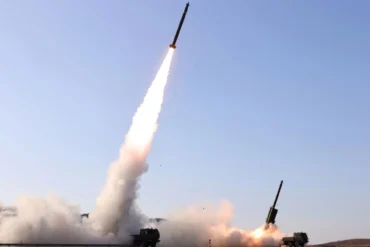
Tensions across Northeast Asia intensified on March 14, 2026, after North Korea launched ten ballistic missiles toward the Sea of Japan, in what analysts widely interpret as a calculated response to ongoing joint military exercises conducted by the United States and South Korea. The launches occurred during the annual Freedom Shield drills, a large-scale allied training operation designed to strengthen military readiness and operational coordination across the Korean Peninsula.
South Korea’s military confirmed that the missiles were fired within a short time window, suggesting a coordinated launch sequence rather than isolated test activity. According to the South Korea’s Joint Chiefs of Staff, the projectiles were launched from the Sunan region, an area near Pyongyang that has frequently served as a staging ground for missile testing operations. Regional monitoring systems tracked the launches as they traveled several hundred kilometers before descending into waters east of the Korean Peninsula.
Japanese defense authorities also confirmed the activity. Officials in Tokyo stated that the missiles fell outside Japan’s exclusive economic zone, indicating no immediate threat to Japanese territory or maritime traffic. Despite the lack of direct impact, the launches underscore the continued volatility of the region’s strategic environment and highlight North Korea’s persistent use of missile demonstrations as political signaling.
Missile Launches Coincide With Major Allied Military Exercises
The timing of the missile launches is far from coincidental. The Freedom Shield exercises, which run from March 9 to March 19, represent one of the largest annual combined training events between the United States and South Korea. Thousands of personnel participate in command simulations and field operations intended to test joint response capabilities across multiple domains, including land combat, air defense, and logistics coordination.
The drills incorporate a parallel training cycle known as Warrior Shield, which focuses on live-field maneuver exercises and operational integration between allied units. These exercises simulate complex wartime conditions, allowing commanders to test communication systems, command structures, and rapid deployment capabilities under realistic conditions.
For decades, Pyongyang has condemned these exercises, accusing Washington and Seoul of conducting rehearsals for invasion. Both governments strongly reject that claim, insisting the drills are purely defensive and designed to maintain military readiness in the face of ongoing regional threats.
Nevertheless, North Korea consistently responds to such exercises with weapons demonstrations, a pattern that has become a familiar rhythm in the geopolitical dynamics of the Korean Peninsula.
Rhetoric Escalates From Pyongyang Leadership
In the days leading up to the missile launches, North Korean officials issued increasingly sharp warnings regarding the military exercises. Kim Yo Jong, the influential sister of North Korean leader Kim Jong Un, publicly criticized the drills and warned that continued military pressure could lead to “terrible consequences.”
Her remarks reflect a broader strategy by Pyongyang to frame allied exercises as acts of aggression, reinforcing domestic narratives of external threat while justifying continued weapons development.
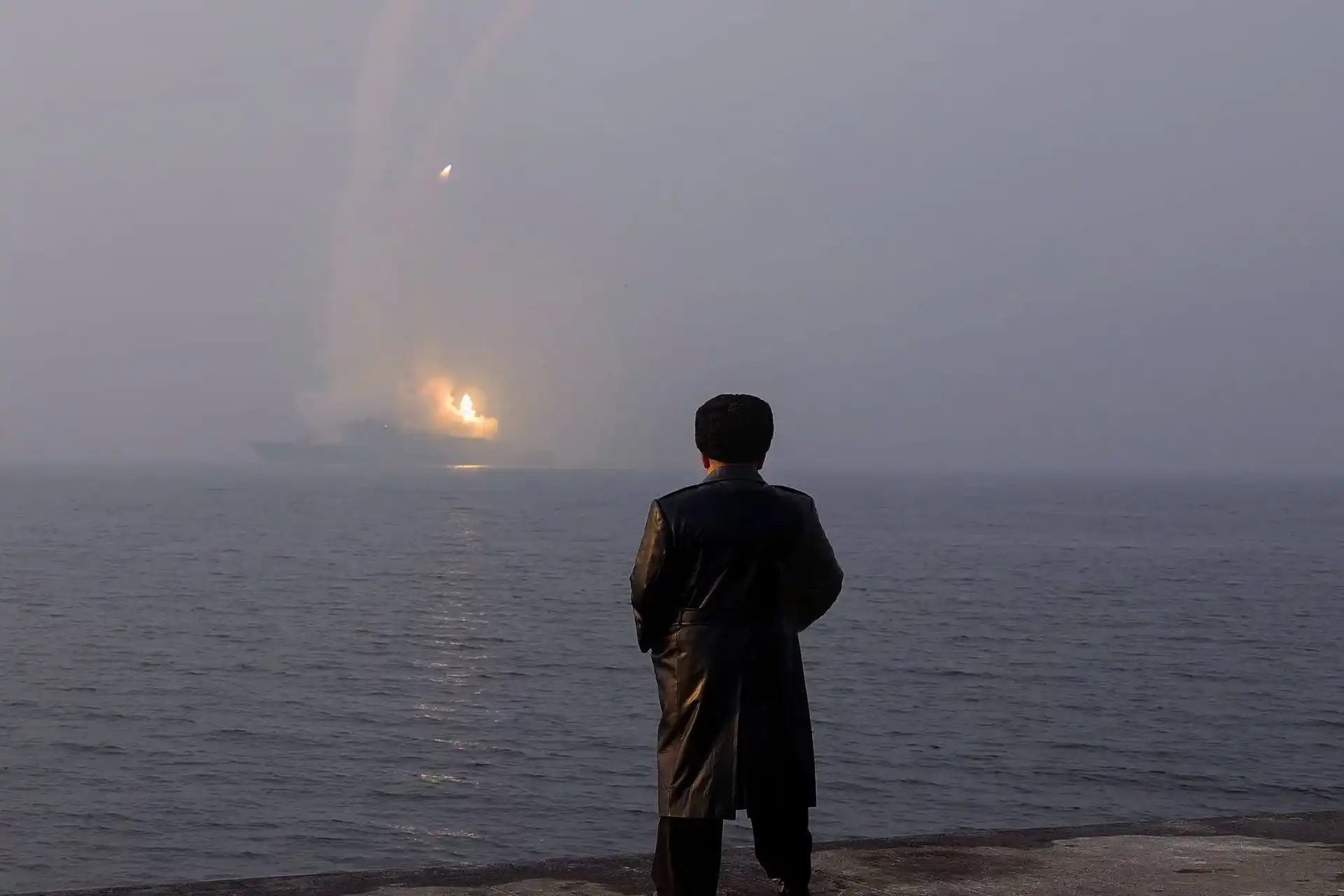
The missile launches also follow a recent demonstration of North Korea’s expanding naval capabilities. Earlier in March, Kim Jong Un personally oversaw a sea-to-surface cruise missile test conducted from the country’s newest destroyer, the Choe Hyon, signaling Pyongyang’s intention to extend strike capabilities beyond traditional land-based systems.
Together, these demonstrations paint a picture of a military establishment actively refining both land and maritime strike platforms.
Possible Missile Systems Behind the Launch
While the exact missile type involved in the March 14 launch has not been officially confirmed, flight data released by South Korean authorities provides valuable clues. The projectiles reportedly traveled approximately 300 to 350 kilometers, placing them squarely within the performance range of several North Korean short-range ballistic missile systems.
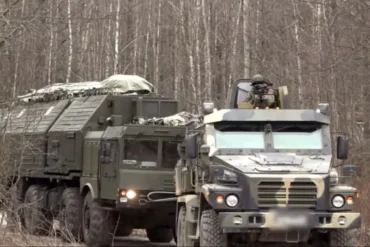
One strong candidate is the Hwasong-11A (KN-23), a solid-fuel tactical ballistic missile that closely resembles Russia’s Iskander system in design and flight profile. The missile is capable of flying along a quasi-ballistic trajectory, meaning it follows a depressed and maneuverable path rather than the traditional high arc associated with earlier ballistic missiles.
This trajectory allows the missile to perform terminal maneuvers, adjusting its course during the final phase of flight to complicate interception attempts by missile defense systems such as the Patriot missile system or the Terminal High Altitude Area Defense (THAAD).
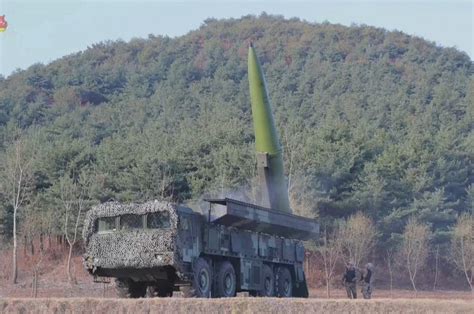
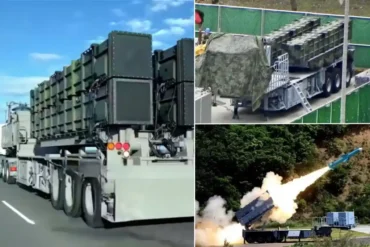
Another plausible system involved in the launch is the KN-25 super-large caliber rocket system, a hybrid platform that blurs the boundary between heavy artillery and ballistic missiles. This system fires massive 600-millimeter guided rockets capable of striking targets up to roughly 380 kilometers away.
Unlike traditional ballistic missiles that launch individually, the KN-25 can fire multiple rockets in rapid succession, enabling a single launcher to saturate defensive systems with numerous incoming threats.
Operational Value of Multi-Missile Launches
Launching ten missiles in rapid sequence is not merely a demonstration of force—it also serves as a valuable operational rehearsal for the Korean People’s Army. Coordinated launches allow North Korean forces to test the entire chain of command involved in missile operations, from strategic decision-making to tactical execution.
These exercises help validate communication links, timing protocols, and launch procedures between missile brigades and centralized command authorities. Military planners can analyze telemetry data from each launch to evaluate performance, accuracy, and system reliability.
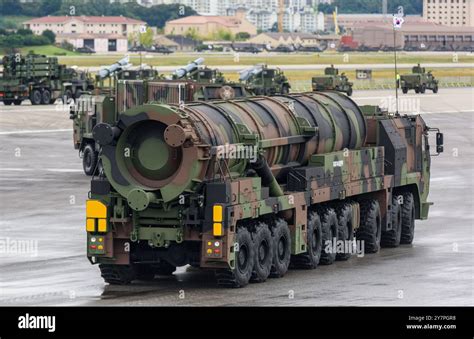
A central element of North Korea’s missile strategy is the use of mobile transporter-erector-launcher vehicles (TELs). These massive trucks carry missiles across road networks and concealed staging areas before erecting them vertically for launch.
Mobility gives missile forces a significant survivability advantage. By dispersing across wide geographic areas and relocating frequently, TEL units become far more difficult for surveillance satellites or reconnaissance aircraft to detect and target.
In practical terms, a mobile missile force creates a strategic dilemma for adversaries: even if some launchers are destroyed, others may remain hidden and capable of striking.
Regional Strategic Implications
The broader strategic picture surrounding the missile launches reveals a deeply entrenched cycle of military signaling across Northeast Asia. North Korea continues to expand its arsenal of short-range and intermediate-range missile systems while simultaneously seeking international recognition as a nuclear-armed state.
Meanwhile, the United States and South Korea continue to reinforce their military alliance through exercises, modernization programs, and expanded missile defense capabilities.
The result is a recurring pattern: allied drills trigger North Korean weapons tests, which in turn reinforce the justification for stronger defense cooperation between Washington and Seoul.
Complicating matters further is North Korea’s evolving geopolitical alignment. Western governments have expressed growing concern about military cooperation between Pyongyang and Moscow, particularly amid reports that North Korea has provided equipment and personnel to support Russian operations in Ukraine.
Such partnerships could potentially accelerate North Korea’s access to advanced military technologies, including missile guidance systems, satellite capabilities, and electronic warfare expertise.
Diplomatic Uncertainty Surrounding the Peninsula
Despite the rising tensions, diplomatic signals remain mixed. South Korean officials recently stated that Donald Trump, the current President of the United States, believes a future meeting with Kim Jong Un could be constructive. However, Pyongyang has dismissed recent diplomatic overtures as insincere, accusing Washington of maintaining hostile policies while proposing dialogue.
This stalemate highlights the fundamental challenge facing international diplomacy on the Korean Peninsula: military deterrence and political negotiation continue to operate on parallel tracks, rarely intersecting in meaningful ways.
For now, missile launches like those seen on March 14 serve as both a technological demonstration and a geopolitical message. They reinforce Pyongyang’s claim to strategic deterrence while reminding regional actors that the security environment around the Korean Peninsula remains volatile.
As long as military exercises, missile development, and political mistrust continue to define relations among the region’s key players, such dramatic demonstrations of force are likely to remain a recurring feature of Northeast Asia’s strategic landscape.