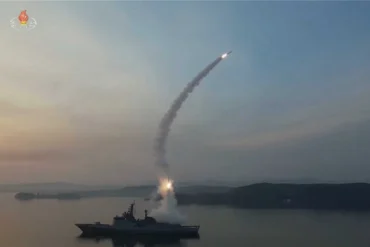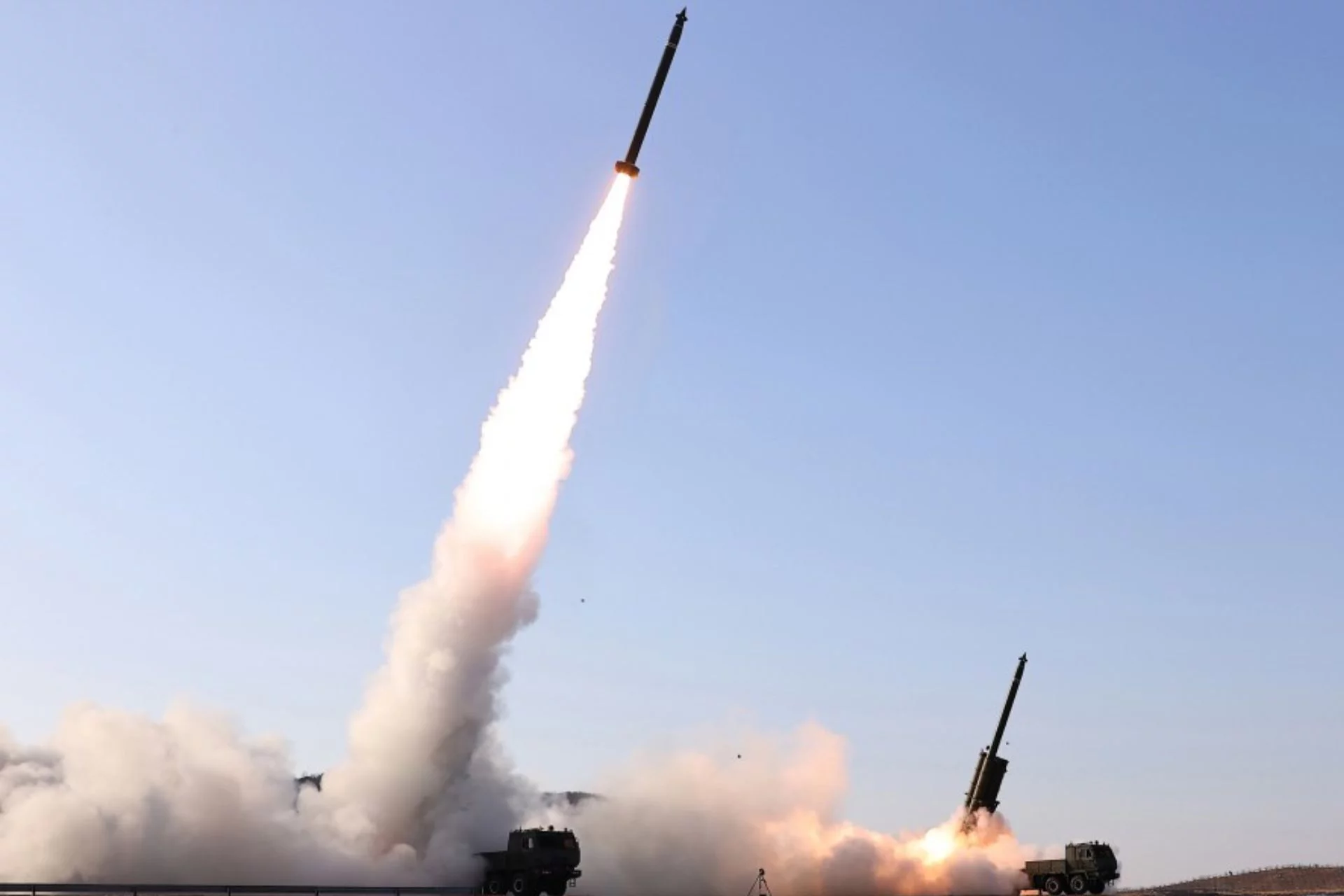
North Korea launched multiple short-range ballistic missiles toward the East Sea in the early hours of January 27, 2026, intensifying security concerns across Northeast Asia and reinforcing long-standing fears about Pyongyang’s steady progress in precision strike capabilities. The launches were detected and confirmed by South Korea’s Joint Chiefs of Staff and Japan’s Coast Guard, both of which stated that the activity constituted a direct violation of United Nations Security Council resolutions prohibiting North Korea from conducting ballistic missile tests.
The missiles are believed to have been fired from an area near Pyongyang, with trajectories carrying them eastward into international waters. Although no damage or casualties were reported, the launch triggered immediate information-sharing among South Korea, Japan, and the United States, highlighting the high-alert environment that now defines the Korean Peninsula. Defense officials across the region moved quickly to assess flight data, propulsion signatures, and terminal behavior to determine the exact missile type involved.
Initial assessments have not formally confirmed the system used, but technical indicators released by North Korean state media strongly suggest the weapons may belong to the KN-25 family. This system occupies a gray zone between multiple launch rocket artillery and conventional ballistic missiles, a deliberate design choice that complicates classification, defense planning, and diplomatic response. The ambiguity itself is strategic, allowing Pyongyang to claim one narrative while forcing its adversaries to plan for another.
A Carefully Timed Signal in a Familiar Pattern
This event marks the second known ballistic missile launch by North Korea in 2026, following a similar firing on January 4. That earlier test occurred against the backdrop of heightened diplomatic activity in the region, reinforcing a pattern in which missile launches are synchronized with political calendars rather than purely technical development cycles. South Korean officials have noted that Pyongyang frequently uses such demonstrations to remind neighboring states that broader regional diplomacy cannot bypass the unresolved security reality of the peninsula.
The January 27 launch fits squarely within this established choreography. Seoul’s presidential office described the event as a provocative act that undermines stability, while urging North Korea to cease further escalatory behavior. Japan echoed these concerns, emphasizing that repeated missile tests erode regional security and challenge international norms. Meanwhile, U.S. Forces Korea acknowledged awareness of the launch and confirmed close coordination with allied commands, stressing that there was no immediate threat to U.S. personnel or territory.
This rapid, synchronized response illustrates the operational routine that now follows each North Korean missile test: detection through layered sensors, joint attribution, aligned public messaging, and a quieter shift toward heightened readiness as intelligence agencies analyze telemetry and imagery. The routine itself underscores how normalized such crises have become, even as their strategic implications grow more serious.
KN-25: The Missile That Blurs Categories
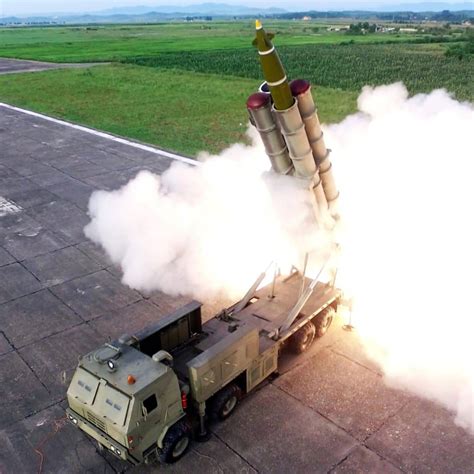
While official confirmation remains pending, the characteristics described by North Korean media are broadly consistent with the KN-25, first publicly tested in August 2019. Pyongyang often refers to the system as a “super-large multiple launch rocket system”, but the United States Forces Korea (USFK) classifies it as a short-range ballistic missile due to its size, range, and flight profile. This dual identity is not accidental. It allows North Korea to exploit definitional gaps while fielding a weapon that delivers missile-like performance under the conceptual cover of artillery.
Technically, the KN-25 is assessed as a single-stage, solid-propellant system with a reported diameter of approximately 600 millimeters and an estimated length of around 8.6 meters. It is typically deployed on a road-mobile transporter-erector-launcher, a configuration that enhances survivability through rapid relocation and shoot-and-scoot tactics. Early tests demonstrated a range of roughly 380 kilometers and a maximum altitude near 97 kilometers, placing it well within the category of theater strike weapons optimized for regional targets.
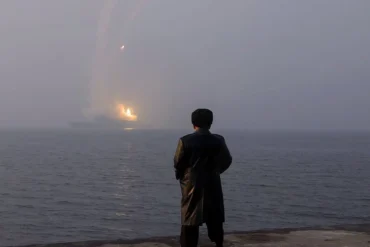
North Korean media coverage of the January 27 launch claimed that four rounds were fired and successfully struck a maritime target at a distance of 358.5 kilometers. This figure aligns closely with South Korean estimates and suggests a launch conducted below the system’s maximum envelope, consistent with a controlled test rather than a maximum-stress demonstration. Kim Jong Un was reported to have personally observed the firing, emphasizing improvements in mobility, accuracy, and resistance to external interference, while explicitly linking the system to broader nuclear deterrence objectives.
Precision, Guidance, and Modern Strike Warfare
A notable aspect of Pyongyang’s narrative was its emphasis on an autonomous precision guidance flight system. While independent verification of such claims remains limited, previous imagery of the KN-25 shows a configuration featuring four fixed rear fins and four forward control surfaces, a layout consistent with mid-course and terminal maneuverability. This suggests an intent to move beyond area saturation toward guided impact, significantly increasing the system’s military utility.
In modern conflict scenarios, accuracy matters as much as range. Even modest improvements in guidance can dramatically enhance effectiveness against air bases, logistics hubs, ports, and command nodes, especially when combined with salvo firing. North Korea’s repeated references to resilience against electronic interference indicate an awareness of electronic warfare environments, where GPS denial and jamming are assumed. A weapon that can maintain acceptable accuracy under such conditions forces defenders to invest more heavily in interceptors, sensors, and redundancy.
The KN-25’s hybrid nature also complicates missile defense. Its quasi-ballistic trajectory and potential for maneuvering challenge traditional interceptor solutions designed for more predictable flight paths. Fired in clusters, such systems can saturate air and missile defense networks, compress decision timelines, and force defenders to make rapid prioritization choices under uncertainty.
Tactical Value and Strategic Leverage
From an operational perspective, short-range ballistic missiles and guided rocket artillery occupy a tactical sweet spot for North Korea. They are quicker to launch than long-range systems, harder to preempt once dispersed, and capable of delivering immediate effects within minutes. In the opening phase of a conflict, such weapons could be used to disrupt sortie generation, damage runways, degrade logistics, and slow the arrival of reinforcements, buying time and leverage for Pyongyang’s leadership.
The KN-25 concept, in particular, supports an approach centered on density rather than singularity. Instead of relying solely on a small number of high-value missiles, North Korea can field larger numbers of shorter-range systems that collectively impose high defensive costs. Each interceptor expended against a KN-25 round is one less available for higher-end threats, a calculus that favors the attacker when inventories are finite.
Beyond the battlefield, missile launches remain one of Pyongyang’s most reliable tools for strategic messaging. Each test compels responses from Seoul, Tokyo, and Washington, reinforces alliance coordination, and keeps the Korean Peninsula firmly embedded in wider Indo-Pacific security debates. The persistence of these events drives continued investment in missile defense, counterstrike capabilities, and intelligence-sharing mechanisms, while also increasing diplomatic pressure on regional stakeholders to manage escalation risks.
Implications for Regional Stability
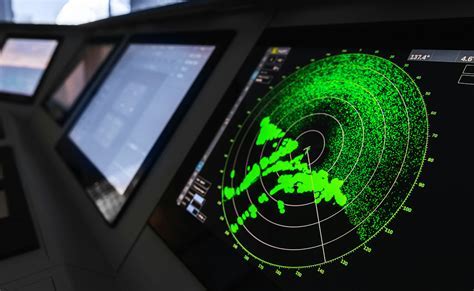
The January 27 launch underscores a broader reality: chronic crisis readiness has become the default condition in Northeast Asia. Even when tests do not immediately escalate, they reinforce a security environment defined by vigilance, rapid response, and constrained political maneuvering. For South Korea and Japan, each launch renews domestic debates over defense spending, interceptor procurement, and strike capabilities. For the United States, it reinforces the importance of extended deterrence commitments and forward-deployed assets.
China, too, remains an indirect but significant stakeholder. While not directly targeted, Beijing must balance its interest in regional stability with its complex relationship with Pyongyang. Each missile test complicates that balance, drawing greater international attention to the peninsula and tightening the linkage between Korean security dynamics and broader Indo-Pacific force posture considerations.
In this context, the suspected KN-25 launch is not an isolated event but part of a sustained pattern. It reflects North Korea’s determination to refine systems that are operationally relevant, politically useful, and strategically disruptive, even in the absence of active diplomacy. As long as these tests continue, they will shape defense planning, alliance behavior, and regional stability calculations far beyond the immediate splashdown zone in the East Sea.
The January 27 firing thus serves as another reminder that North Korea’s missile program is not merely about technical milestones. It is about leverage, perception, and the careful cultivation of uncertainty—an approach that ensures Pyongyang remains an unavoidable factor in the security architecture of Northeast Asia.