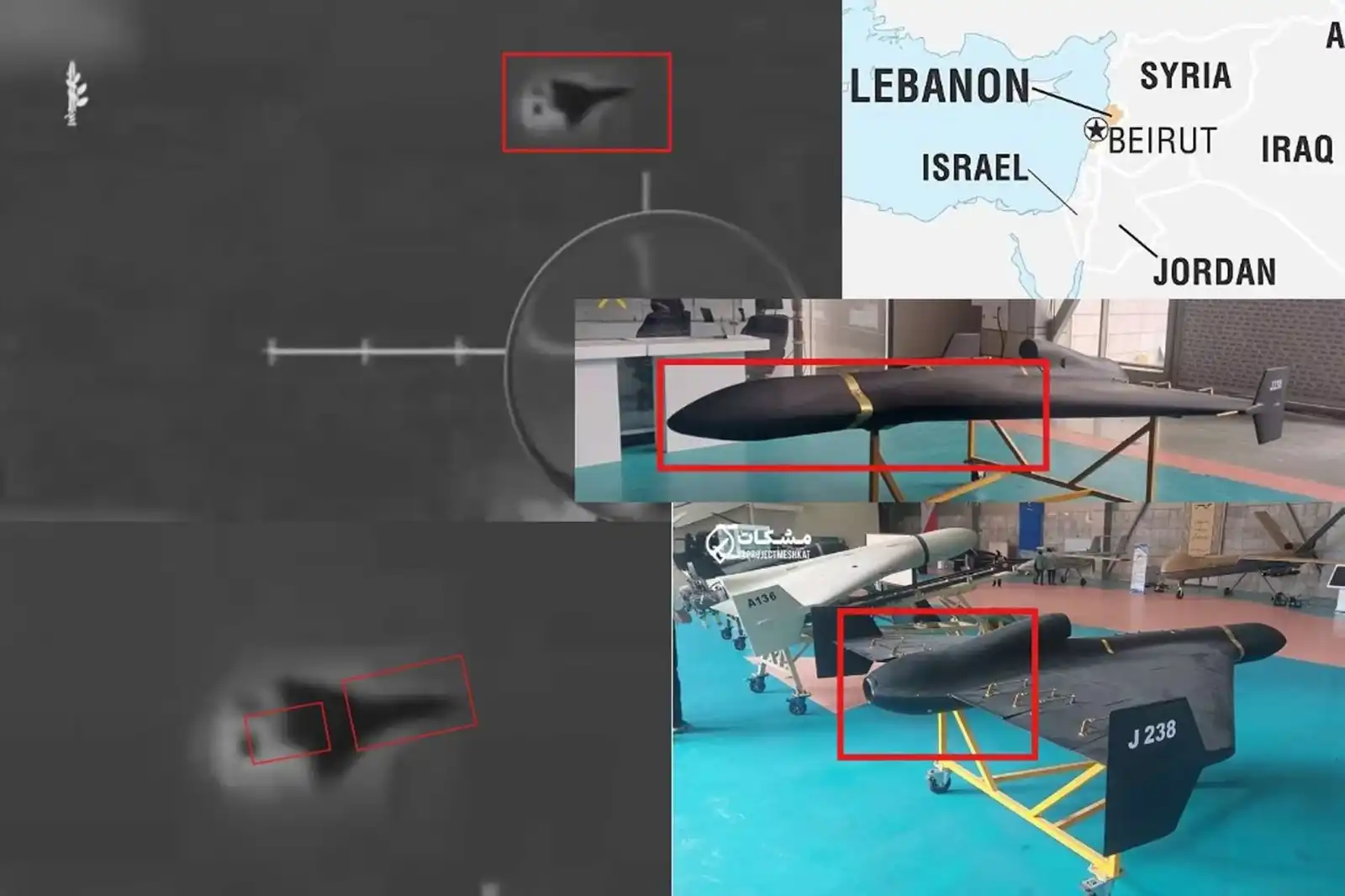
The Israeli Navy has intercepted and destroyed a suspected Iranian-made Shahed-type unmanned aerial vehicle (UAV) launched from Lebanese territory, marking another sharp escalation in the expanding regional confrontation between Israel and Iran-backed forces. Infrared footage released by the Israel Defense Forces (IDF) on March 4, 2026, captures the moment a naval interceptor missile strikes the airborne target over the eastern Mediterranean, underscoring the growing integration of naval assets into Israel’s increasingly complex air-defense architecture.
The engagement took place during Operation Lion’s Roar, Israel’s large-scale campaign targeting Iranian military infrastructure and drone capabilities across multiple theaters. The operation has unfolded in parallel with recent U.S. strikes aimed at curbing Tehran’s expanding regional reach. While Israeli officials did not disclose the precise location of the interception, the available footage indicates the drone was neutralized before reaching Israeli territory, reinforcing the effectiveness of preemptive, layered defensive measures at sea.
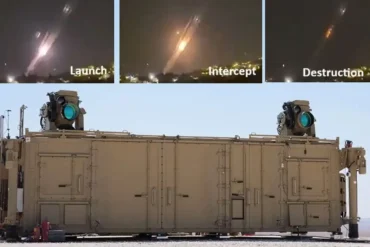
The short infrared sequence released by the IDF Spokesperson’s Unit shows a missile boat detecting and tracking the UAV before launching a surface-to-air interceptor. Moments later, a bright thermal bloom fills the screen as the missile connects with its target. The IDF confirmed the UAV originated from Lebanon but stopped short of formally identifying the drone model or the specific naval platform involved in the engagement.
יירוט איומים מכלל הגזרות: ספינת חיל הים יירטה כלי טיס בלתי מאויש ששוגר משטח לבנון
כוחות חיל הים לוקחים חלק מאז תחילת מבצע ‘שאגת הארי’ במשימת הגנת השמיים, מזהים ומיירטים כלי טיס בלתי מאוישים שמשוגרים לעבר שטח מדינת ישראל pic.twitter.com/RlxoPolIhb
— צבא ההגנה לישראל (@idfonline) March 4, 2026
Naval Air Defense Expands Beyond the Shoreline
The interception highlights a significant operational shift: Israel’s navy is no longer confined to maritime security or coastal patrol missions. Instead, it is functioning as a fully integrated component of the country’s layered air-defense network, designed to intercept threats “from all directions,” as emphasized in the IDF’s official statement.
Israeli surface combatants are equipped with advanced radar systems, electro-optical sensors, and multiple interceptor options capable of engaging low-flying UAVs and cruise missile threats. Although the IDF did not confirm the missile type used in this case, the infrared footage suggests a guided interceptor maneuvering toward the drone’s heat signature. Whether the system relied on an infrared seeker or ship-based targeting data remains undisclosed, and any precise identification remains speculative without official confirmation.
What is strategically notable is the maritime vector of interception. By engaging the drone at sea, Israeli forces effectively expanded the defensive perimeter outward, reducing the probability of debris or warhead fragments impacting populated areas. In modern air-defense doctrine, pushing the intercept envelope farther from civilian infrastructure is not just tactical prudence; it is political necessity.
Suspected Shahed Design Raises Strategic Questions
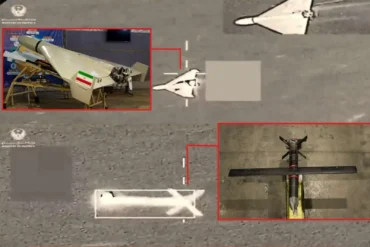
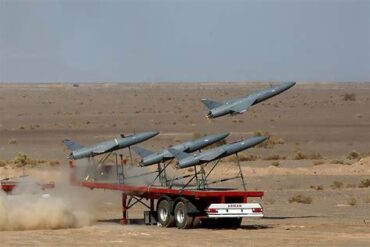
Open-source analysis of the footage indicates the UAV’s silhouette and proportions resemble members of Iran’s Shahed-series long-range attack drones, possibly from the larger 200-series family such as the Shahed-228. These systems are known for their extended wingspan, relatively large fuselage, and capacity to carry explosive payloads over considerable distances.
However, the IDF has not formally identified the drone variant. Infrared imagery can distort apparent size and shape, particularly at night and through thermal optics. While the resemblance is strong enough to warrant informed assessment, definitive classification requires physical debris analysis or confirmed intelligence reporting.
Iran’s Shahed drones have gained international attention in recent years for their deployment in Ukraine and across the Middle East. Designed as cost-effective, expendable platforms, they are often used in saturation attacks intended to overwhelm sophisticated air-defense networks. Their relative affordability compared to high-end interceptor missiles introduces a harsh arithmetic: defenders may expend far more expensive munitions to destroy comparatively inexpensive drones.
Lebanon as a Launch Platform
The fact that this UAV was launched from Lebanese territory carries significant geopolitical implications. Hezbollah, Iran’s primary proxy force in Lebanon, has steadily expanded its arsenal of rockets, precision-guided munitions, and UAVs. Since the outbreak of broader hostilities, Hezbollah has claimed responsibility for multiple cross-border rocket and drone attacks targeting northern Israel.
By launching a suspected Shahed-type drone from Lebanon, Iranian-aligned forces effectively demonstrate the portability and adaptability of Tehran’s drone ecosystem. Systems originally associated with direct Iranian launches can now be operated by allied non-state actors closer to Israel’s borders, reducing warning times and complicating interception timelines.
This development compresses decision-making cycles for Israeli defenders. A drone launched from deep inside Iran may require hours to reach its target. One launched from southern Lebanon could arrive in minutes. In modern warfare, time is oxygen. Remove it, and the defender suffocates.
The Economics of Drone Warfare
The engagement reflects a broader transformation in military strategy: the normalization of drone-centric conflict. Iran’s approach emphasizes scalable, low-cost UAVs capable of being produced in large quantities. The strategic objective is not necessarily precision or survivability but volume and persistence.
In this model, a drone becomes less an individual weapon and more a unit in a swarm ecosystem. Even if most are intercepted, a small percentage penetrating defenses can inflict disproportionate psychological and economic effects. The defender must maintain constant readiness, expending interceptors and manpower with every alert.
Operation Lion’s Roar appears designed not only to intercept incoming drones but to degrade the supply chain behind them. Israeli strikes have reportedly targeted storage depots, launch infrastructure, and logistical hubs associated with Iranian UAV operations. The aim is to disrupt production and distribution networks before drones ever reach launch pads.
Yet as this latest interception demonstrates, even amid offensive operations, defensive vigilance remains paramount. The conflict is not linear. It is iterative. Each intercepted drone is a data point in an evolving contest of adaptation.
Naval Platforms as Strategic Multipliers
Historically, Israel’s air-defense narrative has centered on land-based systems such as Iron Dome and David’s Sling. The integration of naval assets into this framework expands both geographic coverage and operational flexibility. Missile boats operating offshore can engage threats approaching from maritime corridors, complicating enemy targeting calculations.
Naval platforms also provide mobility. Unlike fixed land batteries, ships can reposition in response to intelligence assessments or emerging threat vectors. In a theater where launch sites may shift rapidly between urban and rural terrain, maritime maneuverability offers a dynamic counterweight.
The symbolism is equally potent. A missile boat firing into the night sky to intercept a drone launched from foreign soil illustrates the blurred boundaries of modern battlefields. Airspace, sea lanes, and land borders are no longer discrete domains; they overlap in layered, contested envelopes.
A Region in Technological Flux
This interception encapsulates several defining dynamics of the current Middle Eastern security environment: Iran’s expanding use of long-range drones, Hezbollah’s role as a forward operator of Iranian systems, and Israel’s accelerating adaptation of its defense architecture to meet multidirectional threats.
The precise drone model may remain unconfirmed. The exact interceptor may remain classified. Yet the operational message is unmistakable. The eastern Mediterranean is no longer merely a strategic buffer; it is an active defensive shield. Naval missile boats now function as airborne sentinels at sea, intercepting threats before they can cross into Israeli airspace.
In this evolving technological contest, drones are not anomalies. They are fixtures. Interceptions like this one are not isolated events but components of a sustained, high-tempo struggle over air superiority, deterrence credibility, and strategic endurance. The skies over the Levant are crowded with machines designed to probe, saturate, and test. Each successful interception redraws the invisible lines of defense, extending them outward into darkness where radar beams and infrared sensors quietly scan for the next flicker of heat against the night horizon.