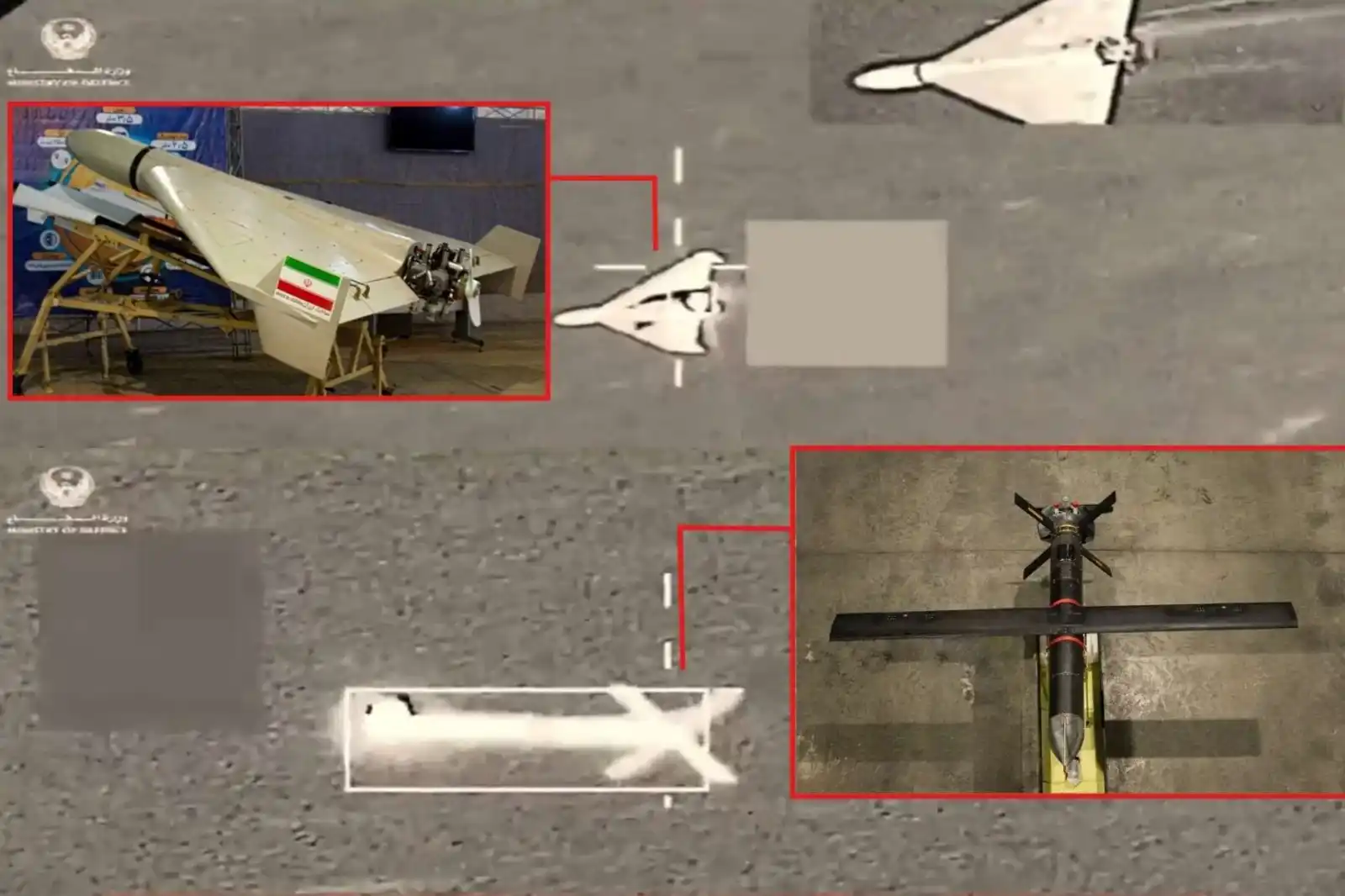
The United Arab Emirates has publicly confirmed the combat interception of multiple Iranian Shahed-136 and Shahed-107 one-way attack drones, alongside Al Qiam ballistic missiles and cruise missiles, during a sustained four-day wave of long-range strikes. The announcement, delivered by the UAE Ministry of Defence during a televised briefing on Abu Dhabi TV, represents one of the most detailed official disclosures of Gulf air combat operations against Iran’s expanding unmanned and missile arsenal.
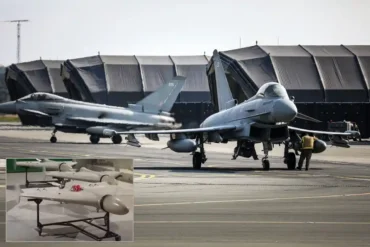
According to Emirati officials, the attacks unfolded over four consecutive days, with “hundreds” of aerial threats detected and engaged. These included ballistic missiles, cruise missiles, and several variants of the Shahed-family loitering munitions. The UAE Air Force deployed F-16E/F Block 60 “Desert Falcon” and Mirage 2000-9 fighter aircraft in coordination with ground-based air defence systems to intercept incoming targets before they could reach populated or strategically sensitive areas.
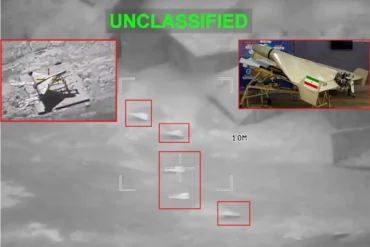
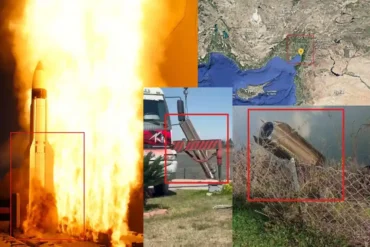
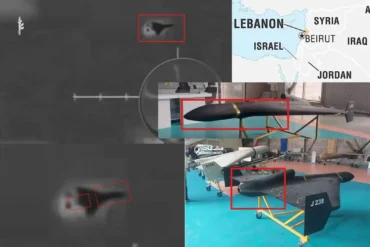
The Ministry released imagery and declassified combat footage showing mid-air intercepts and debris recovered from impact sites across the country. Mangled fuselage sections, piston engines, guidance components, and fragmented warheads were presented as physical evidence of successful neutralisations. The controlled disclosure was designed to demonstrate both the scale of the threat and the operational performance of national defence systems under sustained pressure.
UAE Ministry of Defense today showed us how UAE AF’s advanced F-16s & Mirage 2000 have been destroying Iranian rockets in the last 4 days
100s of Al Qayam ballistic missiles
100s of Shaheh 136, Shahed 107, and Shahed 238 drones
Multiple cruise missiles
RECEIPTS are here ! pic.twitter.com/4a4gj0yHcB
— حسن سجواني 🇦🇪 Hassan Sajwani (@Sajwani) March 3, 2026
Four Days of Coordinated Missile and Drone Attacks
Emirati airspace became the focal point of a complex, multi-layered strike campaign originating from Iran. The attacks combined long-range ballistic missiles, cruise missiles, and successive waves of one-way attack drones launched in staggered formations. This blended approach is tactically significant. Ballistic missiles travel at high velocity on arcing trajectories, compressing reaction times. Cruise missiles fly lower and slower, using terrain-following profiles to reduce radar detection. Shahed drones, meanwhile, are designed to saturate defences through sheer numbers.
Officials stated that air and missile defence forces engaged incoming threats at varying distances and altitudes. Debris reportedly fell in sparsely populated desert regions and offshore zones, minimising risk to civilians. However, even successful interceptions create hazards. Fragmented drone engines and missile components descending at speed can still cause localized damage, underscoring the complexity of defending urbanised airspace against mass salvos.
The scale of the engagement signals a shift in the operational tempo of regional conflict. Rather than isolated launches, the UAE faced sustained, high-density waves intended to probe and potentially overwhelm layered defence systems.
Combat Footage Reveals Air-to-Air Drone Interceptions
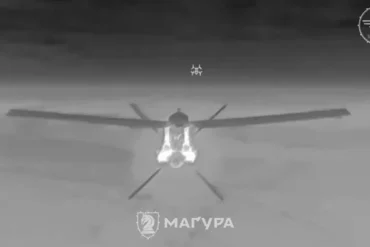
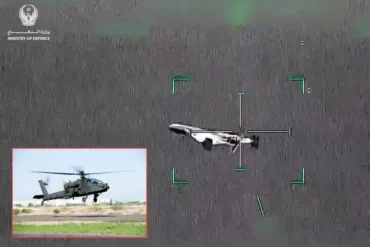
Declassified infrared and electro-optical recordings from UAE fighter aircraft provided rare visual confirmation of manned jets intercepting unmanned aerial vehicles in active combat conditions. The footage shows air-to-air missiles striking Shahed-136 and Shahed-107 drones mid-flight, with the targets disintegrating into multiple fragments before falling into desert or maritime areas.
This detail is operationally important. While ground-based systems form the backbone of air defence, fighter aircraft add flexibility and reach. Drones flying at altitudes or vectors outside optimal engagement envelopes of short-range surface-to-air systems can be rapidly engaged by combat air patrols. In high-volume attack scenarios, airborne fighters also act as mobile interceptors, thinning out incoming formations before they approach defended assets.
The use of F-16 Block 60 and Mirage 2000-9 platforms highlights the UAE’s reliance on advanced multirole fighters equipped with sophisticated radar and targeting pods capable of detecting and engaging relatively small, slow-moving UAVs against complex backgrounds.
Shahed-136: The High-Volume Strike Drone
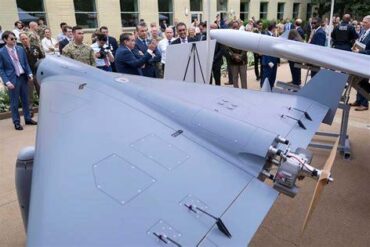
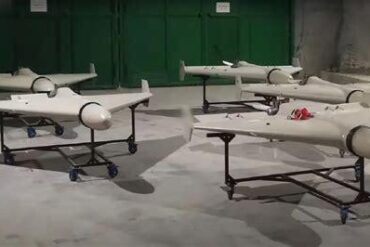
The Shahed-136 has become synonymous with modern drone warfare. Characterised by its cropped delta-wing configuration and rear-mounted piston engine, it is designed as a long-range, one-way attack platform. Open-source assessments estimate an all-up weight near 200 kilograms, carrying a warhead in the 30 to 50 kilogram range depending on configuration.
The drone typically follows pre-programmed flight paths using inertial navigation systems supplemented by satellite guidance. This allows it to travel several hundred to over 1,000 kilometres before striking pre-selected coordinates. Its relatively low speed and distinctive engine sound make it detectable, but its effectiveness lies in numbers. Saturation attacks aim to overwhelm radar tracking capacity and interceptor stockpiles rather than evade detection through stealth.
In previous conflicts, including in Eastern Europe, the Shahed-136 demonstrated how inexpensive, mass-produced loitering munitions can strain sophisticated air defence networks. The UAE interceptions show similar dynamics now shaping Gulf security calculations.
Shahed-107: Compact Precision with Extended Reach
The Shahed-107 represents a smaller and more flexible addition to Iran’s unmanned systems portfolio. Measuring roughly 1.6 to 2.5 metres in length with a wingspan between 2.5 and 3 metres, it carries an internal warhead estimated between 8 and 15 kilograms. Despite its reduced size, some intelligence assessments suggest operational ranges extending several hundred kilometres, with certain configurations potentially exceeding 1,000 kilometres.
Unlike the heavier Shahed-136, the Shahed-107 is described in open-source analyses as incorporating enhanced navigation resilience and, in some variants, possible live-video transmission capabilities. This could allow for improved precision against specific infrastructure targets such as radar installations, logistics hubs, or command facilities.
Its smaller radar signature and shorter flight time create a different defensive challenge. Whereas the Shahed-136 emphasizes mass and endurance, the Shahed-107 introduces a precision-oriented threat that requires rapid detection and interception near defended assets.
Layered Defence: Air Power Integrated with Ground Systems
The UAE response underscores the value of a layered air defence architecture. Long-range detection radars feed targeting data to both ground-based interceptors and airborne fighters. Surface-to-air missile systems engage ballistic and cruise missile threats, while combat air patrols provide mobile coverage against drones flying at varying altitudes.
The F-16E/F Block 60, developed specifically for the UAE, features advanced active electronically scanned array (AESA) radar and electronic warfare suites. These systems enable detection of low-observable or small radar cross-section targets against ground clutter. The Mirage 2000-9, upgraded to meet Emirati specifications, complements this capability with modern avionics and precision engagement tools.
In saturation scenarios, redundancy becomes survival. If ground batteries are temporarily saturated or forced to reposition, airborne fighters can assume a greater share of the intercept mission. The released footage suggests precisely this dynamic: manned aircraft actively reducing the density of incoming drone formations before they approach critical infrastructure.
Ballistic and Cruise Missile Dimension
While public attention often focuses on drones, the Ministry’s statement emphasized that Al Qiam ballistic missiles and cruise missiles were also intercepted. Ballistic missile defence demands entirely different capabilities, including high-speed interceptors capable of engaging targets descending from near-space trajectories.
Combining ballistic missiles with drone swarms is tactically deliberate. High-velocity missile strikes can attempt to distract or deplete defensive resources, creating windows of vulnerability for slower-moving UAVs. Conversely, drone waves can complicate radar tracking environments, potentially masking other incoming threats.
Successfully countering such blended attacks requires integrated command-and-control networks capable of prioritising targets in real time. The UAE’s public briefing signals confidence in that integration under operational stress.
Strategic Implications for Gulf Security
The disclosure carries implications beyond immediate tactical success. It demonstrates that Gulf air forces are not passive recipients of missile defence support but active participants in aerial combat operations against advanced unmanned threats. The engagement also illustrates how regional security dynamics are being reshaped by the proliferation of relatively low-cost precision strike systems.
Each interception consumes resources. Air-to-air missiles, surface interceptors, maintenance cycles, and pilot flight hours all carry financial and logistical costs. Drone warfare introduces an asymmetry: inexpensive unmanned systems can force expensive defensive responses. Sustained operations over four days highlight the importance of stockpile depth and the potential need for more cost-effective counter-UAS solutions such as directed energy systems or interceptor drones.
At a broader level, the events over Emirati airspace reflect a global transformation in air warfare. The era when air superiority was defined solely by manned fighters confronting each other is evolving. Modern air battles increasingly involve networks of sensors, unmanned platforms, and layered defences operating simultaneously across multiple domains.
A Defining Case Study in Contemporary Air Combat
By documenting the combat interception of Shahed-136 and Shahed-107 drones with F-16 Block 60 and Mirage 2000-9 aircraft, the UAE has provided a rare, detailed look into real-time counter-drone warfare conducted by a Gulf state. The scale of the four-day assault and the breadth of threats engaged illustrate the intensity of contemporary aerial conflict environments.
The encounter will likely be studied by defence planners worldwide. It encapsulates key trends: saturation attacks, blended missile and UAV operations, reliance on integrated air defence networks, and the continuing relevance of advanced multirole fighters in an age increasingly defined by unmanned systems.
As long-range one-way attack drones become more accessible to state and non-state actors, the ability to detect, track, and intercept them efficiently will define regional stability. The skies over the Gulf have become a proving ground for that reality, where technology, training, and coordination determine whether incoming threats end in destruction—or in debris scattered harmlessly across desert sands.