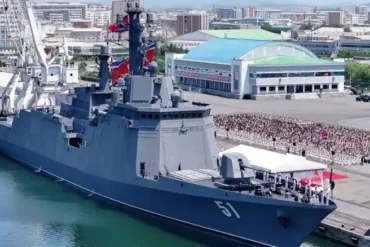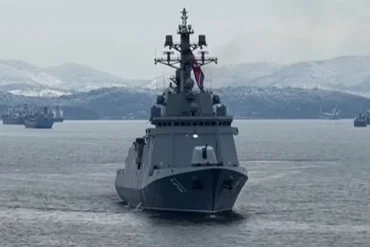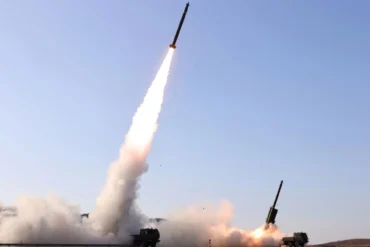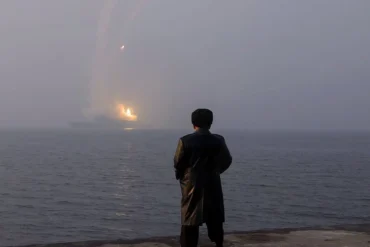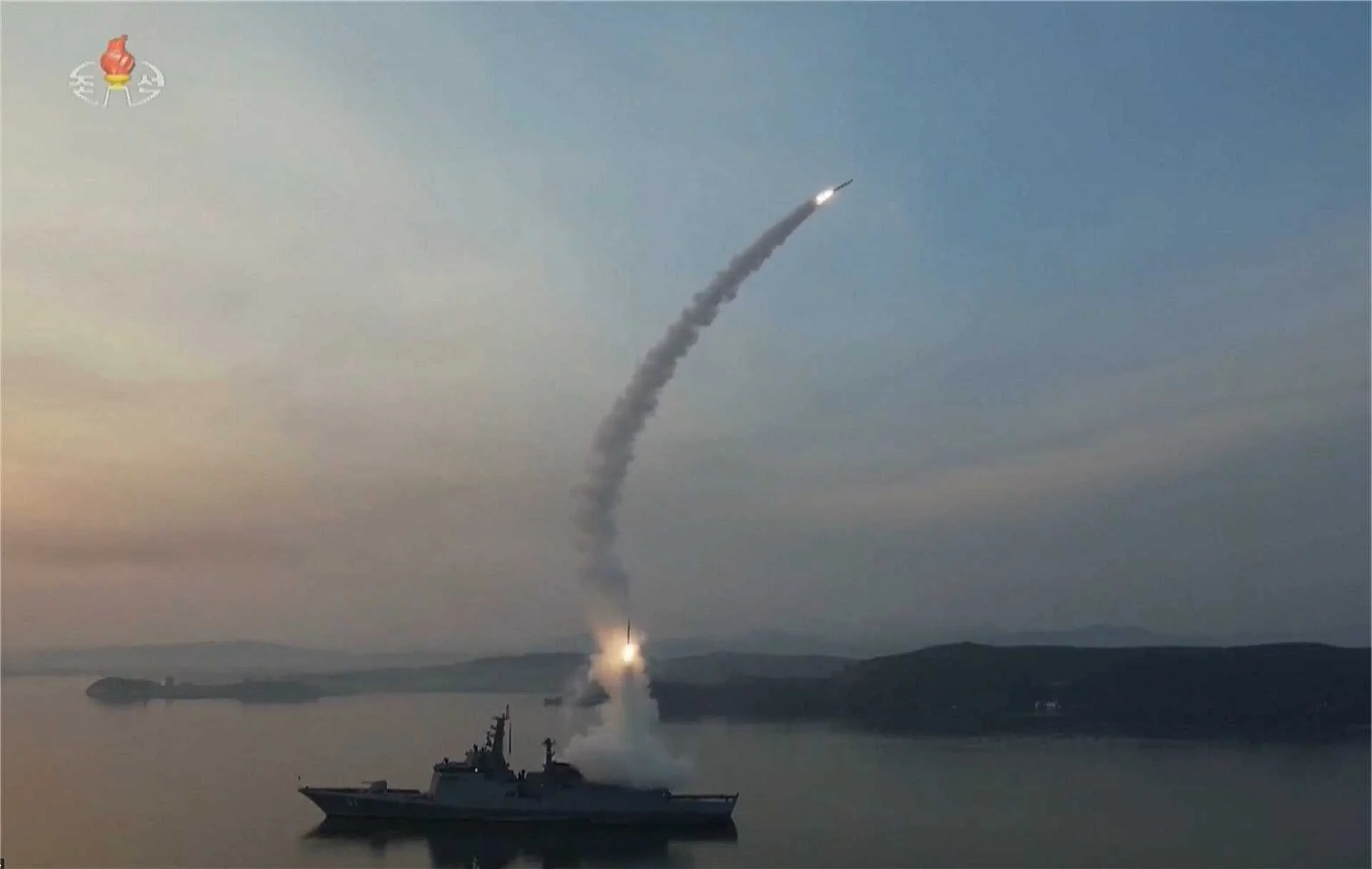
North Korea has conducted another high-profile missile test from the sea, launching several long-range cruise missiles from its newest destroyer as part of a rapidly advancing effort to develop mobile maritime strike capabilities. The launch marks the second naval missile test carried out from the same warship within a week and signals Pyongyang’s determination to integrate long-endurance cruise missiles into its naval doctrine.
According to reports from state media and regional monitoring organizations, the missiles were fired from a recently unveiled surface combatant believed to be the Choe Hyon–class destroyer, the largest warship ever introduced into the Korean People’s Navy. The weapons reportedly flew for nearly three hours before striking designated island targets used as impact zones. Such long flight durations indicate the missiles followed extended low-altitude cruise profiles, a technique designed to reduce radar visibility and complicate interception.
The test also demonstrated evolving command procedures. Instead of supervising the launch directly at sea, Kim Jong Un monitored the event remotely via live video link, authorizing the firing sequence from a command facility on land. The method reflects a gradual shift toward distributed command-and-control structures that allow leadership to maintain oversight without being physically present near operational units.
North Korea has now test-fired cruise missiles from its newest destroyer twice in one week — and Kim Jong Un ordered the second launch remotely, watching via video link as six missiles flew nearly 169 minutes before striking island targets. @ColinZwirko: https://t.co/MSS8JdxaWf pic.twitter.com/h0FM9qfjuX
— NK NEWS (@nknewsorg) March 11, 2026
North Korea’s Expanding Naval Strike Ambitions
For decades, the Korean People’s Navy was largely structured around coastal defense. Its fleet consisted mostly of patrol boats, small missile craft, and aging Soviet-era platforms designed for short-range engagements in the waters surrounding the Korean Peninsula. The appearance of a large destroyer equipped with advanced missile systems signals a dramatic evolution in North Korea’s maritime ambitions.
Analysts estimate the Choe Hyon–class destroyer displaces roughly 5,000 tons, making it substantially larger than most vessels previously operated by Pyongyang. The ship appears designed to carry multiple guided weapon systems, including land-attack cruise missiles and potential anti-ship missiles, giving it the ability to strike targets far beyond North Korea’s coastline.
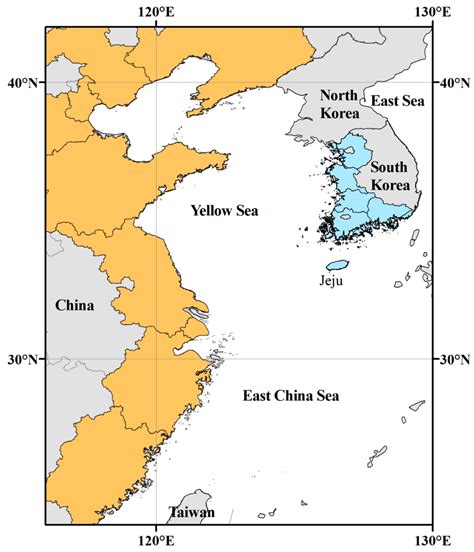
From a strategic perspective, deploying long-range missiles on a surface combatant offers a key advantage: mobility. Land-based missile launchers can be located through satellite surveillance and reconnaissance networks. A warship, however, can move across wide maritime areas such as the Sea of Japan or the Yellow Sea, making its location more difficult to track continuously.
Details of the Latest Cruise Missile Launch
According to defense reporting and analysis from NK News, six cruise missiles were fired during the latest testing sequence. These missiles reportedly remained airborne for approximately 169 minutes, suggesting a long-distance flight profile consistent with strategic land-attack cruise missiles.
Cruise missiles differ significantly from ballistic missiles. Instead of arcing high into the atmosphere before descending on a target, cruise missiles travel within the atmosphere at relatively low altitude, using onboard navigation systems and sometimes terrain-following guidance. This allows them to maneuver around obstacles and reduce their radar signature.
North Korea has previously showcased the Hwasal-series cruise missiles, which analysts believe could potentially reach targets more than 1,000 kilometers away depending on configuration and payload weight. While the specific model launched from the destroyer has not been publicly confirmed, the flight duration observed in this test strongly suggests a long-range strike capability.
Remote Command Signals Evolving Military Control
Another notable aspect of the test was the command structure used during the launch. Instead of observing the missile firing from a coastal facility or naval base, Kim Jong Un reportedly watched the event through a real-time video connection.
This approach hints at a growing emphasis on remote command authorization, a system commonly used by advanced militaries. In such frameworks, high-level decision makers can monitor operations from secure command centers while frontline units execute the mission.
The significance goes beyond convenience. A distributed command system improves operational resilience. If leadership can authorize missile launches from multiple secure locations rather than a single command site, the strategic force becomes harder to disrupt during a crisis.
From a systems-engineering standpoint, implementing this capability requires reliable communications networks, secure data links, and real-time telemetry transmission from ships to command centers. Achieving these capabilities indicates that North Korea is investing in the digital infrastructure needed to support modern missile operations.
Strategic Cruise Missiles and Potential Nuclear Roles
North Korean state media described the weapons fired during the test as “strategic cruise missiles.” In military terminology, the word “strategic” often implies that a missile could carry non-conventional payloads, including nuclear warheads or other weapons of mass destruction.
While no official confirmation has been provided regarding the payload configuration used in this test, analysts note that North Korea has repeatedly emphasized its goal of diversifying nuclear delivery platforms. Traditionally, ballistic missiles have served as the primary carriers of nuclear weapons. Cruise missiles, however, provide additional flexibility.
Unlike ballistic missiles, which follow predictable trajectories that early-warning systems can detect soon after launch, cruise missiles can approach targets at low altitude and along irregular routes. This characteristic can make them more challenging for missile defense systems designed primarily to counter ballistic threats.
A Turning Point for the Korean People’s Navy
The development of a cruise-missile-armed destroyer represents one of the most significant technological steps in the history of North Korea’s navy. Historically, Pyongyang relied heavily on asymmetric maritime tactics, including fast attack boats, coastal missile batteries, and submarines designed for ambush operations.
A modern destroyer changes the equation. With sufficient range and endurance, such a vessel could patrol large areas and conduct precision strike missions against land targets or enemy naval forces.
This shift suggests that the Korean People’s Navy is gradually transitioning from purely defensive coastal operations toward limited blue-water capability. A blue-water navy refers to naval forces capable of operating far from home ports across deeper ocean regions.
While one destroyer alone does not create a blue-water fleet, it serves as a technological stepping stone. The ship can act as a test platform for advanced sensors, missile systems, and command networks that might later appear in future warship designs.
Regional Security Implications
The timing of the test coincides with ongoing joint military exercises conducted by the United States and South Korea, drills that North Korea routinely criticizes as preparations for invasion. Pyongyang often responds to such exercises by conducting missile demonstrations meant to signal its deterrence capabilities.
From the perspective of regional defense planners, the emergence of sea-based cruise missile platforms introduces additional complexity. Missile defense systems deployed in South Korea and Japan are optimized primarily to detect ballistic missile launches from known land-based sites.
A destroyer carrying cruise missiles can operate from unpredictable maritime locations, potentially launching weapons from multiple directions. This mobility forces defense planners to consider a broader range of surveillance and interception scenarios.
Rapid Testing Suggests Approaching Operational Status
The pace of testing surrounding the new destroyer has been unusually rapid. Within a short span of time, North Korea has conducted multiple missile launches from the same platform, indicating an accelerated effort to validate its combat systems and weapons integration.
Such testing typically focuses on several critical factors:
- Launch reliability and mechanical performance of missile cells
- Navigation and guidance accuracy during long-distance flights
- Integration between shipboard sensors and missile targeting systems
- Command authorization and communications procedures
If the system continues to perform successfully during these trials, analysts believe the warship could soon enter active operational service within the Korean People’s Navy.
A Broader Strategy of Diversified Missile Platforms
The cruise missile tests from the Choe Hyon–class destroyer are part of a wider military modernization program pursued under Kim Jong Un’s strategic directives. Over the past several years, North Korea has invested heavily in developing multiple launch platforms for strategic weapons.
These include:
- Land-based ballistic missile launchers
- Submarine-launched ballistic missile systems
- Cruise missiles capable of launching from both ground vehicles and naval vessels
The logic behind diversification is straightforward. By deploying strategic weapons across land, sea, and potentially underwater platforms, North Korea increases the survivability and unpredictability of its missile forces.
A diversified arsenal complicates the calculations of adversaries attempting to track and neutralize launch systems. In strategic planning terms, this approach aims to strengthen deterrence credibility by ensuring that retaliatory capabilities cannot be easily eliminated.
The latest naval missile test therefore represents more than a technical experiment. It reflects a deliberate effort to transform North Korea’s military posture by adding mobile maritime strike options to an already expanding missile arsenal. If future testing confirms the effectiveness of the system, the Choe Hyon–class destroyer may become a central component of Pyongyang’s evolving strategy for projecting power and maintaining strategic leverage in Northeast Asia.