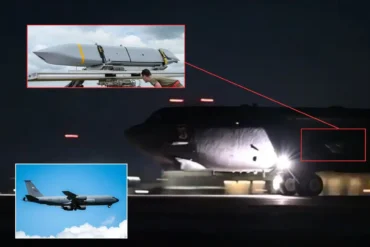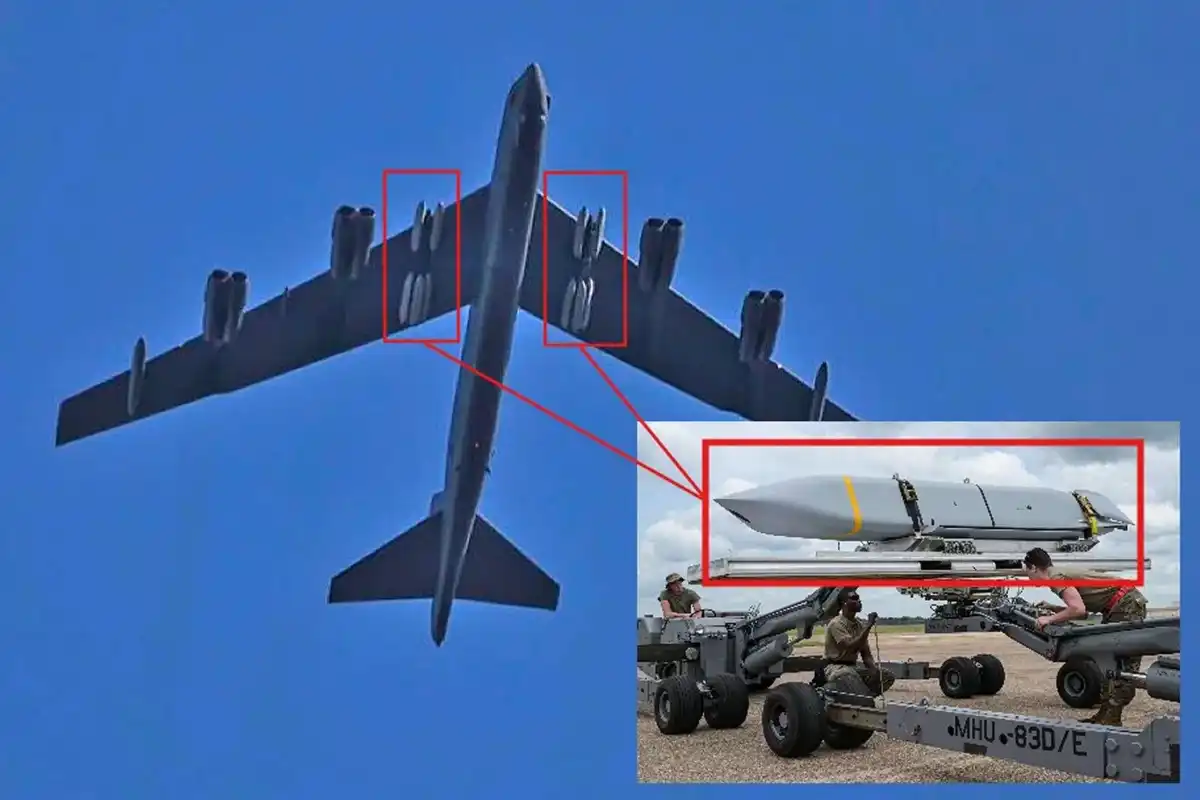
The appearance of a U.S. Air Force B-52H Stratofortress armed with AGM-158 cruise missiles departing RAF Fairford in March 2026 immediately caught the attention of defense analysts around the world. Images circulating online revealed a bomber configured not for ceremonial visibility but for an unmistakably operational long-range strike posture. The aircraft was reportedly carrying multiple AGM-158 Joint Air-to-Surface Standoff Missiles (JASSM), a weapon system designed specifically to destroy heavily defended targets without forcing the launch aircraft into hostile air-defense zones. The sighting occurred in the shadow of Operation Epic Fury, the ongoing American campaign targeting Iranian military infrastructure, amplifying the strategic message embedded in the bomber’s configuration.
Observers quickly noted that the aircraft’s visible payload was unusually explicit. Strategic bombers are often deployed in ways that reveal little about their immediate operational configuration, but the imagery from RAF Fairford told a different story. The bomber appeared loaded with numerous cruise missiles under its wings, creating a highly visible display of precision strike capability. For military analysts accustomed to reading subtle cues in deployments, the message was difficult to misinterpret: the United States was signaling both readiness and capacity to conduct stand-off attacks against strategic targets at considerable distance.
The timing of the sighting added another layer of significance. Just days earlier, additional American bombers had arrived in the United Kingdom as part of the expanding operational footprint connected to Operation Epic Fury. The visible weapons configuration suggested that these aircraft were not simply rotating through Europe for routine deterrence patrols. Instead, the bomber appeared prepared for an actual strike mission profile, reinforcing the perception that Washington was positioning its airpower assets for rapid escalation if required.
B-52H Stratofortress Demonstrates Long-Range Strike Power
The B-52H Stratofortress remains one of the most recognizable aircraft in military aviation, and its continued relevance often surprises those unfamiliar with its evolutionary upgrades. First introduced during the Cold War, the aircraft has undergone decades of modernization that transformed it from a nuclear bomber into a versatile platform capable of delivering a wide range of precision-guided conventional weapons. Its endurance, payload capacity, and ability to integrate new munitions have ensured that it remains a cornerstone of American strategic airpower.
What makes the B-52H particularly formidable in contemporary warfare is its ability to serve as a long-range missile carrier. The aircraft can carry cruise missiles both externally on wing pylons and internally on rotary launchers within its weapons bay. In practical terms, this means a single bomber can launch a large number of precision weapons in a coordinated strike, saturating enemy defenses or hitting multiple strategic targets simultaneously.
The images from RAF Fairford appeared to show at least ten AGM-158 missiles mounted externally, a configuration rarely displayed so openly in public imagery. Because the bomber’s internal weapons bay can also carry additional cruise missiles, the visible payload may have represented only a portion of the aircraft’s full strike capacity. That possibility transforms the aircraft from a symbolic deterrent into a significant offensive asset capable of engaging numerous high-value targets in a single sortie.
The AGM-158 JASSM: A Precision Weapon Built for Modern Warfare
At the center of the bomber’s configuration sits the AGM-158 Joint Air-to-Surface Standoff Missile, widely known as JASSM. This cruise missile was developed to solve a persistent challenge in modern combat aviation: how to strike highly defended targets without exposing aircraft to advanced surface-to-air missile systems.
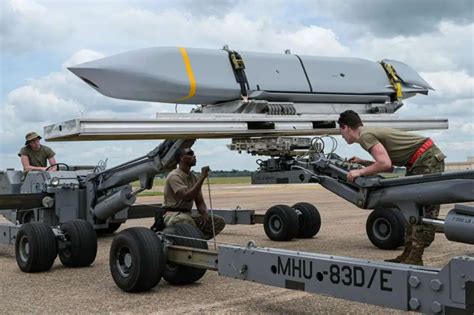
JASSM accomplishes this through a combination of low observable design, precision navigation systems, and a powerful penetrator warhead. The missile uses GPS guidance and an infrared imaging seeker to locate and strike its intended target with exceptional accuracy. Its stealth-shaped airframe reduces detection by radar, allowing it to approach heavily defended installations with a greater probability of success.
The weapon was specifically engineered to destroy critical military infrastructure. Targets commonly associated with JASSM strikes include:
- Hardened command and control centers
- Integrated air-defense radar installations
- Missile storage and launch facilities
- Military airfields and logistics hubs
- Reinforced bunkers and underground structures
The operational logic is straightforward yet powerful. By striking these critical nodes early in a conflict, a force can disrupt the enemy’s ability to coordinate defenses or launch retaliatory strikes, effectively weakening the entire military system rather than merely destroying isolated assets.
JASSM vs JASSM-ER: The Range Question
The imagery from RAF Fairford did not conclusively reveal which variant of the missile was loaded on the bomber. Two primary versions of the weapon are currently fielded: the AGM-158A JASSM and the AGM-158B JASSM-ER (Extended Range). Externally the two missiles appear nearly identical, making visual identification difficult without close inspection.
The distinction, however, matters greatly in operational terms. The baseline JASSM already provides a significant stand-off strike capability, allowing aircraft to launch attacks from distances beyond the reach of many air-defense systems. The JASSM-ER expands this reach dramatically by incorporating a more efficient engine and larger fuel capacity.
A bomber carrying the extended-range version could launch its missiles hundreds of kilometers farther from hostile territory, increasing survivability while giving commanders more flexibility in route planning and launch positions. From a strategic perspective, this expanded reach enables aircraft operating from safe airspace to hold distant targets at risk without ever approaching the densest enemy defenses.
Operation Epic Fury and the Iranian Strategic Equation
The context surrounding the deployment adds weight to its implications. Operation Epic Fury, the American campaign targeting Iranian military infrastructure, has intensified regional tensions and placed considerable attention on the capabilities being deployed to the theater. The presence of cruise-missile-armed bombers in Europe demonstrates that Washington retains the ability to project military power rapidly across large distances.
From an operational standpoint, a B-52H carrying numerous JASSM missiles could play a crucial role in the opening stages of a larger strike campaign. Such a bomber could target Iranian integrated air-defense systems, early-warning radar sites, and command networks. By degrading these systems first, the bomber would help create corridors through which other aircraft or missiles could operate with reduced risk.
The destruction of radar installations and command centers can have cascading effects across a military structure. When sensors lose connectivity with command nodes, defensive networks become fragmented. Individual units may still possess weapons, but their ability to coordinate responses deteriorates rapidly. In military strategy, this principle is often described as “system disruption,” where the objective is to paralyze the opponent’s decision-making chain rather than simply destroy equipment.
Stand-Off Warfare and the Evolution of U.S. Airpower Doctrine
The bomber’s configuration also reflects a broader shift in American military doctrine toward stand-off precision warfare. Instead of relying solely on aircraft that must penetrate hostile airspace, modern operations increasingly emphasize the use of long-range missiles launched from safe distances.
This approach offers several advantages. Aircraft can remain outside the engagement zones of advanced surface-to-air missiles, reducing risk to pilots and valuable platforms. At the same time, modern cruise missiles deliver pinpoint accuracy, ensuring that high-value targets can be neutralized without large-scale bombing campaigns.
In essence, the bomber becomes a mobile launch platform for precision weapons rather than a traditional bomb-dropping aircraft. When combined with intelligence satellites, surveillance drones, and cyber-enabled targeting systems, the result is a highly coordinated strike architecture capable of delivering rapid and overwhelming effects.
Strategic Messaging Beyond the Battlefield
The public circulation of images showing the bomber’s missile loadout carried a message extending well beyond immediate tactical considerations. Military deployments often serve dual roles: operational preparation and strategic signaling. By allowing such imagery to circulate, intentionally or otherwise, the United States demonstrated that it possesses both the capability and readiness to conduct long-range precision strikes.
For Iran, the message is straightforward. Geographic distance and hardened infrastructure offer only limited protection when confronted with advanced stand-off missile systems capable of reaching deep into national territory. Facilities previously considered relatively secure may still be vulnerable to coordinated cruise-missile attacks launched from hundreds or even thousands of kilometers away.
For U.S. allies and partners, however, the same imagery provides reassurance. The deployment signals that Washington retains credible tools to project force quickly and decisively, reinforcing deterrence at a moment of heightened geopolitical tension.
Why the B-52H Still Matters in the 21st Century
The continued relevance of the B-52H Stratofortress illustrates an interesting paradox in military technology. While stealth bombers and advanced fighter aircraft capture headlines, the aging Stratofortress remains uniquely suited for missions involving large numbers of long-range weapons.
Its enormous payload capacity, extended flight endurance, and compatibility with evolving missile systems allow it to function as a strategic arsenal aircraft. As long as new munitions continue to be integrated into its arsenal, the bomber remains capable of influencing modern conflicts despite its Cold War origins.

A Clear Signal of Reach and Resolve
Regardless of which exact missile variant was carried on the March 2026 sortie, the strategic meaning of the aircraft’s configuration was unmistakable. A B-52H visibly equipped with numerous AGM-158 cruise missiles represents a powerful reminder of the United States’ capacity for long-range precision warfare.
The bomber’s presence near the European theater, combined with its apparent strike configuration, demonstrated that American forces can assemble substantial offensive capability far from home bases within a short timeframe. That flexibility forms a central pillar of modern deterrence strategy: the ability to hold critical targets at risk without permanent deployments in every region.
In the volatile strategic environment surrounding Operation Epic Fury, the sight of a missile-laden Stratofortress lifting off from RAF Fairford underscored a fundamental reality of contemporary warfare. Distance no longer guarantees safety. With platforms like the B-52H paired with advanced cruise missiles such as JASSM, precision strike power can reach across continents, reshaping the strategic calculations of allies and adversaries alike.