The United States Air Force’s next-generation B-21 Raider stealth bomber has reached a critical milestone after a prototype aircraft was photographed conducting mid-air refueling over California’s Mojave Desert, a moment that offers one of the clearest glimpses yet into the aircraft’s expanding flight-test campaign. The rare images appeared as the U.S. simultaneously deployed its existing bomber arsenal—the B-1 Lancer, B-2 Spirit, and B-52 Stratofortress—in a major Middle East combat operation targeting Iranian-linked infrastructure.
The refueling sortie took place on March 10, 2026, when a KC-135R Stratotanker connected with the B-21 prototype during a multi-hour test flight believed to have originated from Edwards Air Force Base in California. Aviation enthusiasts and military observers captured a sequence of detailed images showing the stealth bomber trailing the tanker in the distinctive flying-wing silhouette that has already become synonymous with America’s next generation of long-range strike capability.
For analysts who track advanced military aviation programs, the photographs represent more than a rare sighting. They provide visual confirmation that the B-21 Raider is progressing through one of the most critical stages of flight testing: endurance and operational range validation through aerial refueling.
I believe I captured a “first” today. 🙌#b21 #b21raider #stealthbomber pic.twitter.com/ZHj1WnTTQk
— jmh.creates (@JarodMHamilton) March 10, 2026
Historic Aerial Refueling Marks a Major Test Milestone
Mid-air refueling is not simply a routine maneuver for a strategic bomber program. It is a defining capability that transforms an aircraft from a regional strike platform into a truly global weapon system.
During the Mojave test mission, the B-21 connected with a KC-135R tanker aircraft, one of the oldest yet most reliable aerial refueling platforms still serving in the U.S. Air Force. The Stratotanker’s origins stretch back to the late 1950s, creating a striking visual contrast: a Cold War-era refueling aircraft supplying fuel to one of the most advanced stealth bombers ever built.
Observers noted the prototype’s air-data boom protruding from the nose, a specialized instrument used during early flight testing to measure airflow, pressure, and other aerodynamic data. This device confirms the aircraft is still in a development phase, collecting performance metrics needed before operational deployment.
The mission reportedly lasted more than five hours, indicating the flight likely tested several operational parameters simultaneously, including:
- Refueling procedures
- Endurance under extended flight conditions
- Sensor and avionics performance during long sorties
The aircraft was also accompanied by an F-16 Fighting Falcon chase plane, a common safety and monitoring measure during experimental flights. Chase aircraft visually inspect the test platform and provide immediate feedback to engineers and pilots.
Rare Images Reveal Surprising Size and Design Details
Beyond documenting the refueling event, the photographs provided an unexpected benefit: a clearer sense of the B-21 Raider’s true scale.
For years, estimates suggested the B-21 would be significantly smaller than the B-2 Spirit, the stealth bomber it is intended to replace. Early reports indicated a wingspan of around 140 feet, noticeably less than the B-2’s 172-foot span.
However, the new images showing the aircraft alongside a KC-135R tanker suggest the Raider may be larger than previously assumed. When viewed in relation to the tanker’s fuselage and refueling boom, the stealth bomber appears more substantial than many analysts predicted.
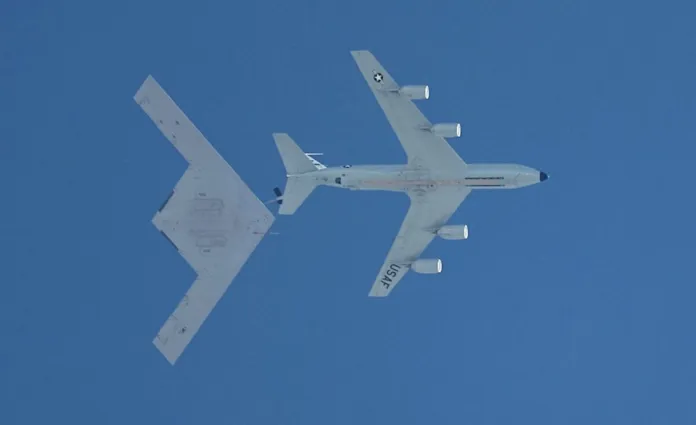
The imagery also offered a rare angle of the aircraft’s internal weapons bay, a critical component of its stealth design. Unlike older bombers that carried weapons externally, stealth aircraft conceal munitions inside the fuselage to maintain a minimal radar signature.
This approach significantly reduces radar cross-section, allowing the bomber to penetrate heavily defended airspace without triggering early detection systems.
Operation Epic Fury: America’s Bomber Fleet Enters Combat
The timing of the B-21 test flight is particularly notable because it occurred while the U.S. bomber fleet was actively engaged in combat operations against Iran.
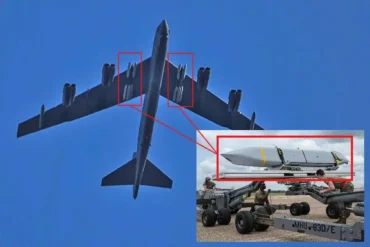
Under the operation code-named “Operation Epic Fury,” American strategic bombers launched a series of strikes targeting approximately 200 sites within the first 72 hours. According to U.S. Central Command, the mission involved coordinated attacks by B-1 Lancers, B-2 Spirits, and B-52 Stratofortresses.
These aircraft represent three generations of U.S. bomber design:
- B-52 Stratofortress: Introduced in the 1950s and still serving as a long-range heavy bomber.
- B-1 Lancer: A supersonic variable-sweep wing bomber designed for high-speed penetration.
- B-2 Spirit: The world’s first operational stealth bomber.
Together they formed the backbone of the opening wave of strikes across the Middle East theater.
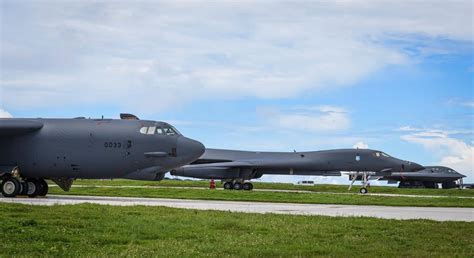
Military officials confirmed that additional bomber waves were preparing for deployment, underscoring the scale of the operation and the enduring importance of strategic aviation in modern warfare.
While these aircraft currently carry the operational burden, the B-21 Raider is intended to become the centerpiece of future U.S. long-range strike capability.
The B-21 Raider: America’s Next Strategic Bomber
The Northrop Grumman B-21 Raider was officially unveiled in December 2022, marking the first new U.S. bomber design in more than three decades. Developed under strict secrecy, the aircraft is designed to perform deep-penetration missions inside highly contested airspace.
Its maiden flight occurred at Air Force Plant 42 in Palmdale, California, before the aircraft transitioned to flight testing at Edwards Air Force Base.
Currently, the program is in Low-Rate Initial Production (LRIP). This stage involves manufacturing a limited number of aircraft while engineers refine production processes and incorporate lessons learned from testing.
At least two flight-test aircraft are believed to be operational, with more prototypes expected as the program advances toward its planned 2027 operational introduction.
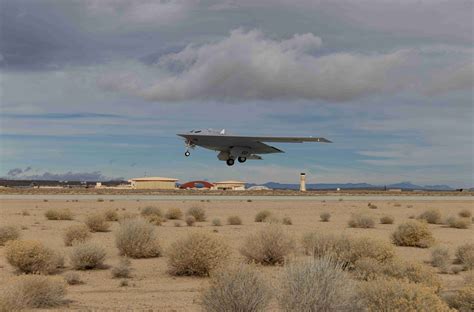
Unlike earlier bombers, the Raider is designed from the beginning as part of a network-centric combat system. That means the aircraft does not operate merely as a bomb delivery platform. Instead, it acts as a node in a larger battlefield network, sharing intelligence and coordinating operations with satellites, fighters, and unmanned systems.
Advanced Stealth and Long-Range Strike Capabilities
Although much of the B-21’s design remains classified, available information indicates it incorporates significantly improved stealth technology compared with the B-2 Spirit.
Key advancements are believed to include:
- Improved radar-absorbent materials with smoother surface coatings
- Recessed engine air intakes designed to reduce radar reflections
- Advanced broadband stealth characteristics across multiple detection frequencies
These features allow the bomber to evade not only traditional radar systems but also newer multi-band detection networks developed by potential adversaries.
Equally important is the Raider’s extended operational range. Thanks to highly efficient engines and aerodynamic optimization for high-altitude flight, the aircraft is expected to travel vast distances without refueling.
When combined with aerial refueling, the result is a platform capable of reaching virtually any target on Earth.
The recent Mojave test provided the first photographic evidence confirming this capability in practice.
Toward a Global Bomber Campaign Force
U.S. Air Force leaders envision the B-21 as the foundation of what they call a “bomber campaign force.” Rather than deploying small numbers of aircraft for isolated missions, future operations could involve large coordinated formations capable of striking multiple continents simultaneously.
Major General Jason Armagost of the Eighth Air Force has emphasized that integrating the Raider will dramatically expand the flexibility of U.S. strategic aviation. The aircraft’s networking, sensor suite, and electronic warfare capabilities will allow it to perform roles traditionally assigned to multiple platforms.
In addition to delivering nuclear and conventional weapons, the bomber is expected to conduct:
- Intelligence, surveillance, and reconnaissance (ISR) missions
- Electronic warfare operations against enemy radar networks
- Battle management functions coordinating multi-domain attacks
The aircraft’s open-systems architecture ensures it can receive upgrades throughout its service life, allowing new sensors, weapons, and software to be integrated as threats evolve.
Production Plans and Strategic Demand
The U.S. Air Force has committed to acquiring at least 100 B-21 Raiders, though several defense analysts argue that the evolving global security environment may require between 145 and 200 aircraft.
Each bomber is expected to cost over $700 million when adjusted for inflation, making the program one of the most expensive aircraft developments in modern history.
Despite the price tag, the Pentagon and Northrop Grumman have already begun expanding production capacity to accelerate delivery timelines. Strategic planners see the Raider as essential for countering advanced air-defense networks developed by China, Russia, and Iran.
As the Mojave Desert photographs demonstrate, the aircraft is steadily moving from theoretical capability toward operational reality.
The sight of a B-21 Raider taking fuel from a KC-135 tanker high above the California desert captured a symbolic moment in aviation history: a bridge between generations of American airpower. One aircraft represents the enduring legacy of Cold War engineering, while the other embodies the stealth-driven future of strategic warfare.