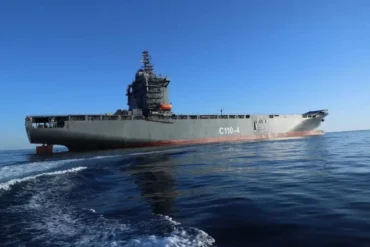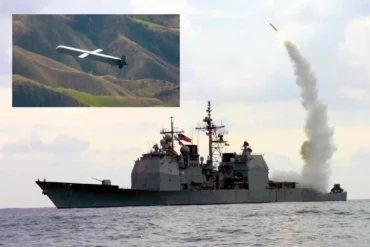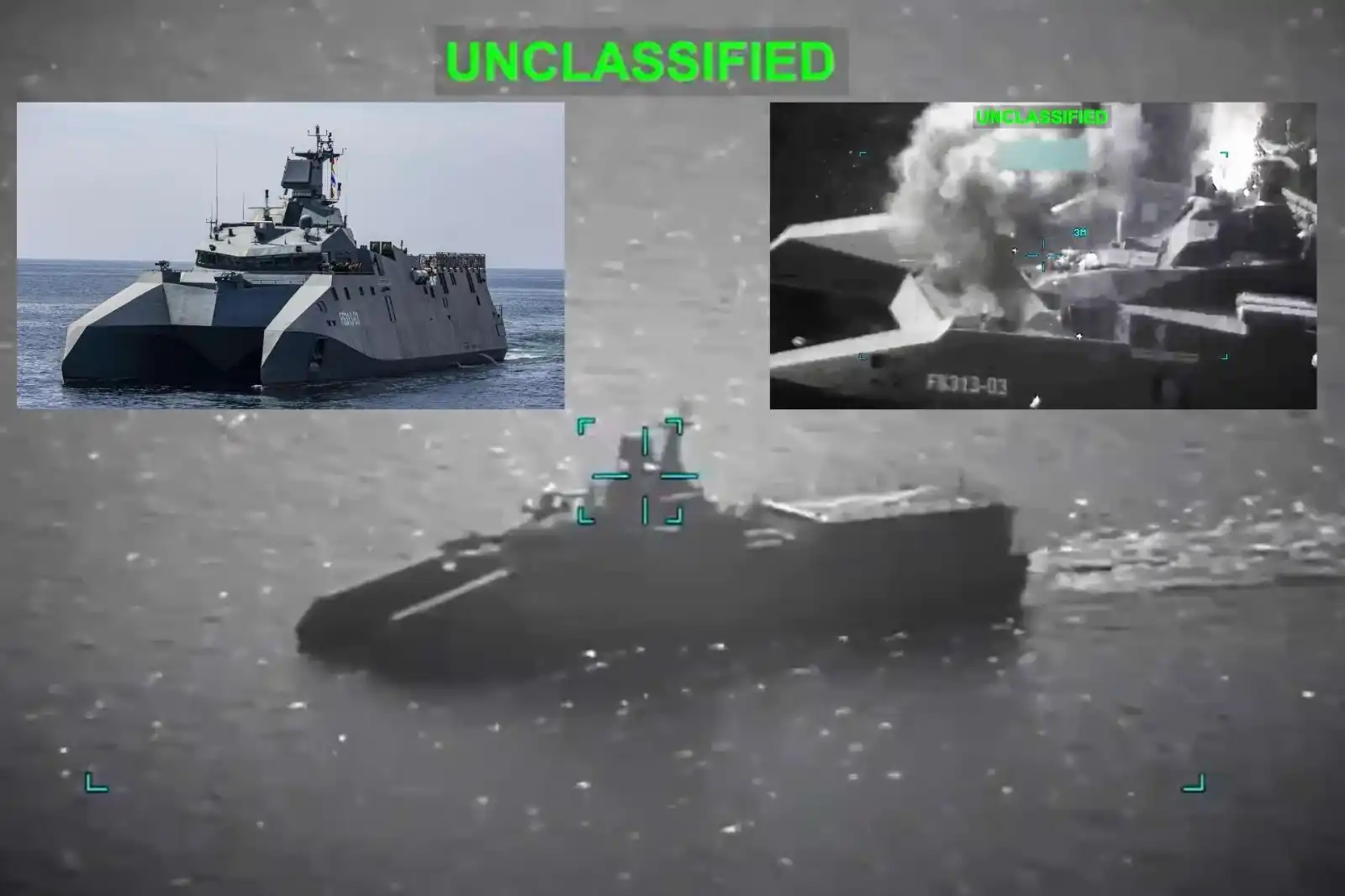
The escalating maritime confrontation in the Persian Gulf took a decisive turn on March 4, 2026, when U.S. forces targeted and severely damaged the Iranian missile corvette IRIS Shahid Sayyad Shirazi during Operation Epic Fury, according to U.S. Central Command (CENTCOM). The strike marks one of the most significant blows to Iran’s modern naval capabilities in recent years, eliminating one of the newest warships in the Islamic Revolutionary Guard Corps Navy (IRGCN) fleet and reinforcing Washington’s dominance in the strategically vital Strait of Hormuz.
CENTCOM confirmed that the attack formed part of a sustained maritime campaign designed to degrade Iran’s naval strike potential and maintain freedom of navigation through one of the world’s most critical shipping corridors. The engagement occurred near Bandar Abbas, Iran’s primary naval hub, where IRGC naval assets frequently operate to monitor and potentially challenge international maritime traffic.
The removal of the Soleimani-class corvette from operational service underscores the rapid attrition of Tehran’s maritime order of battle. Since the beginning of Operation Epic Fury, U.S. forces have reportedly destroyed or disabled more than twenty Iranian naval vessels, dramatically reducing the IRGC Navy’s ability to threaten allied shipping and naval forces operating in the Persian Gulf and Gulf of Oman.
U.S. forces have struck or sunk to the bottom of the ocean more than 20 ships from the Iranian regime. Last night, CENTCOM added a Soleimani-class warship to the list. pic.twitter.com/KgW8cS726P
— U.S. Central Command (@CENTCOM) March 4, 2026
Strike Near Bandar Abbas Signals U.S. Maritime Dominance
The attack on Shahid Sayyad Shirazi unfolded in waters long regarded as a defensive bastion for Iran’s naval forces. Situated along the northern coast of the Strait of Hormuz, Bandar Abbas serves as the operational heart of the IRGC Navy and a launch point for many of its surface combatants, missile boats, and fast-attack craft.
U.S. military officials indicated that the targeted corvette suffered extensive damage to its hull and superstructure, with imagery showing flames and dense smoke rising from the vessel shortly after the strike. While the ship reportedly remained afloat immediately after the attack, U.S. Secretary of War Pete Hegeseth stated that the vessel had ultimately been sunk or rendered permanently inoperable, removing it from Iran’s active naval inventory.
The engagement demonstrates the ability of U.S. forces to locate, track, and strike high-value targets even within heavily defended coastal waters. By neutralizing one of Iran’s most advanced surface combatants close to its home port, the strike sends a clear message about the reach of American surveillance networks and precision strike capabilities operating in the region.
The Shahid Soleimani-Class: Iran’s New Generation of Missile Corvettes
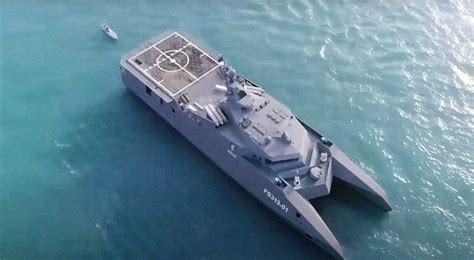
The Shahid Soleimani-class represents a major step forward in Iranian naval design. Unlike traditional single-hull warships, the class uses a wave-piercing catamaran hull, a configuration intended to deliver higher speeds, improved stability, and reduced radar signature in the shallow waters of the Persian Gulf.
Displacing roughly 600 tons, the vessels are relatively compact but heavily armed for their size. Their angular superstructure and stealth-influenced design features aim to reduce radar detectability while supporting a sophisticated sensor and command architecture.
These ships were conceived as multi-mission littoral combatants, capable of coordinating swarm tactics involving smaller IRGC vessels while also launching missile strikes against enemy ships or aircraft. Their combination of anti-ship cruise missiles, naval air-defense systems, and command-and-control facilities makes them among the most capable ships in Iran’s irregular naval fleet.
Advanced Missile Systems Packed into a Compact Warship
Despite their relatively modest size, Soleimani-class corvettes carry an unusually dense array of weapons designed for asymmetric naval warfare.
Key capabilities typically include:
- Deck-mounted anti-ship cruise missiles designed to strike surface vessels at long range
- A vertical launch system (VLS) capable of firing naval surface-to-air missiles
- Integrated air-search and surface-search radar systems
- Command facilities to coordinate fast-attack craft and unmanned systems
This architecture transforms the vessel into more than a simple missile platform. Within Iran’s doctrine, these corvettes function as command nodes for distributed naval operations, orchestrating attacks from swarms of smaller boats while maintaining limited air-defense coverage.
In the confined waters of the Persian Gulf, where geography naturally favors sea-denial tactics, such capabilities are intended to complicate operations for larger naval formations such as U.S. carrier strike groups.
The Sayyad-3G Missile Test That Drew Global Attention
Only weeks before the strike, Shahid Sayyad Shirazi had attracted international attention during the “Smart Control of the Strait of Hormuz” naval exercise conducted by Iran in February 2026.
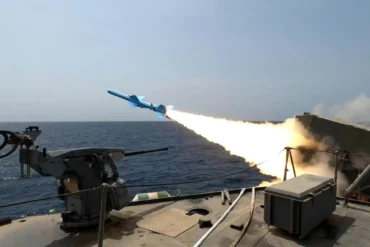
During the drill, Iranian state media broadcast footage showing what was described as the first shipborne launch of the Sayyad-3G surface-to-air missile from the vessel’s forward vertical launch system. The Sayyad-3 family of missiles forms a key component of Iran’s long-range air defense network, and the navalized Sayyad-3G variant was presented as a major step toward establishing layered air defense at sea.
Open-source assessments suggest the missile could reach engagement ranges between 120 and 150 kilometers, allowing it to target aircraft, drones, and cruise missiles operating over the Gulf. If fully operational, this capability would enable Soleimani-class corvettes to provide protective air-defense coverage for nearby Iranian vessels, an important feature for swarm tactics.
The destruction of the very platform that showcased the new missile only weeks earlier dramatically highlights the vulnerability of emerging Iranian naval technologies when confronted with advanced U.S. reconnaissance and strike systems.
Operation Epic Fury and the Systematic Targeting of Iranian Naval Assets
The strike forms part of Operation Epic Fury, a broader U.S. campaign aimed at neutralizing Iranian maritime threats across the Gulf of Oman and Persian Gulf. The operation integrates multiple layers of military capability, including:
- Submarine-based strike systems
- Long-range precision weapons
- Carrier-based and land-based aircraft
- Advanced surveillance networks
Through this multi-domain approach, U.S. forces have methodically targeted vessels associated with the IRGC Navy, which historically relies on asymmetric tactics such as missile boats, drones, and swarm attacks.
The removal of more than twenty Iranian vessels from the battlefield significantly weakens Tehran’s ability to conduct coordinated sea-denial operations. In particular, eliminating larger command platforms like the Soleimani-class corvettes reduces the IRGC Navy’s ability to organize smaller attack craft into effective formations.
Strategic Impact on the Balance of Power in the Strait of Hormuz
The Strait of Hormuz remains one of the most strategically important maritime chokepoints on the planet. Roughly one-fifth of the world’s oil supply passes through the narrow channel connecting the Persian Gulf with the Arabian Sea, making stability in the region a global economic priority.
Iran has long sought to leverage its geographic position to exert influence over the waterway, building a naval doctrine centered on sea denial rather than conventional fleet warfare. Fast attack craft, missile batteries, naval mines, and compact missile corvettes are all part of this strategy.
However, the loss of Shahid Sayyad Shirazi demonstrates the limitations of these efforts when confronted by superior surveillance networks, electronic warfare capabilities, and precision-guided weapons.
From a strategic perspective, the strike reinforces the ability of the United States and its partners to maintain open sea lanes while suppressing emerging Iranian naval threats.
A Symbolic Blow to Iran’s Modern Naval Ambitions
Beyond the immediate tactical impact, the destruction of the Shahid Sayyad Shirazi carries powerful symbolic weight. The Soleimani-class ships were intended to represent the future of Iran’s naval modernization, combining stealthy design, missile power, and command-and-control functions into a single platform.
Losing one of these vessels so soon after publicly demonstrating its advanced capabilities highlights the challenge Iran faces in transforming experimental systems into survivable combat assets in a highly contested environment.
For U.S. strategists, the strike illustrates a broader reality of modern naval warfare: the side that controls the information battlefield—sensors, targeting networks, and precision strike platforms—often decides the outcome long before ships ever see each other on the horizon.
In the turbulent waters of the Persian Gulf, where geopolitical tensions frequently collide with vital global trade routes, the fate of the IRIS Shahid Sayyad Shirazi stands as a stark reminder that technological innovation alone does not guarantee survivability. Control of the seas still belongs to the force capable of integrating intelligence, surveillance, and overwhelming precision firepower into a single, relentless operational system.