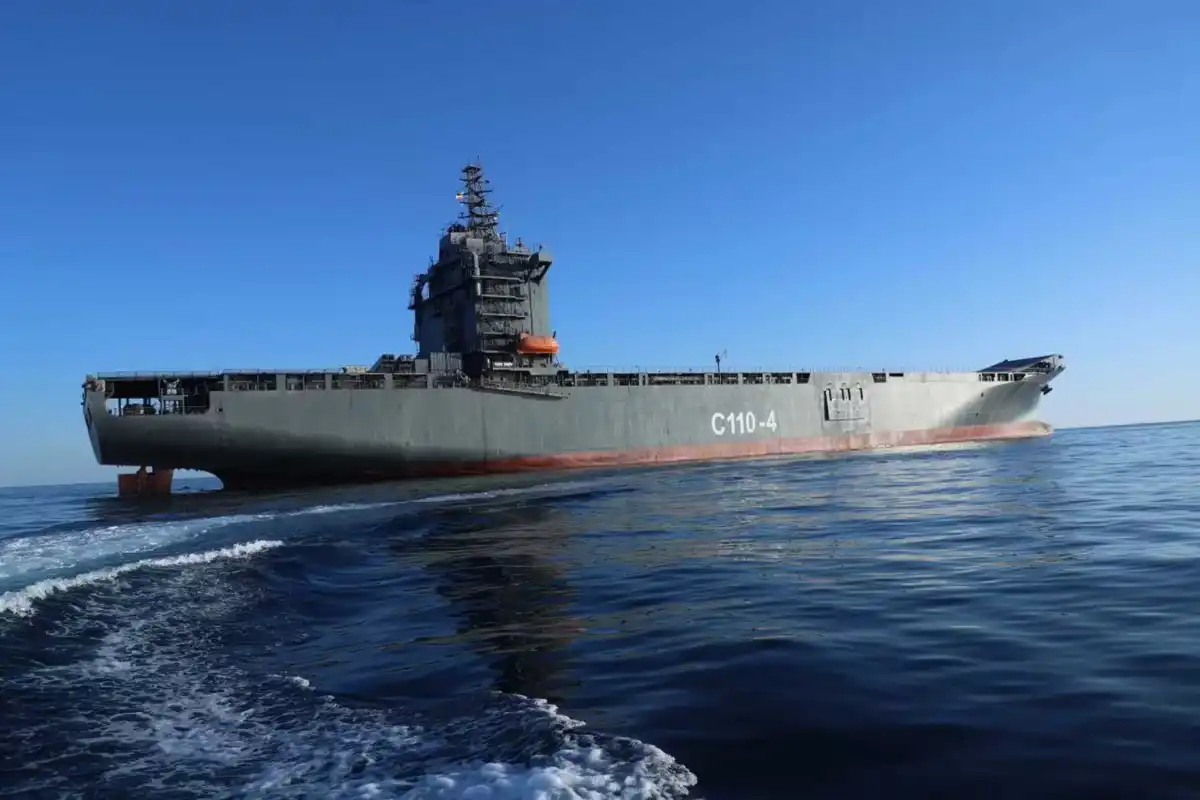
The opening salvos of Operation Epic Fury have delivered a decisive maritime shock: the destruction of Iran’s first dedicated drone carrier, IRIS Shahid Bagheri, in a sweeping U.S.-led naval campaign across the Gulf of Oman. Announced by U.S. Central Command (CENTCOM) on March 2, 2026, the strike marked a direct assault on Tehran’s evolving sea-based unmanned warfare doctrine and signaled a sharp escalation in the contest for control over one of the world’s most strategically vital waterways.
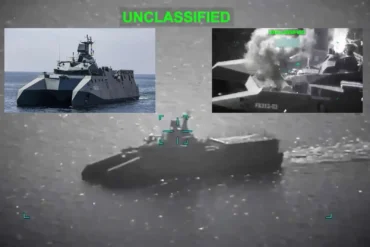
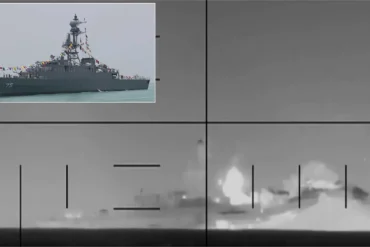
Within hours of the operation’s initiation, U.S. forces reportedly struck and disabled the Shahid Bagheri alongside multiple Iranian naval assets operating beyond the Strait of Hormuz. American officials stated that at least eleven Iranian vessels were destroyed or rendered inoperable during the initial phase, as part of a broader effort targeting missile infrastructure, command nodes, and maritime strike platforms. The campaign unfolded amid heightened tensions, with Iran threatening commercial traffic through the Strait of Hormuz—a chokepoint responsible for nearly 20 percent of global oil shipments.
The sinking of the Shahid Bagheri is more than the loss of a single hull. It represents a calculated move against Iran’s ambition to project unmanned power far beyond its coastline and to transform commercial conversions into floating military ecosystems capable of asymmetric disruption.
The Rise of Iran’s First Dedicated Drone Carrier
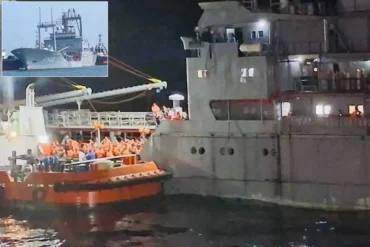
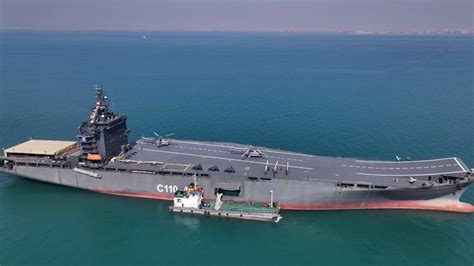
Commissioned after conversion between 2022 and 2024, the IRIS Shahid Bagheri (C110-4) began life as the commercial container ship Perarin. Iran’s defense establishment reshaped the vessel into a multi-role sea base tailored for the Islamic Revolutionary Guard Corps Navy (IRGCN). At 240.79 meters in length, with a beam of 32.2 meters and a draft of 11.7 meters, the ship displaced nearly 41,978 tons—an imposing platform by regional standards.
Its design philosophy was pragmatic and asymmetric. Rather than constructing a traditional aircraft carrier, Iran opted for modular conversion. The result was a hybrid vessel combining drone launch capacity, helicopter operations, missile armament, electronic warfare systems, and internal storage for fast-attack craft. The Shahid Bagheri was intended to operate as a mobile command-and-control node, extending Iran’s surveillance and strike reach into the Gulf of Oman, the Arabian Sea, and potentially the Indian Ocean.
Iranian sources claimed the ship could carry up to 60 unmanned aerial vehicles. Its embarked air wing reportedly included Mohajer-6 armed UAVs, Ababil-3 reconnaissance drones, Shahed-136 loitering munitions, and the more ambitious JAS-313 unmanned jet platforms. Rotary-wing assets such as the Mi-17, Mi-171, Bell 412, and Bell 206 provided additional lift and coordination capability. In essence, the Shahid Bagheri was conceived as a floating hive for distributed drone operations.
A Floating Arsenal Built for Asymmetric Warfare
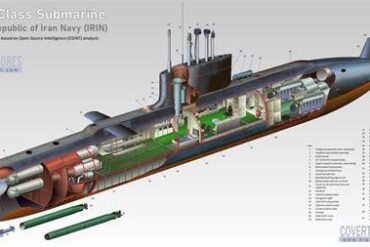
Beyond aviation assets, the ship carried a formidable missile suite. Reports indicated the presence of Noor or Qader anti-ship cruise missiles, both derivatives of the Chinese C-802 lineage, capable of threatening surface combatants at considerable range. Short-range air defense launchers, 30 mm autocannons, and Gatling-type systems offered close-in protection against aircraft and fast-moving threats.
More telling than its armament was its architecture. Side openings allowed the deployment of approximately 30 fast-attack craft, aligning with the IRGC Navy’s longstanding swarm doctrine. In such a scenario, the Shahid Bagheri would coordinate waves of small boats armed with rockets and missiles, supported overhead by reconnaissance drones feeding real-time targeting data.
The vessel’s estimated range of 22,000 nautical miles suggested endurance far beyond Iran’s littoral waters. That endurance mattered. A mobile sea base disrupts predictability. It shifts launch points, complicates adversary targeting, and expands the geometry of threat envelopes. For a state facing technologically superior naval forces, unpredictability is currency.

Operation Epic Fury: Coordinated Maritime Strike
Operation Epic Fury appears to have been structured as a multi-domain campaign rather than a single maritime engagement. U.S. officials described coordination with Israel and the targeting of missile sites, forward base ships, and naval command facilities. The strike against the Shahid Bagheri was therefore embedded in a broader effort to degrade Iranian power projection at sea and to sever the connective tissue between reconnaissance, targeting, and missile launch.
The Gulf of Oman has become an arena where surface ships, submarines, drones, and long-range bombers intersect. Neutralizing a vessel like the Shahid Bagheri removes not only its immediate firepower but also its ability to act as a sensor fusion hub. Modern naval warfare is not merely about platforms; it is about data. The side that sees first, processes fastest, and strikes with precision dictates tempo.
The destruction of eleven Iranian vessels during the opening phase shifts the regional surface balance, at least temporarily. Larger hulls capable of sustained operations beyond the Strait of Hormuz are fewer. Iran’s options narrow toward coastal batteries, mines, and fast-attack craft operating under land-based air defense umbrellas.
Strategic Implications for the Strait of Hormuz
The Strait of Hormuz is less than 40 nautical miles wide at its narrowest point, yet it channels a fifth of global petroleum trade. Any credible threat to shipping reverberates through energy markets and geopolitical calculations. The Shahid Bagheri was designed to complicate Western naval patrol patterns by extending drone surveillance over commercial sea lanes.
Without a sea-based aviation platform, Iran’s maritime domain awareness becomes more geographically constrained. Shore-based UAVs and missile batteries remain potent, but their operational reach is inherently tied to fixed coordinates. A mobile carrier dissolves those coordinates. Its removal restores a measure of predictability to coalition naval planning.
This does not eliminate risk. Iran retains thousands of fast-attack craft and a deep inventory of coastal anti-ship missiles. Yet the loss of a large displacement drone carrier limits Tehran’s ability to orchestrate wide-area drone swarms over open waters beyond immediate coastal missile cover. Coordination becomes more fragmented; reaction windows expand for adversaries.
The Vulnerability of Converted Commercial Warships
The Shahid Bagheri’s fate underscores a broader lesson about converted commercial vessels in high-intensity conflict. While cost-effective and adaptable, such ships lack the layered defensive architecture of purpose-built warships. Their radar cross-sections, compartmentalization standards, and survivability features are rarely optimized for sustained missile engagements.
Iran’s strategy mirrored earlier conversions like Shahid Roudaki and Shahid Mahdavi, leveraging commercial hulls to generate rapid capability. The concept offered flexibility and strategic ambiguity. But against precision-guided munitions and persistent surveillance, large, slower hulls become conspicuous targets.
The sinking of a vessel commissioned scarcely a year earlier represents both a symbolic and operational setback. It signals that maritime improvisation carries inherent vulnerability when facing integrated strike networks composed of satellites, drones, submarines, and long-range bombers.
A Shift in Iran’s Center of Gravity
Strategically, Operation Epic Fury appears designed to push Iran’s military response back toward shore-based systems. Tehran maintains a formidable arsenal of ballistic missiles, land-based UAVs, and anti-ship cruise missiles positioned along its coastline. These assets remain intact and continue to shape deterrence calculations.
However, the loss of the Shahid Bagheri reduces Iran’s capacity for sustained offshore maneuver and sea-based ISR integration. The center of gravity shifts from mobile maritime nodes to static land installations. That shift alters escalation dynamics. Coastal missile forces are powerful but predictable; floating sea bases introduce fluidity.
The destruction of the IRIS Shahid Bagheri therefore resonates beyond the tactical level. It narrows Iran’s maritime toolkit, recalibrates the Gulf’s naval equilibrium, and reinforces the reality that in modern warfare, visibility and precision define survival. In a theater where geography compresses space and amplifies consequence, the elimination of a single ship can ripple across global energy markets and strategic doctrines alike.