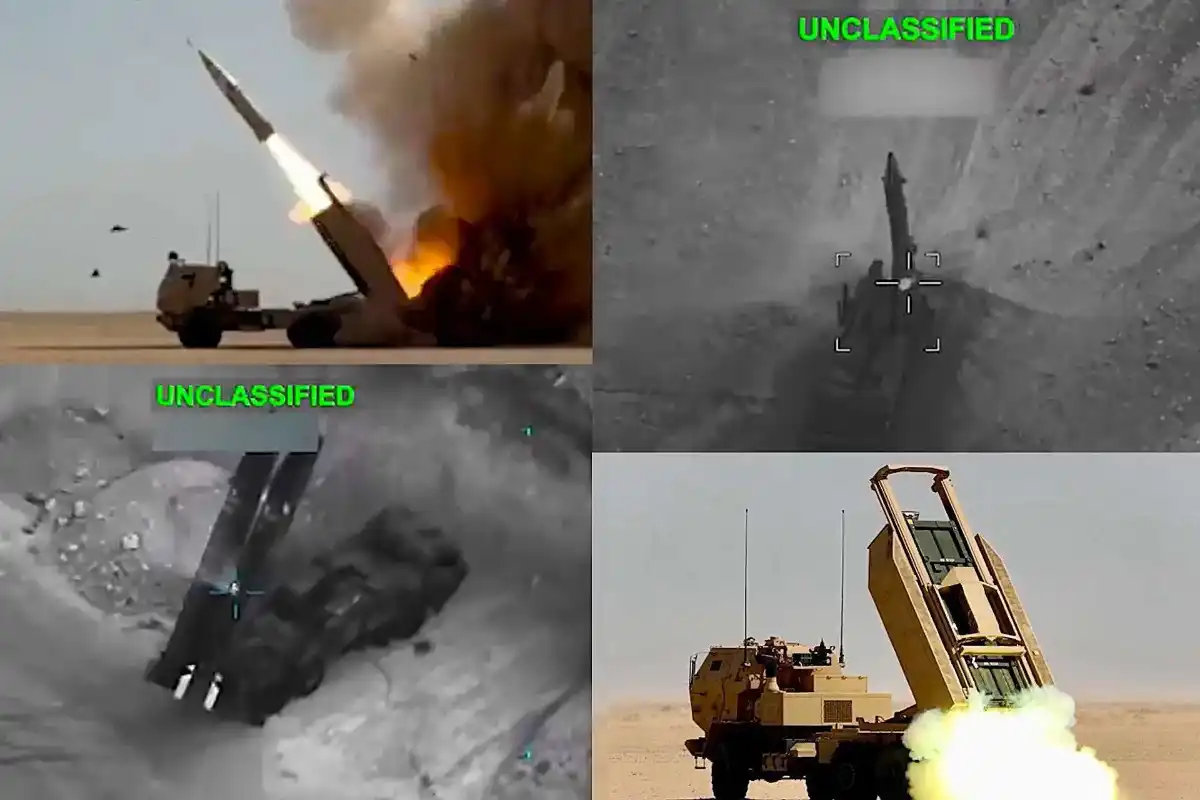
The United States has publicly confirmed the use of Army Tactical Missile System (ATACMS) ballistic missiles launched from the M142 High Mobility Artillery Rocket System (HIMARS) against Iranian targets during the opening phase of Operation Epic Fury, marking one of the most explicit acknowledgments of American ground-based deep-strike capabilities in a live regional confrontation. The disclosure, delivered through unclassified footage released by U.S. Central Command (CENTCOM) on March 1, 2026, provides a rare window into how Washington is integrating land-based precision fires into a broader joint campaign conducted alongside Israel.
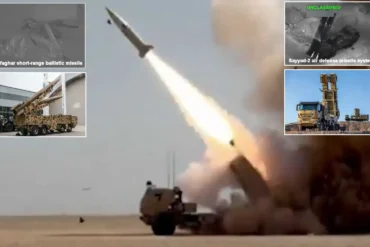
The short nighttime video, distributed on social media platform X, shows a single HIMARS vehicle elevating its launcher pod before firing a ballistic missile that ignites in a bright plume of solid-fuel exhaust. The missile ascends vertically before pitching onto its programmed trajectory, consistent with known ATACMS launch profiles. Although CENTCOM did not specify the exact launch location or the precise targets struck, officials described the action as “swift and decisive,” emphasizing that Iranian leadership had been warned in advance and that the operation was conducted under presidential authorization.
The public release of such footage is strategically significant. The United States has used ATACMS in past conflicts, yet rarely has it chosen to showcase the system so directly at the outset of a major operation. In this case, the messaging appears calibrated: it demonstrates capability and reach without disclosing tactical details that could compromise operational security.
The Iranian regime was warned. CENTCOM is now delivering swift and decisive action as directed. pic.twitter.com/nNDoDexH6g
— U.S. Central Command (@CENTCOM) March 1, 2026
HIMARS as a Mobile Deep-Strike Platform
The M142 HIMARS is often described as rocket artillery, but in scenarios like Operation Epic Fury it functions more accurately as a theater-level precision strike platform. Mounted on a 6×6 wheeled chassis, the system carries a single launch pod capable of firing either six Guided Multiple Launch Rocket System (GMLRS) rockets or one ATACMS missile. Its defining advantage is mobility. After firing, the vehicle can rapidly reposition, reducing vulnerability to counter-battery fire, drone surveillance, or retaliatory missile strikes.
In the Middle East, HIMARS units have been deployed for years across U.S. bases in Kuwait and other Gulf states. From these forward positions, the system provides a land-based alternative to air and naval strike assets. Unlike fighter aircraft, HIMARS does not require air superiority to deliver munitions. Unlike surface vessels, it cannot be easily tracked by maritime surveillance systems. It occupies a middle ground—dispersed, mobile, and difficult to preempt.
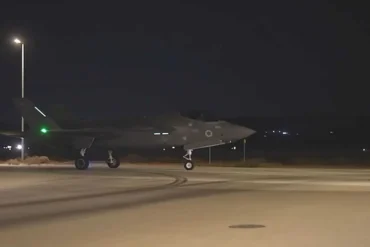
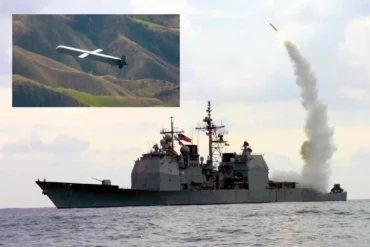
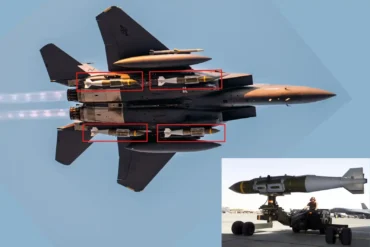
During Operation Epic Fury, HIMARS appears to complement sea-launched Tomahawk cruise missiles, air-delivered precision bombs, and newly deployed one-way attack drones. This layered approach complicates defensive calculations for Iran’s integrated air defense network, which must contend simultaneously with ballistic trajectories, low-flying cruise profiles, and unmanned aerial systems.
ATACMS: Tactical Ballistic Missile with Strategic Implications
The MGM-140 ATACMS is a 610 mm solid-fuel tactical ballistic missile with a maximum range of approximately 300 kilometers in its later variants. Weighing roughly 1.7 metric tons, it launches vertically before arcing along a ballistic path that can reach altitudes of tens of kilometers. At peak velocity, the missile travels at supersonic speeds, compressing engagement timelines for defending forces.
Modern ATACMS variants employ GPS-aided inertial navigation, a dual-guidance system combining internal motion sensors with satellite positioning. Inertial navigation allows the missile to maintain a calculated trajectory even if GPS signals are degraded by electronic warfare. GPS correction refines accuracy during flight, enabling strikes against fixed, high-value targets such as hardened command centers, radar installations, airfields, or logistics depots.
Earlier versions of ATACMS were equipped with cluster munitions, dispersing submunitions over wide areas. Over time, U.S. stockpiles have increasingly transitioned toward unitary high-explosive warheads, designed to concentrate destructive force on a single target point. The specific variant used in Operation Epic Fury has not been publicly disclosed.
Operational Context: Degrading Iranian Military Infrastructure
U.S. officials have indicated that Operation Epic Fury aims to degrade elements of Iran’s command-and-control architecture, air defense systems, and missile and drone infrastructure. While no detailed battle damage assessment has been released for the HIMARS salvo shown in the video, the broader campaign reportedly includes coordinated strikes against radar nodes, surface-to-air missile batteries, and storage facilities linked to ballistic missile operations.
The integration of ground-launched ballistic missiles into this campaign reflects a doctrinal shift toward distributed precision fires. Rather than relying solely on aircraft penetrating defended airspace, planners can now engage high-value targets from dispersed land positions. This reduces the exposure of pilots and aircraft while maintaining pressure on strategic nodes deep inside adversary territory.
The use of ATACMS also carries signaling weight. Ballistic missiles, by their nature, are associated with escalation dynamics. By publicly acknowledging their employment, Washington underscores both its capacity and its restraint. The footage shows a single launcher firing, not a mass barrage. The message appears to be one of controlled reach rather than indiscriminate escalation.
Joint U.S.–Israel Coordination and Strategic Messaging
Operation Epic Fury is described as a joint effort with Israel, which has concurrently conducted air operations targeting Iranian military assets. The United States’ decision to publicize HIMARS launches aligns with a broader communication strategy emphasizing coordination and deterrence.
In recent years, regional tensions have frequently revolved around missile arsenals and drone capabilities. Iran’s ballistic missile inventory has been cited as a principal threat to U.S. bases and allied infrastructure across the Middle East. By demonstrating the ability to strike from land-based systems at comparable ranges, the United States reinforces a countervailing deterrent.
Public disclosure also shapes international perception. By releasing unclassified footage, CENTCOM controls part of the narrative, presenting the strikes as precise, deliberate, and targeted. Absent are details of impact sites or secondary explosions; the focus remains on the launch itself, a technical display of capability rather than a graphic depiction of destruction.
Historical Precedent and Evolution of Long-Range Fires
ATACMS has seen combat use before, including during the 1991 Gulf War and the 2003 Iraq War. More recently, it gained renewed prominence when transferred to partner nations for use against high-value military targets. In each instance, its employment has reflected a broader evolution in warfare: the increasing emphasis on long-range precision engagement as a means of shaping the battlespace early.
What distinguishes Operation Epic Fury is not merely the use of ATACMS, but the context in which it is showcased. The system’s reemergence in a high-intensity confrontation underscores how land-based ballistic missiles remain central to modern military planning. Even as hypersonic technologies and next-generation systems enter development pipelines, ATACMS continues to provide reliable, combat-proven capability.
The system is also nearing a transitional phase. The United States is fielding the Precision Strike Missile (PrSM), intended to replace ATACMS with extended range and improved survivability. Yet in 2026, ATACMS remains operationally relevant, bridging the gap between legacy and future deep-strike systems.
Strategic Implications and Ongoing Scrutiny
The release of HIMARS launch footage during Operation Epic Fury highlights a critical reality of contemporary conflict: precision does not eliminate complexity. Ground-launched ballistic missiles offer speed, reach, and relative safety for operators, but their use in densely populated regions invites scrutiny. Independent assessments of strike outcomes, civilian impact, and proportionality are likely to emerge over time.
For now, the publicly available evidence confirms that HIMARS-launched ATACMS missiles form a visible component of U.S. operations against Iranian targets. The technical characteristics of the system—mobility, GPS-guided accuracy, and 300-kilometer range—make it well suited for targeting fixed infrastructure from outside immediate threat envelopes.
Operation Epic Fury thus illustrates the convergence of tactical systems and strategic messaging. A single launch vehicle, filmed at night, becomes more than a battlefield instrument. It becomes a statement of capability, a demonstration of deterrence, and a reminder that in modern warfare, precision and publicity often travel together.