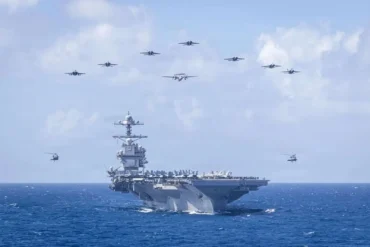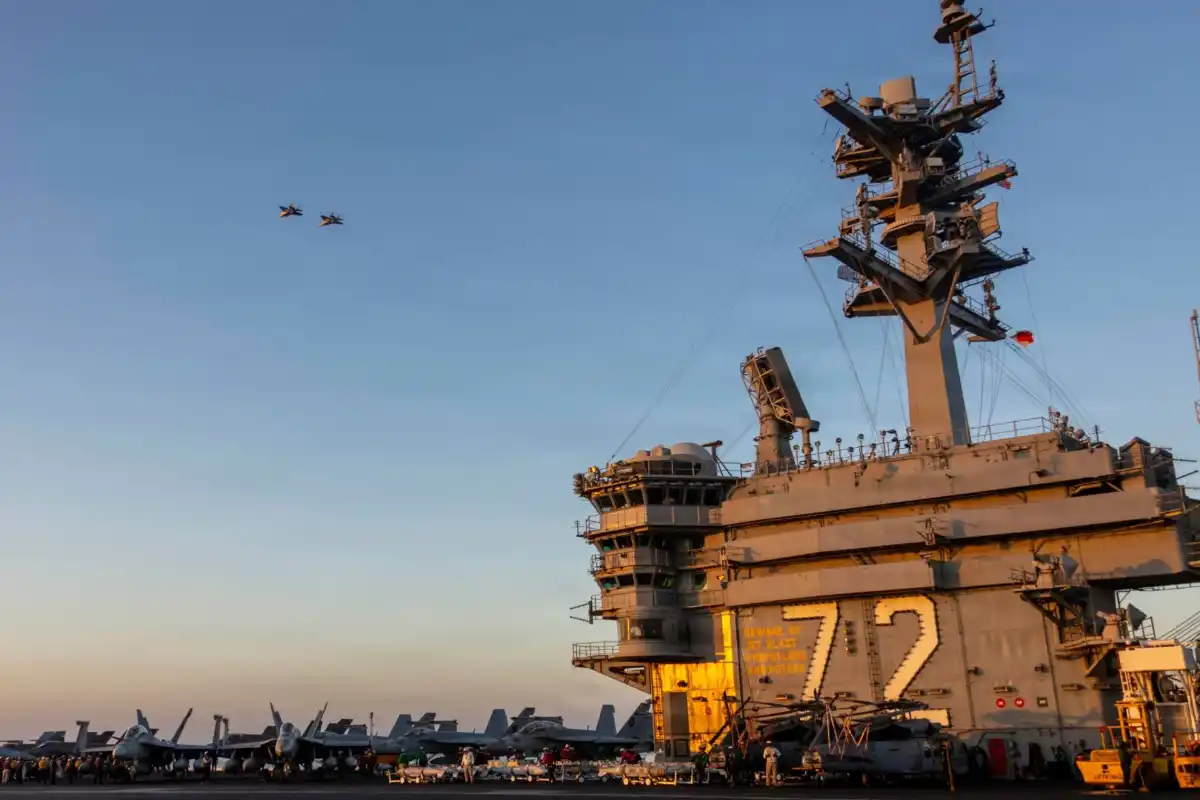
The United States has executed one of the most consequential naval force postures in recent years, deploying two nuclear-powered supercarriers into the U.S. Central Command theater as part of Operation Epic Fury. The decision to position both USS Abraham Lincoln (CVN-72) and a Gerald R. Ford-class aircraft carrier in the same operational zone signals a calculated escalation in maritime airpower projection amid intensifying strikes on Iranian military infrastructure.
At the center of this rare alignment is USS Abraham Lincoln (CVN-72), a combat-tested Nimitz-class carrier capable of sustained high-tempo operations. Operating alongside it is a carrier from the Gerald R. Ford-class aircraft carrier, the newest generation of U.S. naval aviation platforms. Together, they represent a fusion of legacy endurance and next-generation launch technology at a moment of acute regional volatility.
Strategic Weight of a Dual-Carrier Deployment
Dual-carrier deployments to the Middle East are uncommon by design. The U.S. Navy maintains a fleet of eleven nuclear-powered carriers, each cycling through deployment, maintenance, and readiness phases. Under normal conditions, a single carrier strike group maintains presence within the Fifth Fleet’s area of responsibility. Concentrating two large-deck carriers in one theater compresses global naval flexibility—but dramatically expands localized striking power.
This move comes as Operation Epic Fury targets Iranian ballistic missile infrastructure, drone launch networks, air defense systems, and command elements linked to the Islamic Revolutionary Guard Corps. Tehran’s retaliatory launches of ballistic missiles and unmanned aerial systems have heightened the risk of broader regional confrontation, making persistent air coverage and layered defense essential.
The deployment reflects not symbolism, but mathematics. Two supercarriers operating in coordinated cycles can generate well over 120 tactical sorties per day under high-intensity conditions. That translates into sustained strike waves, continuous combat air patrols, and electronic warfare coverage that rarely leaves adversaries breathing room.
Generational Contrast: Nimitz Endurance Meets Ford Innovation
The Nimitz-class carrier, displacing roughly 100,000 tons, relies on steam catapults to launch aircraft. Its design has proven resilient across decades of operations, from the Cold War to counterterrorism campaigns. USS Abraham Lincoln alone can embark more than 60 aircraft, including strike fighters, airborne early warning platforms, and rotary-wing assets.
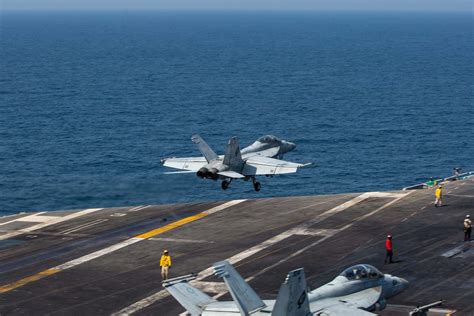
The Ford-class introduces transformative technologies. Its Electromagnetic Aircraft Launch System (EMALS) replaces steam catapults with linear induction motors, allowing smoother acceleration and reduced structural stress on aircraft. The Advanced Arresting Gear improves recovery efficiency, while redesigned flight deck layouts streamline aircraft handling. The class is engineered to produce up to 30 percent more sorties per day than its predecessor during surge operations.
When these two designs operate in concert, the advantages compound. The Nimitz platform provides battle-tested operational rhythm. The Ford-class injects higher sortie generation capacity and modernized sensor integration. The pairing functions less like duplication and more like force multiplication.
Air Wing Composition and Operational Depth
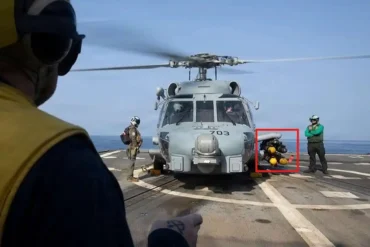
Each carrier strike group fields a composite air wing structured for multi-domain dominance. The backbone consists of F/A-18E/F Super Hornets conducting strike and air superiority missions, supported by EA-18G Growlers dedicated to electronic attack and radar suppression. E-2D Advanced Hawkeyes provide airborne command and control, extending sensor coverage far beyond the horizon. MH-60 helicopters execute anti-submarine warfare, search-and-rescue, and surface surveillance tasks.
Depending on configuration, F-35C Lightning II aircraft may augment the air wings, adding stealth penetration capability and sensor fusion that enhances targeting networks across the battlespace. The presence of two carriers enables parallel mission sets: one deck can prioritize deep inland strike packages while the other sustains maritime security patrols and defensive counter-air operations.
This layered architecture complicates adversary planning. Iranian anti-ship missile batteries, coastal radar systems, and drone swarms must account for distributed targets, overlapping air patrols, and electronic interference fields. The combined escorts—Aegis-equipped cruisers and destroyers—extend ballistic missile defense coverage across vital sea lanes, reinforcing deterrence while preserving operational freedom.
Industrial and Doctrinal Significance
Beyond immediate combat operations, this deployment carries institutional implications. Integrating a Ford-class carrier into sustained high-tempo combat validates the Navy’s investment in next-generation carrier architecture. Early debates about cost overruns and system reliability now confront operational reality: the Ford-class is executing alongside legacy platforms in live conflict conditions.
The Navy’s calculus is clear. Future maritime warfare demands higher sortie generation rates, reduced manpower burdens, and survivable command-and-control nodes. Deploying a Ford-class ship within Operation Epic Fury demonstrates confidence in its readiness under stress, not merely in peacetime presence missions.
For the Nimitz-class, the mission underscores continued relevance. Despite approaching the twilight decades of service life, these carriers remain formidable instruments of power projection. Their nuclear propulsion grants virtually unlimited range, constrained primarily by crew endurance and supply logistics rather than fuel.
Escalation Risks and Regional Impact
The concentration of two supercarriers amplifies deterrence but also underscores the fragility of regional stability. Iran’s missile and drone responses illustrate a willingness to challenge U.S. and allied assets indirectly, leveraging asymmetric tools to offset conventional inferiority. Every sortie launched from these decks reverberates beyond immediate tactical outcomes, shaping perceptions across Gulf states and global markets.
Operating two carriers within confined maritime corridors requires meticulous coordination. Deconfliction of flight paths, escort positioning, and logistics flows must be synchronized to avoid operational friction. Yet the very visibility of this posture sends a calculated signal: the United States retains the capacity to surge overwhelming naval airpower on short notice.
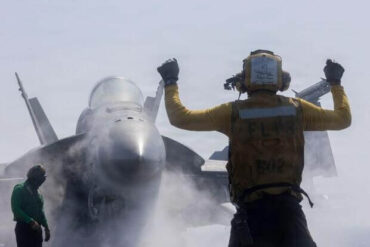
Operation Epic Fury thus becomes more than a campaign of targeted strikes. It is a demonstration of industrial scale, technological evolution, and doctrinal integration. The image of USS Abraham Lincoln’s steam catapults firing in cadence alongside the electromagnetic launches of a Ford-class carrier encapsulates a transitional moment in naval aviation.
As the operation unfolds, the dual-carrier deployment stands as a rare but deliberate assertion of maritime supremacy. Legacy steel and digital-age circuitry share the same contested waters, projecting sustained multi-domain force from the sea. In an era defined by missile proliferation and drone warfare, the flight decks of two American supercarriers remain among the most concentrated instruments of airpower on Earth.