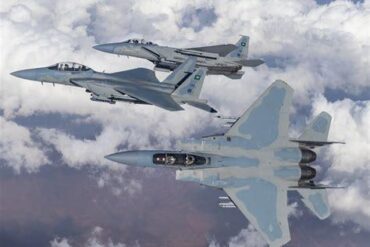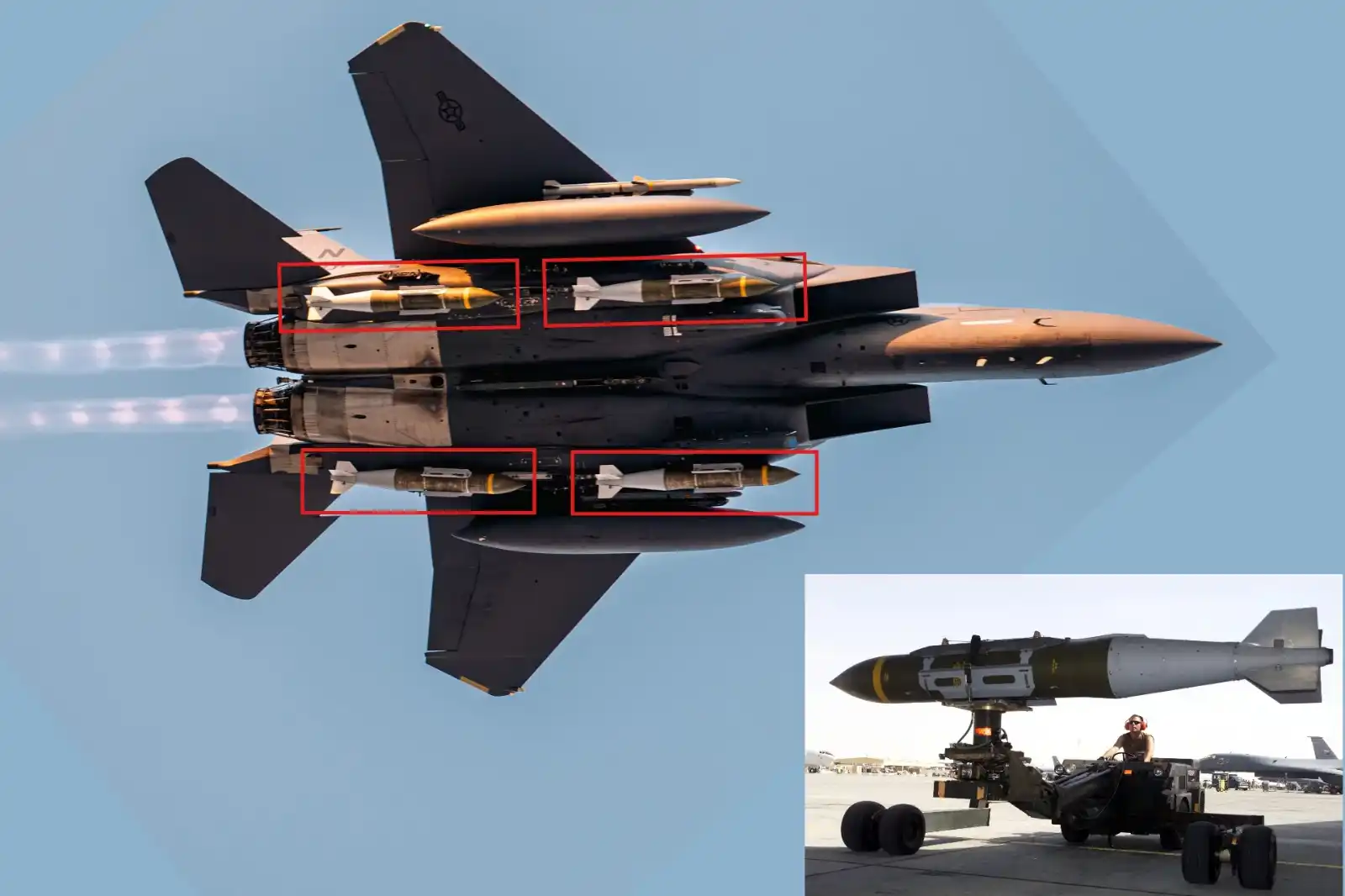
The unfolding air campaign known as Operation Epic Fury has revealed a dramatic escalation in the application of American airpower against hardened Iranian military infrastructure. Images released by U.S. Central Command (CENTCOM) on March 5, 2026 show U.S. Air Force F-15E Strike Eagle fighters flying combat sorties over Iran armed with four GBU-31(V)3/B bunker-buster bombs, a configuration specifically designed to destroy fortified targets buried deep beneath reinforced concrete and earth.
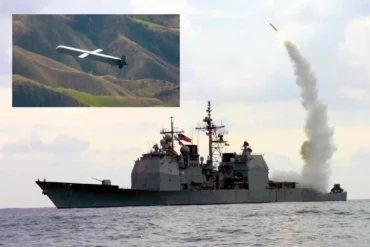
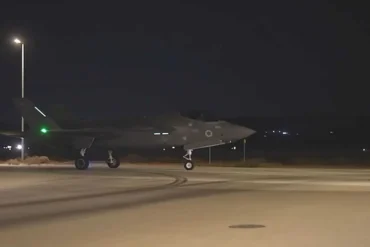
This visual confirmation marks a clear shift in the operational phase of the conflict. Early stages of the campaign relied heavily on long-range cruise missiles and stealth bomber strikes to degrade Iran’s integrated air defense network. As those systems were suppressed and localized air superiority was established by U.S. and Israeli forces, tactical aircraft such as the F-15E have moved deeper into Iranian airspace to conduct sustained precision strikes against strategic military facilities.
The presence of multiple heavy bunker-penetrating bombs on each aircraft signals an unmistakable objective: the systematic destruction of Iran’s underground command centers, missile storage bunkers, and hardened military installations that have long served as the backbone of the country’s strategic deterrent posture.
The Strategic Shift Toward Deep-Strike Operations
Operation Epic Fury has evolved into a high-tempo aerial campaign characterized by continuous sorties, coordinated intelligence gathering, and precision targeting. According to official statements from U.S. Central Command, American and Israeli aircraft are now conducting a wide spectrum of missions that include deep interdiction strikes, suppression of enemy air defenses (SEAD), command-and-control targeting, and leadership disruption operations across Iran’s military infrastructure.
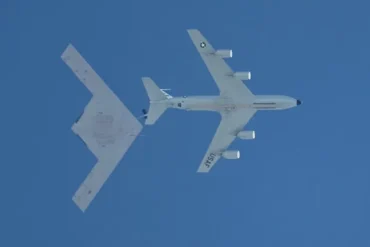
During the initial hours of the conflict, stealth assets such as B-2 Spirit bombers and long-range cruise missiles played a central role in degrading Iranian radar systems, early warning networks, and surface-to-air missile batteries. Once these critical defensive layers were weakened, the operational focus shifted toward tactical aircraft capable of delivering large volumes of precision munitions.
In this environment, the F-15E Strike Eagle has emerged as one of the most valuable platforms in the campaign. Designed for long-range interdiction and heavy payload delivery, the aircraft can penetrate contested airspace while carrying massive bomb loads. Operating from regional bases and supported by aerial refueling tankers, these fighters rotate through persistent strike cycles targeting strategic facilities across Iranian territory.
Their missions typically involve coordination with space-based intelligence systems, reconnaissance drones, and electronic surveillance aircraft such as the RC-135 Rivet Joint. This networked battlespace allows strike crews to update target coordinates in real time, ensuring that bunker-buster weapons hit precisely the intended aim points.
Understanding the GBU-31 JDAM Bunker-Buster
At the center of the F-15E’s devastating strike capability lies the GBU-31 Joint Direct Attack Munition (JDAM), a weapon system that transforms conventional gravity bombs into precision-guided munitions.
The JDAM is not a bomb itself but rather a sophisticated guidance kit attached to standard bomb bodies. The system incorporates a GPS-aided inertial navigation system (INS) housed within a tail assembly equipped with movable control fins. Once released from an aircraft, the weapon autonomously guides itself to a set of pre-programmed coordinates.
Under optimal satellite conditions, the JDAM system achieves a circular error probable (CEP) of roughly five meters, making it one of the most accurate air-delivered weapons in modern military arsenals. This accuracy allows aircraft to strike targets through heavy clouds, smoke, or darkness, conditions that often limit laser-guided weapons.
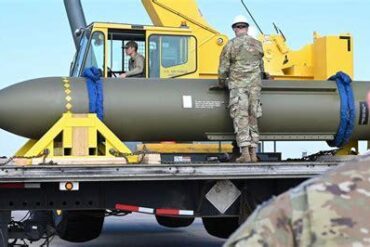
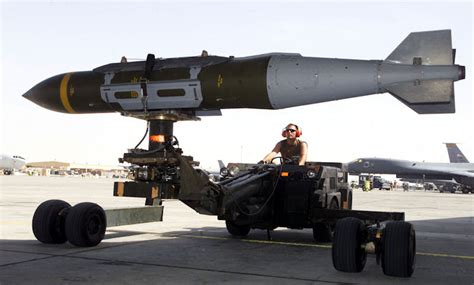
In the case of the GBU-31(V)3/B, the guidance kit is attached to the BLU-109 hard-target penetrator, a formidable 2,000-pound bomb specifically engineered to destroy fortified structures.
BLU-109: The Weapon Built to Crush Concrete
The BLU-109 penetrator is designed for a singular purpose: defeating hardened targets that standard bombs cannot destroy. Unlike general-purpose explosives, the BLU-109 uses a thick forged steel casing that enables it to punch through layers of reinforced concrete before detonating.
Inside this casing lies approximately 550 pounds of high explosive, triggered by a delayed-action fuze that allows the bomb to penetrate structures before exploding. Under typical impact conditions, the weapon can pierce between 1.2 and nearly 2 meters of reinforced concrete, depending on release altitude and velocity.
This capability makes the GBU-31 particularly effective against a wide range of strategic facilities, including:
- Underground command bunkers
- Hardened aircraft shelters
- Missile storage vaults
- Ballistic missile launch infrastructure
- Tunnel entrances connected to subterranean complexes
For decades, Iran has invested heavily in building such fortified structures, often burying critical facilities deep beneath mountains or reinforced bunkers. The deployment of BLU-109-equipped JDAMs represents a direct countermeasure to this defensive strategy.
Why the F-15E Strike Eagle Is the Perfect Platform
The F-15E Strike Eagle was originally developed during the Cold War to penetrate heavily defended Soviet airspace and strike strategic targets far behind enemy lines. Its design emphasizes payload capacity, range, and survivability, qualities that remain crucial in modern combat operations.
One of the aircraft’s defining characteristics is its ability to carry more than 23,000 pounds of external ordnance, allowing it to transport multiple heavy bombs in a single mission. The configuration revealed in the CENTCOM images shows a particularly powerful strike package: four 2,000-pound bunker-busters mounted beneath the wings.
With each bomb capable of striking a different target, a single aircraft can simultaneously attack multiple hardened structures during a single sortie. Alternatively, crews can release pairs of bombs against especially fortified facilities, maximizing the probability of destroying deeply buried targets.
The Strike Eagle’s advanced avionics further enhance its effectiveness. Equipped with the AN/APG-70 or upgraded APG-82 radar, the aircraft possesses terrain-following capabilities that allow it to fly low-altitude routes while avoiding detection. Combined with conformal fuel tanks that extend operational range without sacrificing weapon stations, the F-15E can conduct long-distance strike missions without requiring dedicated escort fighters.
JDAM Glide Range and Tactical Flexibility
Another advantage of JDAM-equipped weapons is their ability to glide significant distances after release, allowing aircraft to strike targets while remaining outside the most dangerous segments of enemy air defense zones.
When dropped from high altitude, standard JDAM configurations can reach targets up to roughly 15 miles away. Some variants equipped with extended-range wing kits can travel 40 to 45 miles or more, depending on altitude and bomb weight.
This extended reach complicates defensive planning for Iranian forces. Radar operators may detect incoming aircraft but cannot immediately determine which specific target will be struck or when the weapon will be released. Pilots can launch bombs from unexpected angles, reducing reaction time for air defense crews and personnel inside targeted facilities.
These tactics create a layered challenge for defenders: they must detect the aircraft, identify the intended target, and intercept the weapon itself—all within a narrow time window measured in seconds.
Self-Escorting Strike Capability With AIM-120 AMRAAM
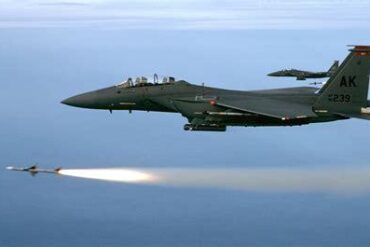
Even while carrying massive bunker-buster payloads, the Strike Eagle retains the ability to defend itself in aerial combat. The aircraft seen in the CENTCOM imagery carried an AIM-120 Advanced Medium-Range Air-to-Air Missile (AMRAAM) alongside its bomb load.
The AIM-120 is one of the most advanced beyond-visual-range air combat missiles in service today. It uses a combination of inertial navigation, datalink updates, and an active radar seeker to track and destroy hostile aircraft.
Later variants of the missile possess engagement ranges exceeding 40 to 100 nautical miles, depending on launch conditions. With speeds approaching Mach 4, the missile allows the F-15E to engage enemy fighters or drones while still focusing on its strike mission.
Data from AWACS airborne early warning aircraft and Link-16 tactical data networks can provide targeting information long before hostile aircraft approach visual range. This capability enables the Strike Eagle to operate as a self-escorting strike platform, reducing the need for separate fighter protection.
The Networked Battlespace Over Iran
Modern air warfare rarely involves isolated aircraft operating independently. Instead, missions are conducted within a complex network of sensors, intelligence systems, and communication links that provide constant updates on battlefield conditions.
During Operation Epic Fury, U.S. strike aircraft are believed to be supported by:
- Satellite reconnaissance systems providing strategic imagery
- High-altitude drones conducting persistent surveillance
- Electronic intelligence aircraft monitoring radar emissions
- Airborne early warning platforms coordinating aerial operations
This integrated system allows target coordinates to be refined minutes before weapon release. For bunker-buster strikes, this level of precision is critical, as underground facilities often have limited access points such as ventilation shafts or tunnel entrances that must be struck accurately to neutralize the entire complex.
Crushing Iran’s Hardened Military Infrastructure
Iran has long relied on deeply buried facilities to protect key components of its military and strategic programs. Many of these sites were constructed specifically to survive conventional airstrikes, featuring thick concrete ceilings, blast doors, and extensive tunnel networks.
The deployment of GBU-31 bunker-buster weapons directly challenges this strategy. With accurate GPS guidance and powerful penetrator warheads, these bombs can destroy structures previously considered safe from air attack.
Targets believed to be under threat include:
- Ballistic missile storage tunnels
- Islamic Revolutionary Guard Corps (IRGC) command centers
- Underground drone launch facilities
- Strategic communications bunkers
- Weapons development infrastructure
By systematically striking these facilities, coalition forces aim to disrupt Iran’s ability to coordinate military operations and sustain regional proxy activities.
Strategic Significance for the Middle East
The imagery of an F-15E carrying four massive bunker-buster bombs sends a powerful signal across the region. It demonstrates that the United States possesses both the technological capability and operational willingness to destroy hardened military assets once thought secure beneath layers of concrete and rock.
For regional allies in the Gulf Cooperation Council, Europe, and the Indo-Pacific, the campaign highlights the continuing relevance of U.S. airpower as a strategic deterrent force. The ability to strike deep into fortified territory without resorting to nuclear weapons offers policymakers a potent tool for addressing emerging threats.
From a military perspective, Operation Epic Fury showcases a modern doctrine built on precision, intelligence integration, and sustained strike operations rather than sheer volume of bombs. Aircraft such as the F-15E can conduct multiple sorties per day, each delivering targeted strikes against carefully selected objectives.
Precision, Depth, and Air Dominance
The image of an F-15E Strike Eagle carrying four BLU-109 bunker-buster bombs encapsulates the essence of contemporary American air warfare. Precision guidance systems allow individual bombs to strike within meters of their intended coordinates, while heavy penetrator warheads ensure that even deeply buried facilities remain vulnerable.
Combined with advanced sensors, electronic warfare support, and real-time intelligence networks, these aircraft can methodically dismantle hardened infrastructure that once provided strategic protection.
Operation Epic Fury therefore represents more than a series of airstrikes. It illustrates how precision weapons, advanced aircraft, and integrated intelligence systems can reshape the battlefield, allowing modern air forces to penetrate defenses and neutralize critical targets with unprecedented efficiency.
As long as Strike Eagles armed with bunker-buster JDAMs continue to patrol Iranian skies, the message remains unmistakable: no underground sanctuary can guarantee protection from modern precision airpower.