Russia’s recent claim to have forward-deployed its nuclear-capable Oreshnik ballistic missile system to Belarus has stirred alarm across Eastern Europe and NATO, raising strategic and diplomatic stakes at the close of 2025. The announcement, made by the Russian Ministry of Defence on December 30, has drawn significant scrutiny from military analysts and open-source intelligence communities, many of whom question the credibility of Moscow’s narrative.
Russia’s Announcement and Visual Evidence
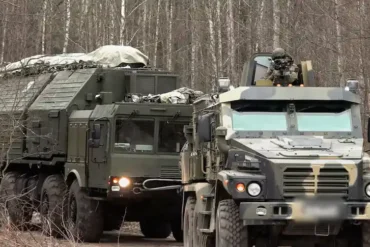
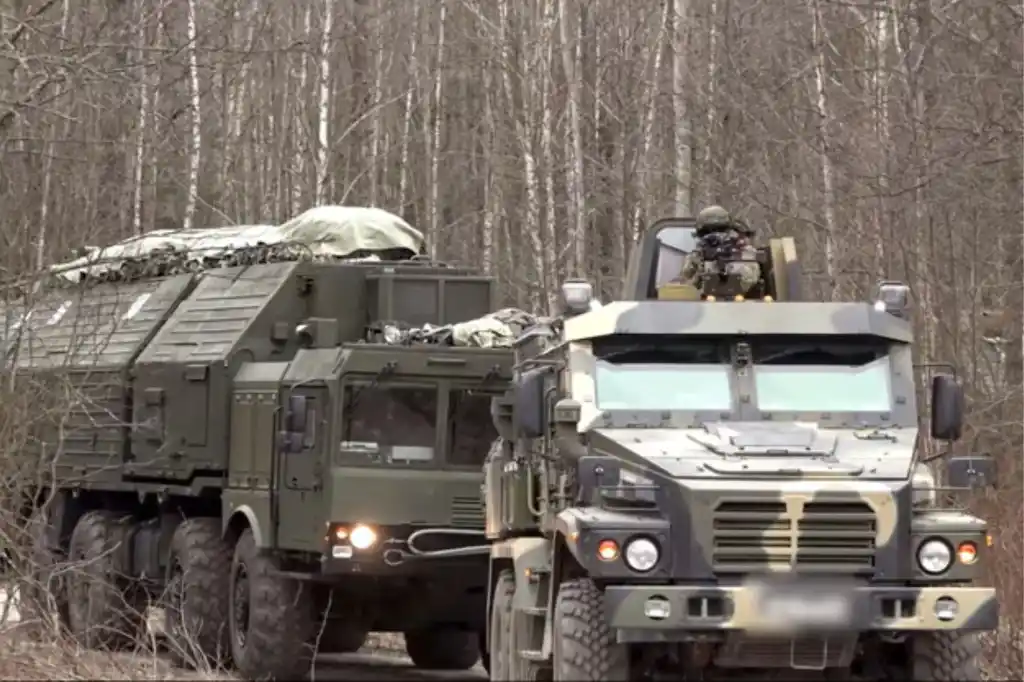
The Ministry released a state-produced video showing military vehicles navigating snow-laden Belarusian forest roads, camouflage nets being deployed, and Russian officers declaring the Oreshnik system to be on “combat alert.” However, conspicuously absent from the footage was the actual Transporter-Erector-Launcher (TEL) that would carry and launch the Oreshnik missile. The video only depicted three auxiliary vehicles: an armored vehicle derived from the Ural-63095 Typhoon, a command post vehicle, and a communications support truck.
According to defense observers, these support vehicles resemble those used in the RS-24 Yars strategic missile system, indicating a continuity in platform design. However, the modest number of troops—estimated at around 70—also falls short of the personnel required for a fully functional missile unit.
Understanding the Oreshnik Ballistic Missile System
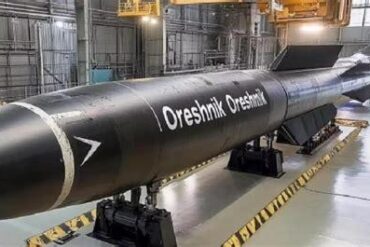
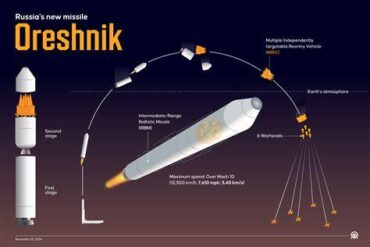
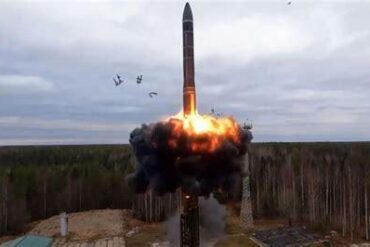
The Oreshnik missile represents a modern, mobile, medium-to-intermediate range ballistic missile (MRBM/IRBM) platform. It is derived from the RS-24 Yars and RS-26 Rubezh programs, suggesting a lineage of advanced solid-fuel, road-mobile strategic weapons. Technically, Oreshnik is a two-stage, solid-fueled missile, designed to launch from rugged terrain with high survivability and mobility.
Its range is estimated to be between 3,000 and 5,500 kilometers, giving it the capacity to strike deep into Western Europe. It reportedly travels at terminal speeds exceeding Mach 10, making it a formidable challenge for even the most advanced missile defense systems.
In terms of payload, Oreshnik is capable of carrying up to six MIRV (Multiple Independently targetable Reentry Vehicle) warheads, with options for low- to medium-yield nuclear payloads, or conventional submunition warheads intended to destroy large-area military targets such as airfields or logistics hubs. This versatility allows the system to function in both nuclear deterrence and conventional escalation scenarios.
First Combat Observation and Operational Signals
The Oreshnik system was first observed in a combat scenario during a strike on Dnipro, Ukraine, on November 21, 2024. Analysts believe that this operation may have served as a real-world operational test, likely utilizing inert or non-lethal warheads to validate missile trajectory, accuracy, and deployment protocols.
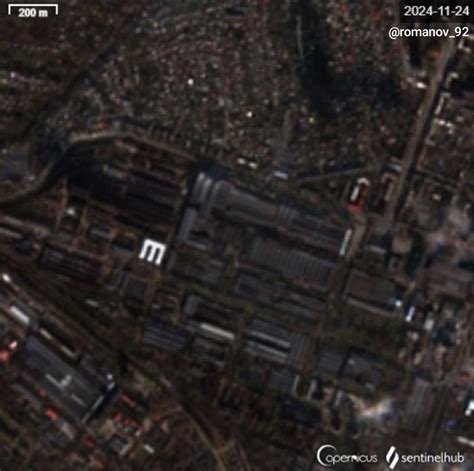
The strike offered a glimpse into Oreshnik’s rapid deployment capabilities. With the system’s road mobility and autonomous command nodes, Russia can reposition it quickly across a range of terrain, making it difficult to track or neutralize. This enhances its value not just as a warfighting tool, but as a strategic signaling instrument.
Belarus Deployment: Provocation or Posturing?
Russia’s declaration of deploying Oreshnik in Belarus coincides with a sharp escalation in rhetoric between Moscow and NATO. With Western support for Ukraine increasing in 2025, including expanded military aid and intelligence sharing, the Kremlin appears intent on leveraging the Belarusian theater as a platform for strategic posturing.
Belarusian President Alexander Lukashenko, long seen as a loyal Kremlin ally, endorsed the deployment as a counterweight to perceived NATO encroachment. He previously indicated that up to twelve Oreshnik systems could be stationed on Belarusian soil, further integrating his military posture with Moscow’s.
Despite these declarations, the lack of visual confirmation of actual missile launchers on Belarusian soil suggests that this may be more of an informational operation than an operational deployment. Analysts propose that the footage may serve to test Western reactions, influence regional military planning, and deter deeper NATO engagement in Eastern Europe.
Strategic Implications for NATO and Regional Security
Should the deployment prove real, it would mark a significant shift in the strategic landscape of Eastern Europe. The presence of nuclear-capable MRBMs just a few hundred kilometers from Poland, Lithuania, and Latvia forces NATO to reevaluate its eastern flank posture, particularly in terms of early warning systems, missile defenses, and forward deployments.
Such a deployment would also represent a violation of the post-INF Treaty balance, which although defunct since 2019, has continued to inform European arms control norms. With the Oreshnik outside of any formal arms control regime, its deployment would symbolize the continuing unraveling of Cold War-era strategic frameworks.

This plays into Russia’s broader strategy of nuclear ambiguity and strategic unpredictability. By deploying or merely claiming deployment of such systems, Russia leverages uncertainty to influence NATO’s force planning, potentially deterring reinforcements to Ukraine or preempting missile defense improvements near Russia’s borders.
Expert Reactions and Intelligence Assessments
Several Ukrainian and NATO-aligned analysts have publicly questioned the veracity of Russia’s announcement. The lack of identifiable TELs in the video, the absence of logistical scale typically required for deployment, and the general tone of the release suggest that this may be a case of strategic misdirection.
Additionally, open-source intelligence groups like Conflict Intelligence Team (CIT) and OSINTdefender noted that the footage lacks key indicators—such as loading cranes, maintenance trailers, or secure missile storage units—that would accompany a live missile system.
Nevertheless, these same analysts caution against dismissing the claim entirely. Russia has historically used deceptive deployments as precursors to real operations, particularly in hybrid warfare contexts. This ambiguous signaling allows it to maintain strategic pressure without immediate escalation, a hallmark of its regional doctrine.
Belarus’ Role in Russia’s Military Doctrine
Belarus’s growing role as a staging ground for Russian forces is not new. Since the invasion of Ukraine in 2022, it has served as a launchpad for multiple operations. The country’s railways, roads, and military airfields have been used for troop deployments, weapons transfers, and drone operations.
The inclusion of nuclear-capable systems like Oreshnik into this integrated architecture reinforces the notion that Belarus is no longer a buffer state, but rather a forward-operating zone for Russian strategic assets. This development may catalyze stronger NATO deployments in the Suwałki Gap and increased surveillance on Belarusian territory.
The Future of Arms Control in Europe
The Oreshnik case also underscores the absence of a functioning arms control framework governing intermediate-range missiles in Europe. With both the INF Treaty and New START either defunct or strained, there is little oversight or verification preventing regional deployment of strategic missile systems.
The reintroduction of such weapons, particularly without transparency, introduces destabilizing variables into an already fragile European security environment. It increases the likelihood of miscalculation, shortens decision-making timelines during crises, and raises the pressure on NATO to deploy reciprocal systems.
Conclusion: Symbolic Move or Strategic Shift?
Whether real or performative, Russia’s claim to have deployed the Oreshnik missile system in Belarus is a potent reminder of the geostrategic volatility facing Europe in 2026. Even without a confirmed presence of nuclear launchers, the mere suggestion compels adversaries to alter their military calculations, drain resources into readiness measures, and reassess threat matrices.
For Russia, the value lies in the signal, not necessarily the substance. It leverages uncertainty as a weapon, knowing that in the arena of nuclear brinkmanship, ambiguity is often more powerful than action. As NATO weighs its options and Ukraine pushes for continued support, the Oreshnik specter may become a new fixture in the evolving post-INF European battlefield.