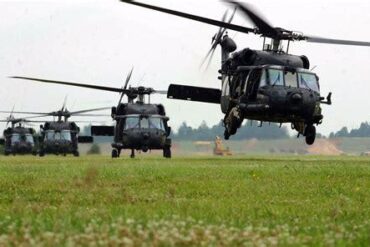
U.S. Army aviation crews from the 2nd Combat Aviation Brigade executed high-intensity combined day and night air assault training with the Republic of Korea (ROK) Army near Seoul on February 5, 2026, reinforcing the alliance’s rapid-response posture on the Korean Peninsula. Operating out of Sungnam (Seoul Air Base), the drills were designed to rehearse the rapid projection of combat power under conditions where warning time could shrink to minutes. In a theater defined by mountainous terrain, dense urban corridors, and one of the world’s most heavily militarized borders, speed and coordination are not theoretical advantages—they are decisive ones.
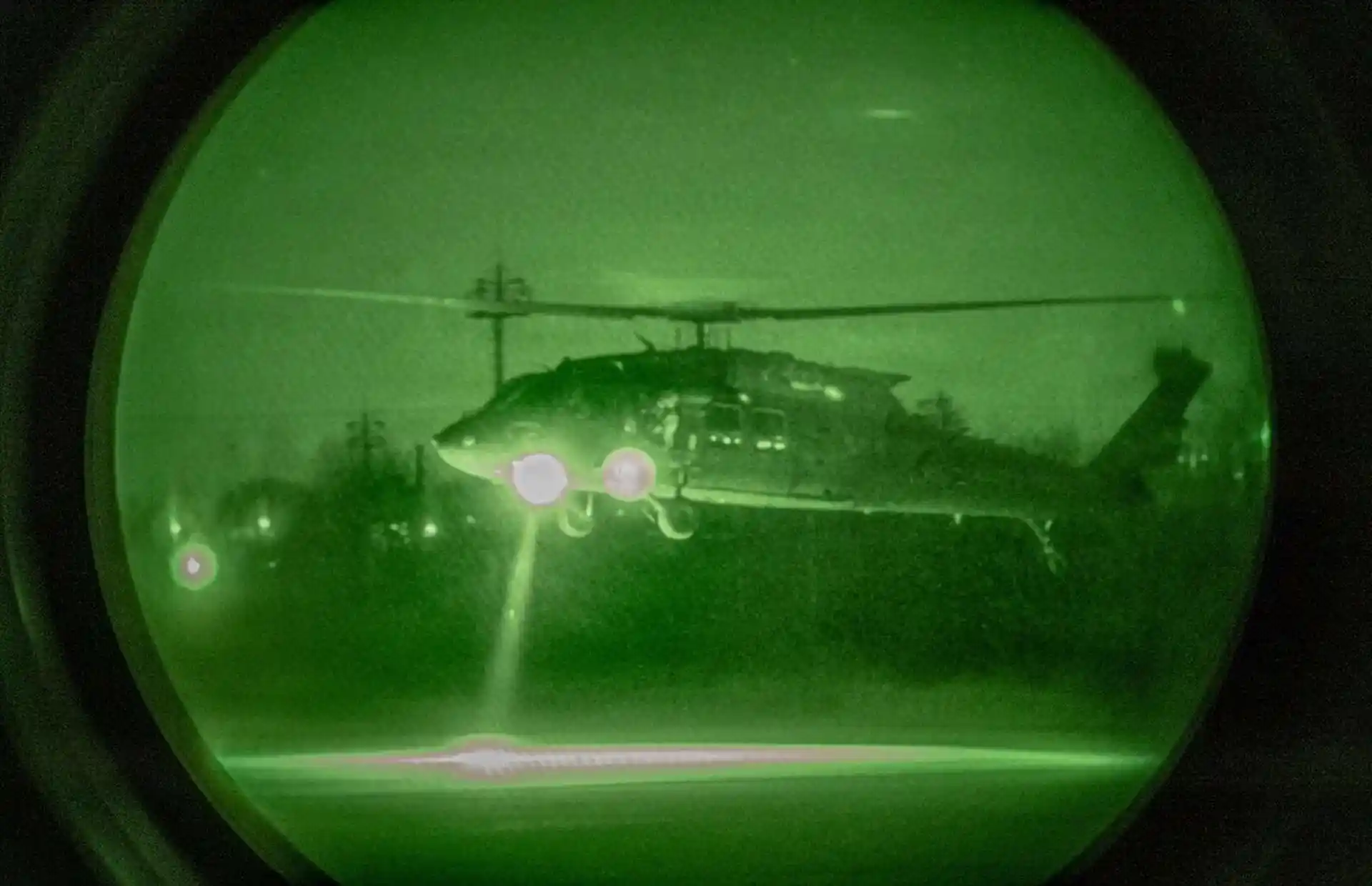
The exercise centered on complex air assault scenarios that demanded precision flying, disciplined communications, and tightly synchronized ground coordination. Combined crews practiced inserting troops into confined landing zones carved from steep terrain and urban edges, simulating the kind of high-friction environment that would characterize early-phase operations in a contingency. Darkness added another layer of complexity, compressing decision-making timelines and magnifying the consequences of error.
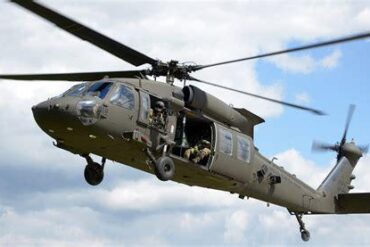
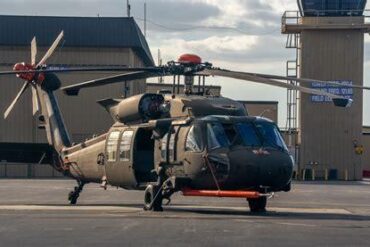
The aircraft at the core of these drills was the UH-60 Black Hawk, the U.S. Army’s primary assault utility helicopter and a long-standing pillar of allied air mobility operations in Korea. Increasingly fielded in the UH-60M configuration, the platform brings upgraded digital avionics, improved flight management systems, and enhanced engines that provide greater lift performance in demanding “hot-and-high” conditions. For crews navigating narrow valleys and tight landing zones at night, that extra margin translates directly into survivability and mission success.
A standard Black Hawk assault configuration enables the transport of an 11-soldier infantry squad, fully equipped, in addition to the flight crew. The aircraft can also carry substantial internal cargo or sling external loads approaching the 9,000-pound class depending on configuration and environmental conditions. That flexibility allows commanders to move troops, ammunition, water, or light vehicles rapidly across terrain where road networks may be vulnerable to interdiction or congestion.
Night Air Assault Operations on the Korean Peninsula
Night air assault is not a simple extension of daytime aviation. It is a compressed, multi-domain operation executed in minutes. Crews must navigate using terrain masking to reduce exposure to radar and surface threats, maintain disciplined formation flying under night vision goggles, and coordinate precise landing zone control with ground elements already under pressure. In a conflict scenario on the peninsula, adversary artillery, electronic warfare, and unmanned aerial systems could all converge on a landing site within moments of detection.
The drills near Seoul simulated that urgency. Pilots rehearsed low-level ingress routes designed to avoid known threat corridors while ground forces practiced rapid offload procedures and perimeter security. The choreography is deliberate: touchdown, disembarkation, perimeter establishment, and immediate departure. Lingering invites risk. The Black Hawk’s design—its responsive rotor system, robust landing gear, and adaptable cabin layout—supports these violent transitions from forward flight to hover to immediate extraction.
Defensive measures are layered rather than singular. Door-mounted 7.62 mm machine guns provide baseline protection, but survivability depends more heavily on tactics, emission control, and time-on-target discipline. In a dense threat environment, minimizing signature and exposure is often more effective than relying on firepower alone.
2nd Combat Aviation Brigade’s Forward Mission
For the 2nd Battalion, 2nd Aviation Regiment, night air assault is not an abstract training event but a core wartime requirement. Stationed forward in South Korea, the unit’s mission is to transition rapidly from deterrence to active combat operations in support of the 2nd Infantry Division and the ROK-U.S. Combined Forces Command. That mission includes air assault insertion, aerial resupply, casualty evacuation, and general support aviation for maneuver forces operating across dispersed and contested terrain.
The Korean Peninsula’s geography amplifies the importance of rotary-wing mobility. Mountain ranges bisect lines of advance, urban sprawl constrains ground maneuver, and infrastructure nodes become immediate targets in any high-end conflict. Under such conditions, helicopters provide operational elasticity—moving forces laterally, reinforcing threatened sectors, or extracting isolated units faster than ground transport could manage.
The brigade’s routine integration with ROK Army units ensures that combined tactics are practiced continuously rather than improvised during crisis. Shared landing zone marking procedures, standardized communications protocols, and coordinated airspace deconfliction reduce friction when tempo accelerates. Interoperability is measured not in joint press releases but in how seamlessly multinational crews execute under stress.
The Strategic Role of the ROK-U.S. Combined Division
The 2nd Infantry Division/ROK-U.S. Combined Division represents a structural commitment to integrated defense. Activated in 2015 with the partnership of the ROK 16th Mechanized Brigade, the combined division embeds South Korean and American units into a unified command architecture. The intent is clear: combined operations should be the default setting, not an exception triggered by crisis.
In a contingency, aviation assets like the Black Hawk would serve as connective tissue between dispersed maneuver elements. Rapid insertion of infantry into key terrain, reinforcement of defensive lines, and logistical sustainment under fire would all depend on coordinated air mobility. By rehearsing these missions under both daylight and night conditions, alliance forces reduce uncertainty and reinforce deterrence.
The political signal is equally significant. High-visibility combined drills near Seoul communicate readiness without escalation. They demonstrate that the alliance retains the ability to surge combat power quickly and cohesively, complicating any adversary’s calculus about exploiting surprise or compressed timelines.
Modernization and Enduring Relevance of the UH-60M
While future vertical lift programs continue to evolve, the UH-60M Black Hawk remains the backbone of U.S. Army air assault capability. Modernized cockpit displays, digital navigation systems, and improved propulsion ensure the aircraft can operate effectively in complex terrain and degraded visual environments. Sustainment investments and incremental upgrades extend its service life while preserving operational reliability.
In Korea, reliability is strategic. Aircraft must launch on short notice, operate in unpredictable weather, and perform repeated sorties under high operational tempo. The Black Hawk’s proven design and global logistics network support that demand. Its adaptability across roles—from assault insertion to medical evacuation—makes it indispensable in both peacetime training and potential combat scenarios.
The February 5 drills underscored a fundamental reality: on the Korean Peninsula, readiness is measured in minutes, not days. Combined night air assault training sharpens the alliance’s ability to respond at that speed. By integrating aviation, ground maneuver, and joint command structures in realistic conditions, U.S. and ROK forces strengthen both deterrence and operational credibility.