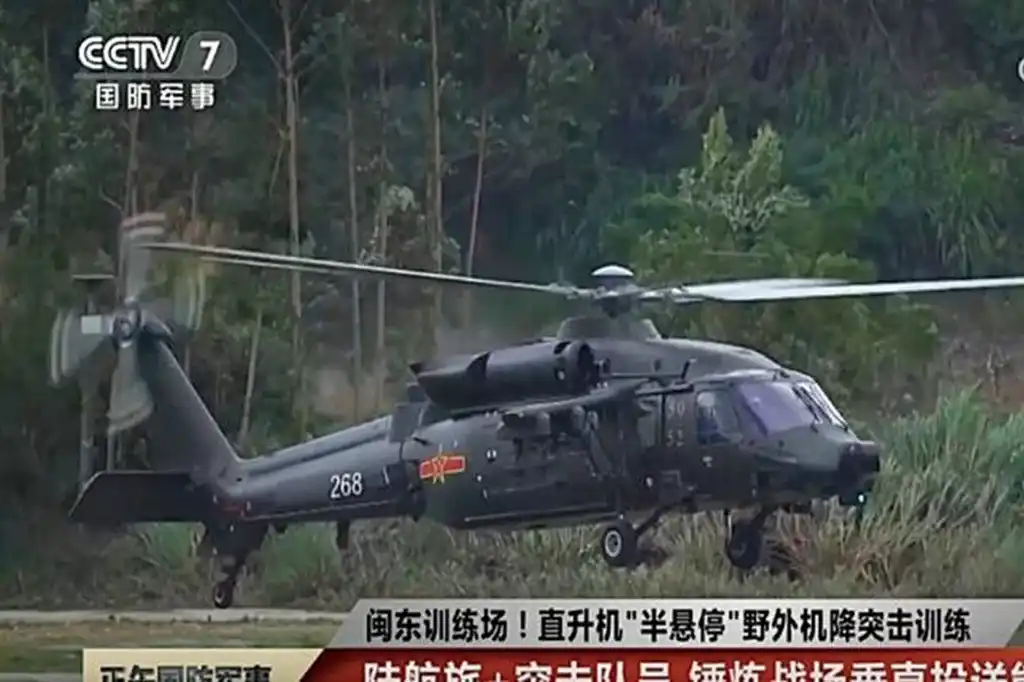
China’s unveiling of the Z-20T Assault Eagle in its first publicly reported air-assault drill near Taiwan marks a decisive step in the country’s bid to develop a fast, flexible, and heavily armed vertical envelopment capability. Conducted on November 24, 2025, by an army aviation brigade of the 71st Group Army in eastern Fujian, the operation was not a symbolic demonstration but a deliberate exhibition of tactics designed for contested airspace just across the Taiwan Strait.
The drill took place near Taiwan-facing approaches, underscoring Beijing’s focus on creating the kind of air-assault proficiency required for rapid penetration, swift insertion, and high-tempo maneuver in tight, urban and mountainous environments. State broadcaster CCTV showcased scenes of Z-20T helicopters flying at ultra-low altitude, performing semi-hover insertions, and deploying assault troops under “real battlefield” conditions—imagery crafted to signal operational readiness, not experimentation.
At its core was the Z-20T itself, a platform that blends transport capacity with close air support in a single 10-ton-class airframe. The helicopter is a militarized descendant of the standard Z-20 but equipped with stub wings, hardpoints, upgraded defensive suites, and compatibility with anti-armor weapons such as the AKD-10. These enhancements allow it to both deliver troops and provide suppressive fire, a pairing that represents a major departure from China’s older rotary-wing doctrine.
Z-20T: China’s First Indigenous Assault Helicopter Reaches Operational Maturity
The Z-20T emerges from a broader modernization arc that began when Western arms embargoes forced China to pivot toward indigenous helicopter development. The baseline Z-20—similar in size and mission to the U.S. UH-60 Black Hawk—entered service in the late 2010s. Its evolution into the Z-20T assault variant unfolded with unusual speed: showcased at the September V-Day parade, flown publicly at the Tianjin helicopter expo weeks later, and now inserted directly into frontline tactical drills.
This rapid transition from debut to deployment suggests that the Z-20T has achieved technical maturity and that meaningful production is underway. Analysts in Chinese state media highlighted that these frequent appearances indicate a platform already being distributed across multiple army aviation brigades. China appears to be following a fast-track model similar in spirit to the U.S. expansion of the MH-60 series—though with far tighter timelines.
A New Tactical Playbook: Semi-Hover Single-Wheel Landings and Vertical Envelopment
One of the drill’s defining moments was the demonstration of the single-wheel landing technique, a semi-hover maneuver used when terrain prevents a full landing. By touching down with only one wheel while keeping the rotor loaded, the Z-20T can deploy troops in urban alleyways, cliffside terraces, forested patches, or island ridgelines where traditional helicopters cannot safely land.
The tactical advantages are clear: reduced exposure time, minimized landing zone requirements, and immediate low-altitude departure. Combined with sea-skimming ingress and terrain-following flight through ravines and coastal valleys, this technique signals a doctrinal embrace of vertical maneuver warfare tailored for Taiwan’s topography.
The Z-20T stands in contrast to legacy Z-8 and Z-9 helicopters, which traditionally separated troop transport and fire support functions across multiple airframes. Now, China can insert a squad and cover its breakout from the same helicopter package—dramatically increasing sortie efficiency and tactical density.
Strategic Implications for Taiwan, the South China Sea, and the Indian Border
The ripple effects of this development extend well beyond the Fujian coastline. In a Taiwan Strait crisis, mixed formations of Z-20 and Z-20T helicopters could attempt rapid insertions behind beachheads or seize vital intersections before Taiwanese or U.S. forces could respond. This capability would also reduce China’s reliance on airfields, which remain high-priority targets for Taiwan’s long-range munitions.
In the South China Sea, Z-20T-equipped detachments could shuttle troops between reefs, reinforce forward outposts, or conduct sudden raids on contested features—without waiting for large amphibious groups. The same helicopter family also supports operations at high altitude, strengthening China’s posture along the India border, where mobility is limited and reinforcement time is crucial.
The arrival of an armed, air-assault-optimized Z-20T alters regional planning assumptions. Governments across the Indo-Pacific must now factor in a PLA capable of rapidly inserting ground forces deep into contested regions, supported by organic firepower and protected by terrain-masking flight profiles.
A Turning Point in China’s Vertical Lift Doctrine
The November 24 exercise represents more than another training clip on Chinese state television. It signals the integration of a domestically produced, Black Hawk-class helicopter into realistic assault scenarios that mirror potential combat missions. The Z-20T is not a prototype, nor a showpiece. It is a combat asset being woven into the PLA’s playbook of joint, fast-moving, multidomain operations.
For military planners, defense analysts, and regional governments, the significance is unmistakable: rotary-wing modernization has become central to China’s operational thinking. As Beijing sharpens its vertical envelopment doctrine, the region enters a new phase in which air assault—once a secondary consideration in assessments of Chinese power—now sits near the forefront of Indo-Pacific security planning.