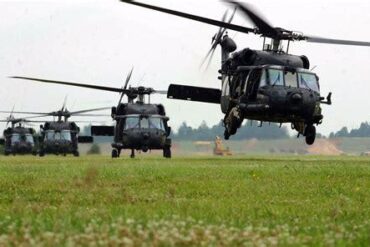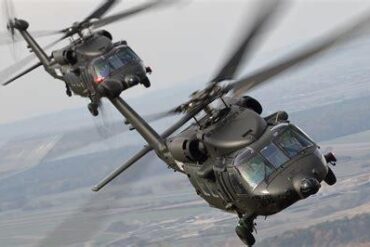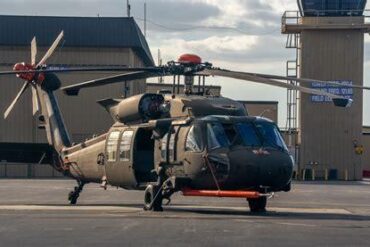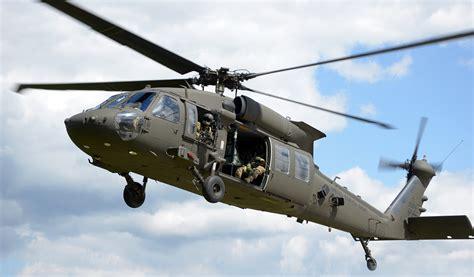
The Black Hawk helicopter, officially designated as the UH-60, has become a symbol of American air mobility and battlefield dominance since its introduction into U.S. Army service in 1979. Developed by Sikorsky Aircraft—now a Lockheed Martin subsidiary—the Black Hawk was designed to replace the legendary Bell UH-1 Iroquois, better known as the “Huey.” Over the decades, it has evolved into one of the most versatile and widely deployed military helicopters in the world.
As of 2025, the United States military operates 2,276 Black Hawk helicopters across multiple branches, accounting for more than three-quarters of the nation’s combat helicopter fleet. These aircraft serve an array of mission profiles, from tactical troop transport to combat assault, medical evacuation, special operations, and disaster relief. The scale of its use and the depth of its integration into U.S. defense operations make it essential to understand the Black Hawk’s strategic importance.
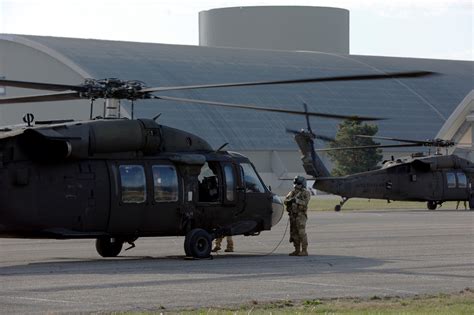
The Backbone of U.S. Army Aviation
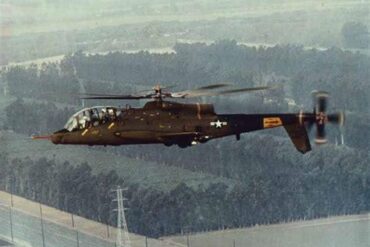
The UH-60 was a product of the Utility Tactical Transport Aircraft System (UTTAS) program, which aimed to develop a more survivable, powerful, and reliable platform than the Huey. Sikorsky’s submission beat out Boeing-Vertol’s YUH-61 in the mid-1970s, and deliveries of the UH-60A began shortly thereafter. The design quickly proved effective in numerous operational theaters, including the Gulf War, Somalia, Afghanistan, and Iraq.
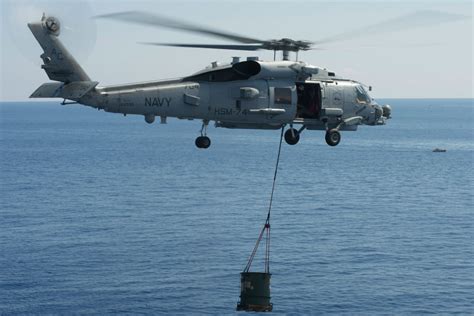
Today, the UH-60 serves primarily in the U.S. Army, but its variants have also been adopted by the Air Force, Navy, and Coast Guard under different designations, such as the HH-60 Pave Hawk, SH-60 Sea Hawk, and MH-60 Jayhawk.
Total Number in Service: 2,276 and Counting
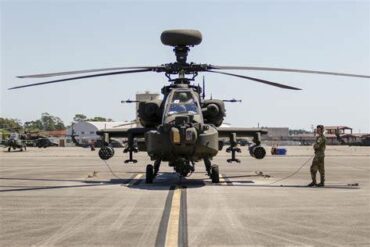
The U.S. military’s active Black Hawk fleet totals 2,276 helicopters, according to official defense data. These aircraft comprise an astonishing 75%+ of America’s entire combat rotorcraft force. The remainder consists of platforms like the CH-47 Chinook, AH-64 Apache, and light utility helicopters. Despite being in service for over four decades, the Black Hawk remains in high demand due to its proven battlefield adaptability and the military’s continued investment in upgrades and modernization.
The broader production record reveals that over 5,000 Black Hawk helicopters have been built since 1979, with aircraft delivered to 36 allied nations, making it one of the most exported and battle-proven helicopters in military history. Collectively, Black Hawks have logged more than 15 million flight hours, including 5 million in active combat zones—a testament to both their durability and strategic use.
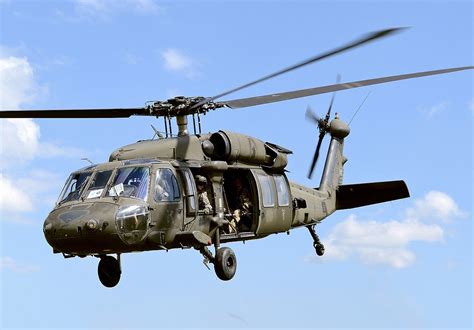
Technical Capabilities and Combat Loadout
While speed is not its primary feature, the Black Hawk’s twin General Electric T700 turbine engines allow it to reach a respectable top speed of 161–178 mph in military configuration. Its commercial S-70 variant, used by some allied governments and emergency response units, can hit speeds of up to 187 mph. More crucially, the Black Hawk is designed for load-bearing and combat versatility:
- Payload Capacity: Up to 9,000 pounds internally or externally slung
- Seating: 12 fully geared infantry troops or 6 stretchers for medevac missions
- Weapons Loadout (Attack Configuration):
- 16 AGM-114 Hellfire missiles
- .50-caliber machine guns
- 19-shot Hydra 70 rocket pods
- 7.62mm M134 miniguns mounted on cabin doors
Its modular design allows mission-specific adaptations. For example, in combat rescue operations, it is equipped with in-flight refueling probes, infrared countermeasures, and armored seating. In search-and-rescue missions, it features hoists and flotation gear. In firefighting, it can carry large water buckets or tanks.
Variants and Roles Across the Armed Forces
Over the years, the Black Hawk has evolved into a family of specialized platforms:
- UH-60A/L/M: Core Army variants for utility, medevac, and transport
- MH-60L/M: Special operations configurations with advanced sensors
- HH-60G Pave Hawk: U.S. Air Force version for combat search-and-rescue (CSAR)
- MH-60T Jayhawk: Coast Guard version adapted for maritime SAR and patrol
- SH-60 Sea Hawk: Naval variant optimized for shipboard use, anti-submarine warfare, and over-the-horizon targeting
Each service branch configures the Black Hawk to meet unique mission demands, reflecting its inherent design flexibility. The Army’s modernization push has upgraded older UH-60A/Ls to the UH-60M standard, which includes a new digital cockpit, upgraded engines, and wider rotor blades for improved lift and performance.
Sikorsky and Lockheed Martin: A Strategic Alliance
The Black Hawk’s success is deeply tied to Sikorsky Aircraft’s legacy, a company founded in 1925 by Igor Sikorsky, a pioneer in helicopter innovation. When Lockheed Martin acquired Sikorsky in 2015 for $9 billion, it brought one of the most successful rotorcraft producers under the umbrella of the U.S.’s top defense contractor. This strategic acquisition has allowed greater integration of avionics, sensors, and defense systems into the helicopter’s design evolution.
Production of new Black Hawks continues, not only for the U.S. military but also for foreign allies through Foreign Military Sales (FMS) and Direct Commercial Sales (DCS). This continuous production ensures a stable supply chain for maintenance, spare parts, and upgrades.
Operational Longevity and Future Replacement
Despite being in operation for over four decades, the Black Hawk shows no signs of imminent retirement. Its current generation, the UH-60M, is expected to remain in service well into the 2040s, if not beyond. However, the U.S. Army has begun to look toward the future, preparing for a new generation of long-range assault aircraft.
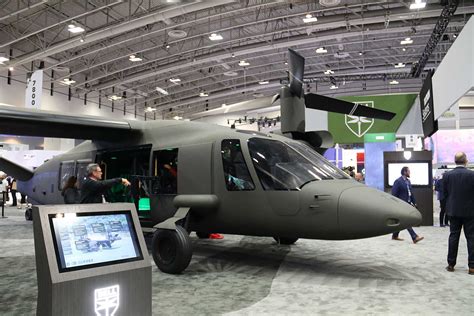
The Future Long-Range Assault Aircraft (FLRAA) program is currently developing the Bell V-280 Valor and Sikorsky-Boeing Defiant X as potential replacements. Additionally, the Army has already started testing prototypes of the MV-75, a tiltrotor or coaxial rotor platform intended to eventually replace a portion of the Black Hawk fleet. But this transition will take decades, and the current fleet will continue to form the core of U.S. tactical aviation for the foreseeable future.
Global Presence and Combat Legacy
Beyond the U.S., the Black Hawk is used by over 30 allied nations, including Australia, Colombia, Japan, South Korea, Poland, Saudi Arabia, and Israel. These exports have often included customized configurations for local combat environments and mission requirements.
The Black Hawk has seen extensive action in nearly every U.S. military operation since the 1980s. It became an icon—though tragically—in the 1993 Battle of Mogadishu, immortalized in the film Black Hawk Down. That incident, in which two UH-60s were shot down and resulted in an intense firefight, revealed both the helicopter’s vulnerabilities and the bravery of U.S. forces under extreme conditions. It also led to significant upgrades in armor, communications, and tactics.
In the wars in Iraq and Afghanistan, Black Hawks became essential for air assaults, medevac extractions, supply missions, and command and control. Their performance in rugged terrain and hostile environments demonstrated unmatched durability and mission success.
Conclusion: A Helicopter with Unmatched Legacy
The Black Hawk helicopter remains the undisputed workhorse of the U.S. military aviation system, with 2,276 aircraft in service forming the cornerstone of its battlefield mobility. Its history, adaptability, and ongoing upgrades ensure it will continue playing a frontline role for at least another generation. While newer technologies are on the horizon, the Black Hawk’s multi-role capacity, ease of maintenance, and combat-proven performance have earned it a near-mythic status among both soldiers and strategists.
In a defense landscape rapidly evolving toward autonomous systems, next-gen tiltrotors, and hybrid propulsion, the Black Hawk endures—not as a relic, but as a living legend of military aviation.