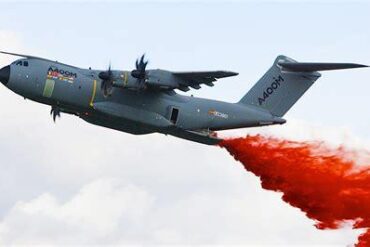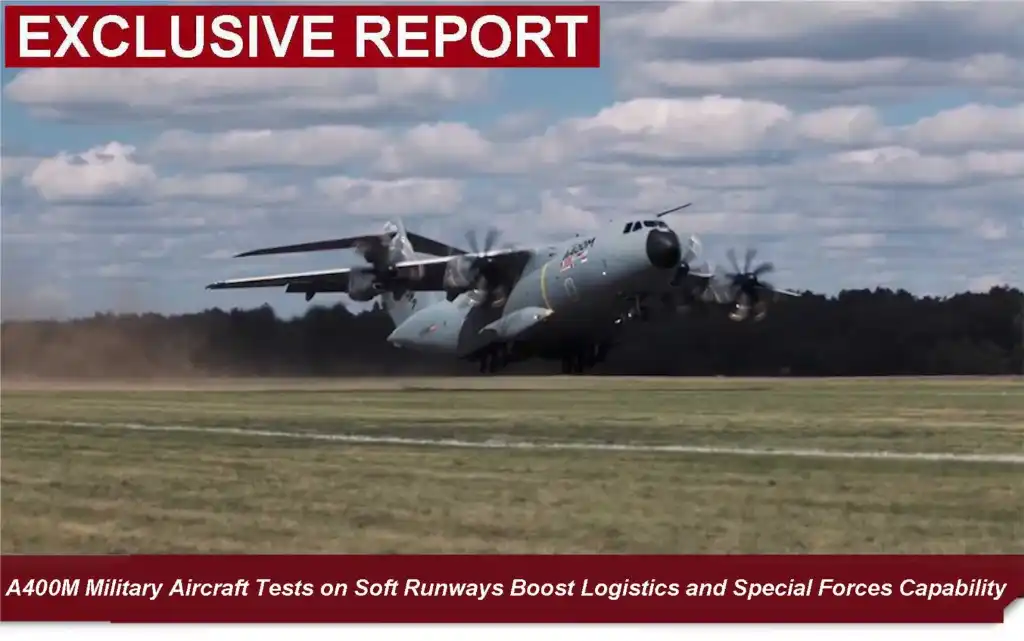
The summer trials conducted by Airbus and the German Bundeswehr have reaffirmed the A400M military transport aircraft as a vital force multiplier in global air mobility. The aircraft’s ability to operate at full payload capacity from soft, vegetated, and unpaved surfaces now opens up critical avenues for missions requiring flexible access, rapid deployment, and robust operational tempo.
Operational Breakthrough: High Payload from Soft Runways
Over a series of intensive weeks at the Altengrabow training area, engineers from Airbus Defence and Space and the German Armed Forces validated that the A400M could safely and consistently operate from non-tarmac runways while carrying heavier payloads. Without requiring structural modifications, the aircraft managed repeatable takeoff and landing cycles under degraded ground conditions, proving its agility and durability in adverse field environments.
This development signifies a paradigm shift in strategic and tactical logistics. The capability to use semi-prepared strips in remote zones offers not just logistical flexibility but also lowers the dependency on developed infrastructure. As a result, forward-operating bases, special operations detachments, and humanitarian missions can now expect reduced turnaround times and extended reach into previously inaccessible locations.
Engineering the Edge: Trial Procedures and Results
The trials, co-managed by the Organisation for Joint Armament Cooperation (OCCAR), entailed rigorous measurement and analysis. Each flight sortie involved:
- Detailed surface integrity testing to assess bearing capacity.
- Repeated high-mass landings and takeoffs to monitor gear stress.
- Continuous braking behavior evaluation on vegetation-rich soil.
These evaluations demonstrated that the A400M retained predictable handling, throttle precision, and safe rollout lengths, even under increased mass and dynamic pressure. Notably, the trials were performed without any change to the aircraft’s hardware, emphasizing the strength of its original design.
Expanding Tactical Reach for Special Forces and Disaster Relief
The implications of this capability stretch far beyond technical validation. For special operations forces, the ability to land and take off from soft runways means insertion and extraction missions can now occur much closer to operational theaters—especially in jungle, desert, or tundra environments where conventional airstrips are non-existent.
Similarly, in disaster-struck regions, where airfields may be damaged or nonexistent—as seen in the Mayotte cyclone response (2025) or Syria-Turkey relief missions (2023)—the A400M becomes a linchpin for life-saving aid delivery. By reducing the need for infrastructure restoration before deployment, the aircraft accelerates the initial response window, which is often critical in humanitarian operations.
Multi-Role Mastery: Configuration Versatility of the A400M
The A400M’s true power lies in its multi-role flexibility. Within hours, it can be reconfigured for a wide array of missions:
- Troop transport (up to 116 equipped soldiers)
- Medical evacuation (66 stretcher patients + 25 attendants)
- Cargo delivery (up to 37 tonnes)
- Vehicle deployment, including heavy armor and helicopters
- Aerial resupply via parachute drops (up to 25 tonnes)
This adaptability, paired with its capacity to use short and unpaved runways, makes the A400M a force projection platform that supports both kinetic and non-kinetic operations with equal effectiveness.
Power Under the Wings: Advanced Propulsion and Performance
Equipped with four Europrop International TP400-D6 turboprop engines—each producing 11,000 shaft horsepower—the A400M sustains a cruising speed of Mach 0.72 and can operate at altitudes up to 40,000 feet. Yet, it is in low-altitude tactical profiles where it truly excels, with short takeoff and landing (STOL) performance that puts it leagues ahead of conventional heavy lifters.
The reinforced landing gear and high-mounted wings are crucial in handling irregular terrain during operations, while the advanced flight systems offer a stable ride even in adverse atmospheric conditions.
A Comparative Advantage in the Airlift Ecosystem
Positioned between two key platforms, the A400M fills a critical mid-capability niche:
- Compared to the Lockheed Martin C-130J Super Hercules, the A400M offers nearly double the payload (20t vs. 37t) and a significantly larger cargo hold.
- While the Boeing C-17A Globemaster III carries more (77t), it demands high-maintenance, long runways and greater logistics overhead.
- The Ilyushin Il-76, although competitive in lift, falls short on short-field operability, mission modularity, and avionics sophistication.
This balance allows the A400M to serve both tactical and strategic roles, reducing fleet complexity while maximizing mission coverage.
Digital Dominance: Avionics, Protection, and Mission Systems
At the heart of the A400M lies a cutting-edge fly-by-wire flight control system and a glass cockpit architecture that fuses situational awareness with operational command. Pilots benefit from mission management systems that offer route optimization, threat alerts, and dynamic re-tasking capability.
In conflict zones, the aircraft is protected by self-defense suites, including:
- Missile warning systems
- Chaff and flare dispensers
- Electronic countermeasures for radar and infrared-guided threats
This ensures that even in low-intensity conflict zones, the A400M can operate with a reduced risk profile, bolstering its value for forward-deployed missions.
Certification and Future Enhancements
Following the success of the Altengrabow trials, Airbus is moving into the final certification phase for these capabilities. Once approved, enhancements will be rolled out via software updates and procedural refinements, allowing all user nations to adopt the new features without costly airframe modifications.
Further developments in the pipeline include:
- Increased payload capacities
- Satellite and tactical mesh connectivity
- Integration with unmanned aerial systems
One of the most ambitious upgrades is the concept of an A400M acting as a drone mothership, capable of deploying networked unmanned systems in contested airspace—adding a critical edge to battlefield intelligence, surveillance, and reconnaissance (ISR) capabilities.
Conclusion: Redefining Expeditionary Airlift for the Modern Battlefield
As global security challenges continue to evolve, the A400M has demonstrated that it is more than a strategic transporter. It is a mission-flexible platform tailored to the multidomain requirements of modern warfare, disaster response, and geopolitical maneuvering.
The Altengrabow trials affirm that the A400M is no longer limited to prepared airfields. Its enhanced soft-runway performance significantly elevates its relevance in dispersed operations, whether delivering aid in the wake of a cyclone, inserting special forces into hostile terrain, or evacuating casualties from forward zones.
By fusing engineering excellence with mission adaptability, the A400M stands poised to define the next generation of military mobility. It is not just meeting operational demands—it is anticipating them.