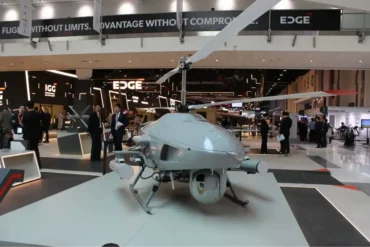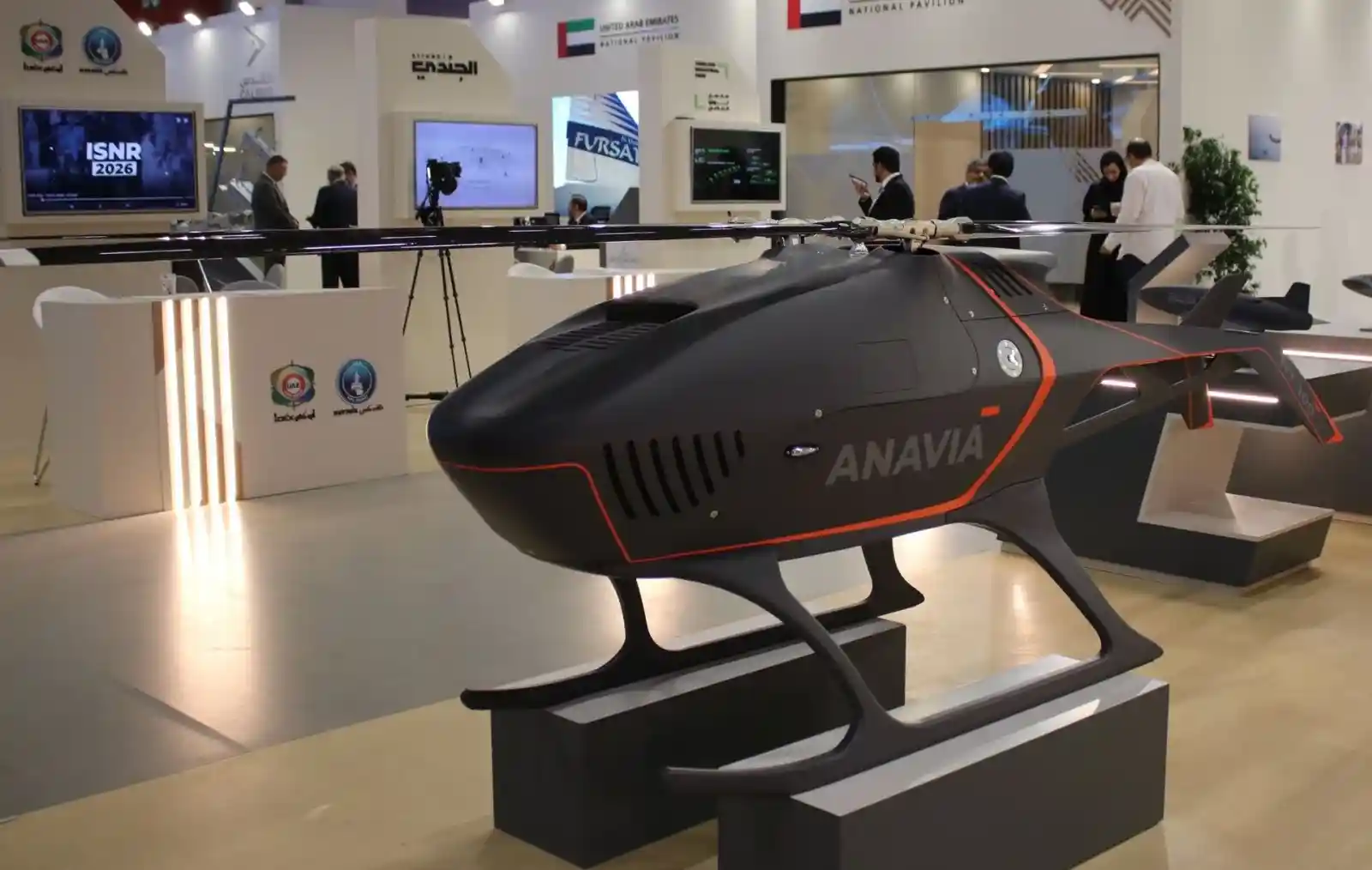
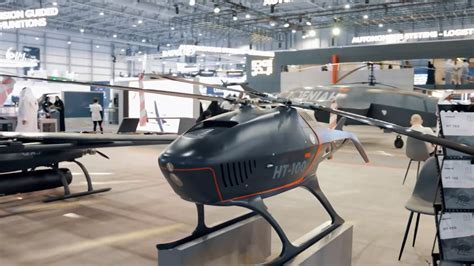
Unveiled at IDEF 2025, the HT-100 rotary-wing drone by Swiss manufacturer Anavia represents a groundbreaking leap in unmanned aerial vehicle (UAV) technology, purpose-built for long-endurance tactical operations. With a focus on mechanical simplicity, mission flexibility, and aeronautical safety, the HT-100 introduces a new benchmark for rotary-wing UAVs operating in complex military and civilian environments.
Next-Generation Propulsion: Turbine-Powered Efficiency
At the heart of the HT-100 lies a 15 kW turbine engine, developed and manufactured in Switzerland. Unlike conventional piston engines used in many UAVs, this turbine system achieves exceptional fuel efficiency, consuming just 9 liters per hour, regardless of altitude or load. Even more impressive is its multi-fuel capability, seamlessly operating on Jet A1, JP-5, and JP-8, a must-have for global military logistics.
The engine design features circumferential lubrication, reducing wear and increasing durability. It boasts a Time Between Overhaul (TBO) of 1,000 hours, a remarkable figure in the tactical UAV class, translating into fewer maintenance intervals and lower life-cycle costs.
Dual-Rotor Flettner Configuration: No Tail Rotor, More Power
The HT-100 abandons the conventional tail rotor concept in favor of a dual-rotor Flettner system, enabling torque balance without relying on a separate anti-torque mechanism. This architecture removes complex tail boom mechanical assemblies, reducing energy consumption by approximately 30%, particularly when transporting heavy mission payloads.
This Flettner-based system also improves centerline thrust control, allowing better maneuverability in confined or cluttered environments such as urban terrain or naval vessels. Additionally, the modularity of the structure allows for rapid deployment, easy transport, and seamless integration with ground or sea-based platforms.
Endurance and Payload Versatility: Built for Long and Tough Missions
The HT-100 supports a maximum payload capacity of 60 kg, suitable for an array of mission kits—electro-optical sensors, communication relays, logistical payloads, or even light electronic warfare modules.
Depending on loadout, flight durations range from 1 to 6 hours, offering flexible performance profiles for ISR, tactical supply drops, or reconnaissance missions. With a maximum cruising speed of 120 km/h, and operational ceilings up to 4,000 meters, the HT-100 is capable of operating in mountainous, high-wind, or battlefield environments.
Take-off and landing are fully autonomous, enabled by a robust onboard autopilot suite that allows point-to-point programming. With the added advantage of terrain following and pre-programmed auto-hover routines, the drone adapts to changing environmental conditions.
Secure and Redundant Communication Architecture
The HT-100 utilizes a MESH IP encrypted communication link, ensuring jam-resistant, low-latency data transmission across distributed units. The system supports SATCOM and LTE integration for extended range or beyond-line-of-sight (BLOS) operations, ideal for search and rescue, border patrol, or deep-strike reconnaissance.
By deploying encrypted MESH networks, multiple HT-100s can form adaptive swarms, enhancing situational awareness and enabling multi-vehicle coordination across wide theaters of operation.
Advanced Safety Systems Modeled on Manned Aviation
Anavia has made safety a cornerstone of the HT-100 design, embedding redundancies and fail-safe systems usually found in manned platforms.
Among these are:
- Autorotation recovery: A backup electric motor allows for pre-programmed autorotation landings in the event of a main engine failure.
- Full-frame ballistic parachute: Ensures a safe descent even during complete power failure.
- Flight control redundancy: Powered by four independent actuators, allowing continued operation even in the event of a critical system loss.
- ADS-B Mode S transponder and FLARM: Provide airspace integration and deconfliction.
- Detect-and-avoid system: Incorporates front and bottom FPV cameras to detect aerial and terrain obstacles.
- Automated Return-to-Home (RTH): Triggered during GNSS signal loss or operator communication breakdown.
Designed for Naval and Field Deployment
The HT-100’s compact footprint is one of its most compelling features for military planners. The airframe, excluding rotors, measures only 2.82 meters in length, 0.72 meters in width, and 1.00 meter in height, while the main rotor spans 3.75 meters. These proportions enable storage in standard shipping containers, vehicle-based launch systems, or naval hangars.
The structure’s modularity ensures quick assembly and disassembly, and the use of non-tail rotor architecture eliminates many logistical constraints related to calibration, balance, and vulnerability in close-quarters combat zones.
Smart Maintenance and Operator Support Packages
Anavia offers a fixed-price, all-inclusive maintenance plan, significantly reducing operational complexity for end users. The model includes:
- Scheduled parts replacements shipped in advance, ensuring minimal downtime
- Digital documentation compliant with manned aviation standards, simplifying cross-training
- Custom training for pilots and maintenance technicians, with emphasis on real-world mission simulation and troubleshooting
These support systems are tailored to militaries transitioning from legacy UAV systems to next-generation platforms and civil operators entering unmanned industrial surveillance, pipeline inspection, or infrastructure mapping.
Multi-Mission Capabilities: Civilian and Military Use Cases Aligned
While designed with combat-readiness in mind, the HT-100 is equally well suited to civilian applications. The 60 kg payload and 6-hour endurance profile make it a prime candidate for:
- Border surveillance and environmental monitoring
- Disaster relief and emergency response logistics
- Agricultural mapping and industrial inspection
- Telecommunications and broadcast relay deployment
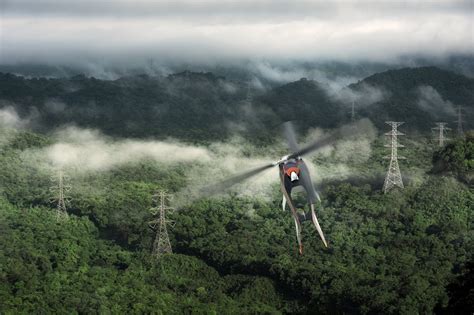
Its safety-first design ensures regulatory compliance across multiple international jurisdictions. The inclusion of ADS-B, parachute recovery, and redundant control systems may streamline civil aviation authority approval processes.
Conclusion: HT-100 as the Future of Rotary UAV Tactics
The HT-100 rotary-wing UAV is more than a drone—it’s a modular aerial system engineered to address the challenges of modern warfare, complex environments, and evolving civil missions. With its turbine engine, Flettner rotor architecture, and mission-adaptable structure, it presents a strategic asset for military forces and civil agencies alike.
By leveraging Swiss precision engineering and a forward-thinking safety and support model, the HT-100 emerges from IDEF 2025 not just as a product showcase—but as a harbinger of where rotary-wing UAV capabilities are heading next.