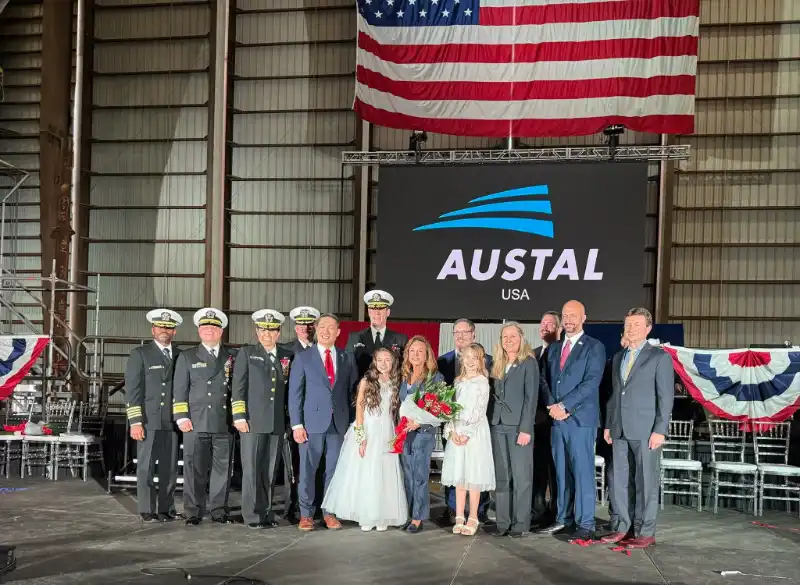
On January 10, 2026, the U.S. Navy celebrated the christening of the USNS Lansing (EPF 16), marking the final addition to the Spearhead-class of expeditionary fast transport (EPF) ships. The ceremony, held at Austal USA’s shipyard in Mobile, Alabama, marked a significant milestone in the Navy’s commitment to enhancing its capabilities for rapid sealift, intra-theater lift, and afloat medical support—critical elements as logistical demands continue to grow in both the Indo-Pacific and European theaters.
The christening of the USNS Lansing underscored the U.S. Navy’s ongoing investment in maintaining a robust, high-speed auxiliary platform capable of responding swiftly to evolving global maritime challenges. With its advanced features and versatile design, the Lansing adds to the U.S. Navy’s already impressive fleet of fast transport ships. The ship’s christening signals the continued prioritization of versatile, rapid-response vessels to support global operations, and highlights the ongoing transformation of U.S. naval logistics capabilities.
The Spearhead-Class EPF: A Game-Changer in Military Mobility
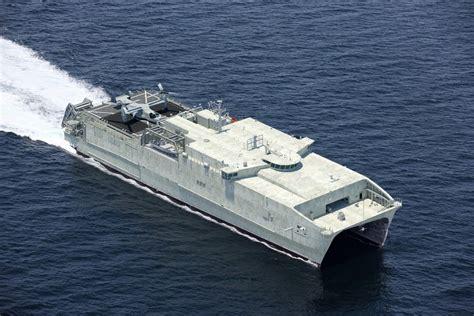
The USNS Lansing is the sixteenth and final ship of the Spearhead-class expeditionary fast transport series, which has become a cornerstone of U.S. Navy operations since its inception in the early 2010s. This final vessel, built by Austal USA, is particularly noteworthy for its enhanced Flight II configuration, which focuses on balancing high-speed intra-theater lift with critical medical and aviation capabilities.
Built on an aluminum catamaran hull, the ship spans approximately 103 meters in length, with a beam of about 28.5 meters. Its shallow draft of just under 3.8 meters allows it to access ports and littoral areas that may be closed to larger combatants. The ship is powered by four MTU 20V8000 diesel engines that drive waterjets, enabling speeds exceeding 35 knots and, in ideal conditions, pushing closer to 40 knots.
One of the most significant features of the USNS Lansing is its reconfigurable mission bay, which spans around 20,000 square feet. This bay is capable of carrying vehicles, containers, and palletized cargo, making the vessel highly adaptable for a variety of missions. Additionally, the ship is equipped with a flight deck capable of supporting large helicopters. The Flight II configuration further enhances the vessel’s versatility by enabling it to support tiltrotor aircraft, such as the MV-22 or CMV-22, providing it with aviation flexibility that is rare for an auxiliary platform.
While the earlier Flight I variants of the EPF class were optimized primarily for fast sealift, the Flight II design, which began with the USNS Cody (EPF 14), provides additional medical and aviation capabilities at the expense of some cargo capacity. The cargo payload of the Lansing is around 330 short tons—down from the 600 short tons seen in earlier Flight I variants. This reduction allows room for the integration of strengthened structures, expanded power and utilities, and enhanced medical facilities, including Role 2 Enhanced medical spaces.
Enhanced Medical and Aviation Capabilities for Expedited Operations
A key distinguishing feature of the USNS Lansing, and other Flight II ships, is the integration of advanced medical facilities. The ship’s medical capabilities include treatment areas and an elevator linking the mission deck to medical spaces. This makes the ship an invaluable asset in operations requiring immediate medical response, as it can act as a mobile medical facility for large-scale operations or as a forward medical node in high-risk areas where access to fixed medical infrastructure may be limited.
The Lansing is designed to be operated by a core crew of civilian mariners under the auspices of Military Sealift Command (MSC), with the capacity to embark mission-tailored detachments of up to 155 personnel, including full expeditionary medical teams. This setup provides a highly flexible platform that can operate as a high-speed connector, a forward medical hub, or a mobile casualty evacuation platform, depending on the operational requirements.
A Symbol of U.S. Industrial Strength and Global Maritime Strategy
The christening of the USNS Lansing is more than just a technical achievement—it also carries symbolic significance. The ship is named after Lansing, Michigan, a city with deep roots in U.S. industrial history. During the Civil War and World War II, Lansing was a critical manufacturing hub, providing support for U.S. war production efforts. The choice of Lansing as the namesake connects the U.S. Navy’s naval operations to a broader network of American industrial capabilities, highlighting the country’s maritime power and the importance of its national manufacturing base in sustaining global naval operations.
At the christening ceremony, Michigan Governor Gretchen Whitmer and Congresswoman Lisa McClain, both of whom served as the ship’s sponsors, took part in the traditional bottle-breaking ceremony. This act symbolically linked Lansing’s manufacturing heritage with the shipbuilding expertise of the Gulf Coast, underscoring the importance of collaboration between the nation’s industrial heartland and its naval forces.
USNS Lansing Joins a Proven Class of Ships
The USNS Lansing joins 15 other Spearhead-class EPFs already in service, each demonstrating the class’s proven track record in supporting critical operations across the globe. These ships have played pivotal roles in missions ranging from crisis response to humanitarian assistance and theater security cooperation.
For example, the USNS Millinocket, one of the earlier ships in the class, has deployed in the Indo-Pacific region as a platform for Pacific Partnership, providing medical assistance and civil-military engagement in countries such as the Federated States of Micronesia, the Solomon Islands, and the Philippines. The USNS Brunswick, another Spearhead-class vessel, has participated in exercises with advanced systems like the High Mobility Artillery Rocket System (HIMARS), showcasing the versatility of the class in transporting and deploying long-range fires and other critical assets.
These ships have also been deployed to regions such as the Baltic, Mediterranean, and Atlantic, demonstrating the flexibility of the EPF design in connecting U.S. forces and NATO allies. The addition of the USNS Lansing, with its enhanced medical and aviation capabilities, further strengthens the operational flexibility of this class of ships.
Strategic and Tactical Advantages of the EPF Design
The USNS Lansing’s greatest strengths lie in its ability to combine speed, accessibility, and modularity—capabilities that are vital in modern maritime operations. Unlike traditional cargo ships or larger amphibious assault ships, the EPF provides a mid-range solution that can transport significant payloads quickly without relying on well-established port infrastructure.
The vessel’s shallow draft and stern ramp allow it to load and unload vehicles, equipment, and cargo in small or damaged facilities—perfect for operating in ports that have been disrupted during conflict. This ability to operate in austere or improvised ports makes the EPF design especially valuable in high-intensity conflicts, where conventional infrastructure is likely to be targeted.
In addition to its transport function, the USNS Lansing’s medical capabilities also relieve pressure on fixed-wing and rotary-wing evacuation assets, particularly in contested areas where these resources are in high demand. By acting as an intermediate medical node, the Lansing can stabilize casualties closer to the frontlines, ensuring that critical care is provided in a timely manner.
Relevance in Modern Geostrategic Context
In the context of the ongoing U.S. military strategy in the Indo-Pacific and Europe, the USNS Lansing’s capabilities are especially significant. The ship is designed to support U.S. concepts such as Expeditionary Advanced Base Operations (EABO) and distributed maritime operations, which rely on the ability to sustain widely dispersed units across geographically challenging areas such as island chains in the Indo-Pacific.
The Lansing’s rapid mobility allows it to shuttle troops, equipment, and medical teams between smaller ports or temporary facilities, complicating adversary targeting and increasing the resilience of U.S. forces. Similarly, in Europe, the EPF design provides a means of moving equipment and personnel between critical ports, particularly in regions where large-scale infrastructure might be compromised by long-range strikes, sabotage, or cyberattacks.
Beyond its combat-related missions, the EPF class also plays a critical role in humanitarian operations and crisis response. The USNS Lansing, like its predecessors, is poised to support emergency evacuations, disaster relief, and medical assistance, as demonstrated by the class’s previous deployments in the Pacific Partnership program.
Looking Ahead: The Future of High-Speed Auxiliary Platforms
With the christening of the USNS Lansing, the Spearhead-class EPF program comes to a close, but the legacy of this ship design will continue to influence U.S. naval strategy in the coming years. The US Navy’s investment in high-speed, highly adaptable auxiliary platforms is expected to continue, with future ships likely to feature enhanced protection, increased autonomy, or specialized capabilities tailored to specific mission requirements.
In the immediate term, however, the USNS Lansing and its Flight II counterparts—such as the USNS Cody and USNS Point Loma—will remain critical components of U.S. naval logistics, ensuring that the United States maintains flexibility and resilience in contested littoral zones. As the geostrategic landscape evolves, these ships will continue to play a central role in supporting U.S. and allied operations worldwide, from crisis response to long-term security cooperation.
In conclusion, the christening of the USNS Lansing represents not only the completion of a significant program but also an ongoing commitment to maintaining and expanding the U.S. Navy’s logistical and humanitarian reach. The ship’s capabilities are a testament to the U.S. military’s focus on adaptability and readiness in the face of emerging global challenges.