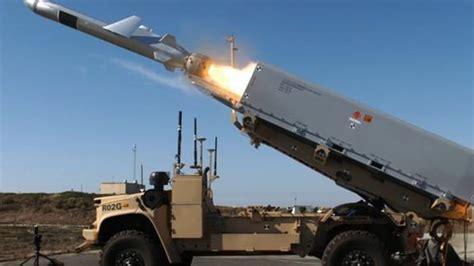
The United States Marine Corps is undergoing a significant strategic transformation, one that prioritizes agile, mobile, and sea-targeted firepower over traditional, multi-role systems. Central to this evolution is the Navy-Marine Expeditionary Ship Interdiction System (NMESIS), a cutting-edge missile platform designed to excel in littoral combat zones, where the Tomahawk cruise missile, despite its venerable history, no longer fits the Corps’ evolving needs.
What Is the NMESIS Missile?
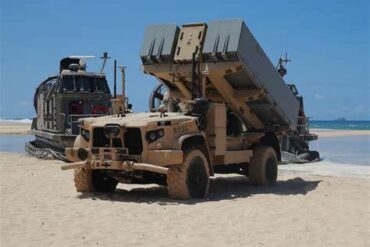
The NMESIS system is not a standalone missile but an integrated system designed to launch the Naval Strike Missile (NSM) from a ground-based, remote-controlled vehicle known as the ROGUE Fires Carrier. This unmanned, high-mobility platform gives the NMESIS its defining feature: a land-to-sea strike capability optimized for forward deployment in contested maritime zones. Unlike legacy systems that depend on manned platforms or traditional naval vessels, NMESIS enables dispersed, rapidly deployable firepower.
Technically, NMESIS employs the Naval Strike Missile, a precision-guided, stealthy, sea-skimming weapon capable of autonomously identifying and engaging enemy ships at ranges exceeding 100 nautical miles. Its integration into the ROGUE Fires Carrier marks a strategic shift toward unmanned and autonomous battlefield assets, reducing risk to personnel while enhancing operational flexibility.
Why NMESIS Over Tomahawk?
The Tomahawk cruise missile, originally introduced during Operation Desert Storm in 1991, has served as the backbone of U.S. long-range precision strikes for decades. Capable of striking targets up to 1,500 miles away, Tomahawks are launched from ships, submarines, and land-based platforms. However, as the U.S. Marine Corps pivots towards expeditionary littoral operations, certain limitations of the Tomahawk system have become apparent.
In tests conducted by the USMC, land-based Tomahawk batteries were found unsuitable for austere, expeditionary environments. Specifically, their launch systems were too large, immobile, and reliant on established infrastructure — making them ill-suited for rapid deployment to contested island chains or forward positions in the Pacific theater. Furthermore, the Tomahawk’s primary design focuses on land-attack missions, lacking the dedicated anti-ship focus the NMESIS provides.
From the perspective of Force Design 2030, the Marine Corps’ strategic roadmap, the emphasis is clear: smaller, more agile units capable of operating within enemy weapons engagement zones (WEZ). NMESIS supports this vision through its ability to:
- Deploy in contested, austere environments
- Engage enemy ships directly from shore positions
- Leverage unmanned systems to minimize personnel risk
- Integrate seamlessly into distributed, networked operations
Strategic Importance of NMESIS in Force Design 2030
The introduction of NMESIS aligns with broader USMC strategic initiatives aimed at countering peer threats, particularly in the Indo-Pacific region. As noted by Admiral Harry Harris in 2018, the absence of ground-launched missiles capable of threatening Chinese naval assets left the U.S. at a strategic disadvantage. The withdrawal from the Intermediate-Range Nuclear Forces Treaty (INF Treaty) in 2019 lifted restrictions on ground-launched missile development, paving the way for systems like NMESIS.
Deployed in strategic chokepoints such as the Luzon Strait, NMESIS batteries can potentially control maritime access near Taiwan, presenting a credible deterrent to Chinese naval movements. This capability embodies the essence of deterrence by denial, positioning forces where they can directly threaten high-value targets without needing to fight their way into position.
Lieutenant General Karsten Heckl summarized this approach succinctly: “Being forward inside the weapons engagement zone…that is deterrence.” NMESIS enables this by allowing U.S. forces to establish effective, land-based anti-ship zones in areas previously dominated by blue-water navies.
Comparison: NMESIS vs. Tomahawk Missile System
| Feature | NMESIS | Tomahawk |
|---|---|---|
| Primary Role | Anti-ship (surface interdiction) | Land-attack (multi-role) |
| Launch Platform | Unmanned ground-based (ROGUE Fires Carrier) | Ship, submarine, land-based |
| Range | ~115 nautical miles | Up to 1,500 miles |
| Mobility | High (autonomous, expeditionary) | Low (requires established infrastructure) |
| Suitability for Littoral Ops | Optimized | Limited |
| Stealth Capability | High (sea-skimming, autonomous targeting) | Moderate |
| Deployment Readiness | Rapid, modular | Infrastructure-dependent |
While Tomahawk offers longer range and flexibility, NMESIS provides the tactical precision, mobility, and survivability essential for modern littoral warfare.
The End of Tomahawk for the Marines?
The Marine Corps’ FY2026 budget proposal notably omits further Tomahawk procurement, signaling an end to its frontline deployment within USMC ground units. This is not a dismissal of the Tomahawk’s effectiveness but rather a realignment of assets toward systems better suited for future combat scenarios. In parallel with abandoning tanks in previous years, the Marines are prioritizing technologies that support dispersed, expeditionary operations.
The NMESIS system represents more than just a new missile; it embodies a philosophy of warfare focused on forward deployment, operational unpredictability, and leveraging autonomous systems for strategic advantage. Its success will not only influence U.S. Marine Corps doctrine but potentially reshape how allied forces approach coastal defense and sea control.
Future Outlook: NMESIS as a Force Multiplier
As USMC modernization continues, NMESIS will likely expand beyond its current deployments. Integration with broader sensor networks and command systems will enhance its effectiveness. Its modular, open-architecture design means future upgrades, including extended-range missiles or enhanced autonomy, are plausible. Interoperability with allied forces in the Indo-Pacific theater will also be a critical factor, supporting combined operations in multinational task forces.
In conclusion, the shift from Tomahawk to NMESIS is not a rejection of the past but a calculated investment in future conflict realities. By choosing NMESIS, the U.S. Marine Corps is equipping itself to control key maritime spaces, deter near-peer adversaries, and ensure operational relevance in the evolving landscape of 21st-century warfare.