The New Zealand Defence Force (NZDF) has taken a decisive step into the future of integrated autonomous warfare, selecting Syos Aerospace to deliver a comprehensive suite of uncrewed systems spanning maritime, aerial, and ground domains. The February 26, 2026 contract signals not merely a procurement decision but a strategic acceleration of New Zealand’s ambition to build a resilient, multi-domain drone architecture capable of surveillance, logistics support, and experimental strike operations.
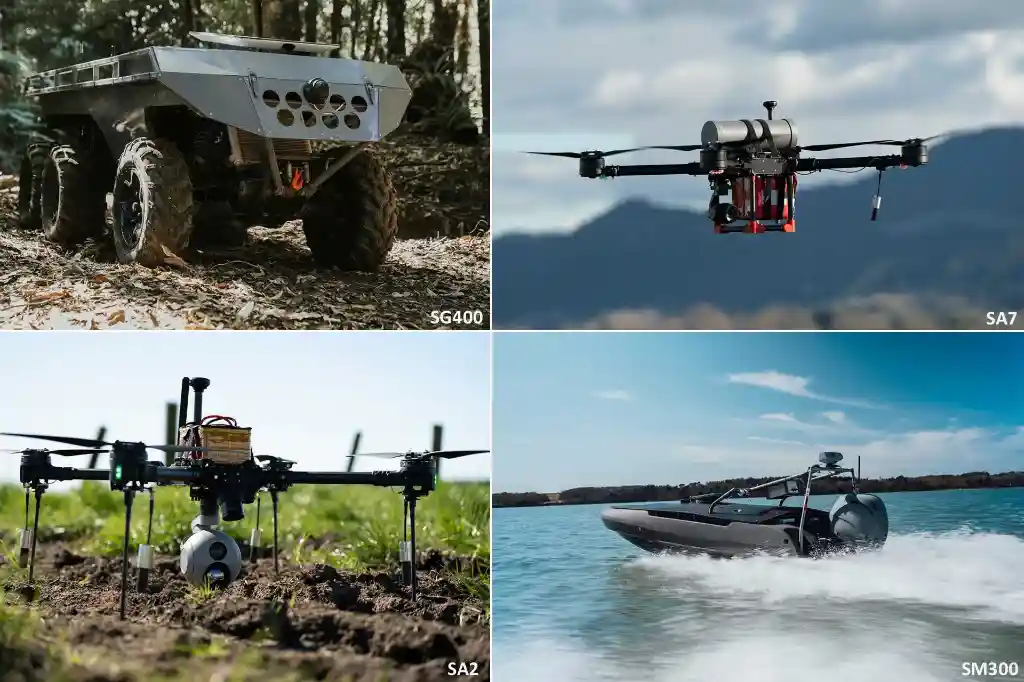
Rather than acquiring isolated platforms, the NZDF has opted for an ecosystem approach. The agreement includes SM300 uncrewed surface vessels (USVs), SA2 and SA7 aerial systems, and the SG400 autonomous ground vehicle (UGV), alongside structured experimentation and capability development programs managed within the NZDF Capability Branch. This structure emphasizes integration, doctrinal refinement, and rapid operational learning—an increasingly critical requirement in modern defense environments where technological cycles move faster than traditional procurement timelines.
SM300 Uncrewed Surface Vessel: Maritime ISR With Operational Depth
At the center of the maritime component is the SM300, a 6-meter uncrewed surface vessel rated at Technology Readiness Level 9, indicating full operational maturity. With a payload capacity of 300 kilograms and endurance reaching up to 650 nautical miles, the vessel is engineered for sustained offshore missions, including operation in Sea State 5 conditions—an essential attribute for the challenging maritime environments surrounding New Zealand.
The SM300’s architecture is built for persistent intelligence, surveillance, and reconnaissance (ISR). It integrates onboard electro-optical (EO) and infrared (IR) camera processing systems capable of detecting and tracking both static and moving maritime targets. This embedded processing reduces bandwidth dependency and accelerates decision cycles, ensuring operators receive actionable information in real time.
Electronic resilience remains a defining feature. The platform employs a PACE communications framework—Primary, Alternate, Contingency, and Emergency pathways—ensuring layered communication redundancy. Controlled Reception Pattern Antenna (CRPA) GNSS technology mitigates jamming risks, while SATCOM connectivity extends operational range beyond line-of-sight constraints. Complementary navigation modes such as visual navigation and dead reckoning maintain mission continuity even in degraded environments.
A large modular payload bay enhances flexibility. The SM300 supports ISR packages, cargo operations, and multi-domain tasking, including the deployment of unmanned aerial vehicles (UAVs) and unmanned underwater vehicles (UUVs). Command-and-control architecture allows operators to set mission intent and dynamically retask assets while onboard autonomy manages execution and synchronization.
Syos Aerospace has positioned itself as a significant player in the USV market, producing more than 140 vessels in the past year. Its surge manufacturing capacity enables rapid scaling, as demonstrated in a three-day proof-of-concept exercise in UK waters. During that event, five 7.2-meter RHIB-based uncrewed vessels operated in coordinated formation for 72 hours, escorting HMS Tyne and HMS Stirling Castle in the North Sea. Commanded remotely from Portsmouth Naval Base, 800 kilometers away, the vessels validated long-range control, operational coordination, and rapid deployment readiness.
SA2 Autonomous Mini-Copter: Tactical ISR in Contested Environments
In the aerial domain, the SA2 heavy-lift mini-copter provides advanced tactical ISR capabilities. Designed for portability and rapid deployment, the system supports small teams operating in austere environments. Its stabilized 3-axis EO/IR sensor suite enables day-and-night surveillance, ensuring persistent overwatch for dismounted forces or expeditionary units.
Navigation continuity is sustained through vision-based navigation systems, enabling operation in GNSS-denied environments. Redundant radios and dual encrypted, frequency-hopping data links reinforce resilience against electronic warfare threats. These attributes position the SA2 as a versatile ISR platform capable of functioning effectively in contested radio-frequency landscapes.
The system’s mission scope spans overwatch operations, littoral surveillance, and broader multi-domain ISR roles. Its compact configuration enhances logistical agility while preserving sensor performance, addressing the growing requirement for rapidly deployable surveillance assets across distributed operational theaters.
SA7 Multi-Role Drone: Logistics and Experimental Strike Flexibility
Complementing the SA2 is the SA7, a multipurpose aerial platform configured for both logistics delivery and one-way strike missions. With a 7-kilogram payload capacity and endurance exceeding 35 minutes, the SA7 is designed to transport critical supplies to forward elements or conduct non-return payload delivery operations depending on mission configuration.
The weather-sealed airframe supports operations in harsh and remote conditions, aligning with New Zealand’s diverse geographic requirements. The system is engineered for electronically contested environments, integrating resilient communications and adaptable mission profiles.
Beyond military roles, the SA7 is capable of surveying, scientific payload integration, and tethered operations for persistent aerial presence. Its compact design supports multi-aircraft deployments, increasing operational tempo without expanding logistical footprint. This versatility enhances NZDF’s ability to experiment with doctrinal concepts around distributed logistics and precision payload delivery.
SG400 Autonomous Ground Vehicle: Heavy-Duty Mobility for High-Risk Missions
On land, the SG400 6×6 uncrewed ground vehicle introduces heavy-duty mobility for demanding operational contexts. With a payload capacity of up to 400 kilograms, the platform is designed to transport equipment and support activities categorized as dull, dirty, or dangerous.
Its driverless configuration reduces personnel exposure to hazardous environments while improving productivity and access to difficult terrain. The SG400 integrates seamlessly into the broader multi-domain framework, enabling coordinated operations alongside aerial and maritime assets.
The NZDF contract includes not only the hardware but also structured training, technical services, and operational support. This approach ensures that personnel can evaluate, integrate, and refine the vehicle’s employment through systematic experimentation. Such structured development reflects an institutional commitment to iterative capability enhancement rather than static acquisition.
Structured Experimentation and Capability Development
A defining element of the agreement is its emphasis on structured experimentation within the NZDF Capability Branch. Instead of deploying systems in isolation, the program embeds evaluation, doctrinal development, and operational feedback into the acquisition framework.
This methodology aligns with Syos Aerospace’s iterative development philosophy. The company maintains operational and support presence in Ukraine, channeling real-world feedback into system updates. That feedback loop accelerates adaptation cycles, enabling rapid refinement of autonomy algorithms, communications resilience, and mission payload integration.
Founded in 2021 as a joint UK-New Zealand enterprise, Syos operates maritime headquarters in Fareham near Portsmouth and an aviation base in Mount Maunganui on New Zealand’s North Island. The company’s cross-hemispheric footprint supports both production scalability and localized support.
In the United Kingdom, Syos has advanced to the next phase of Project NYX, a Ministry of Defence initiative aimed at developing wingman drones for Apache attack helicopters. This progression underscores the company’s broader relevance in emerging autonomous combat ecosystems.
Strategic Implications for New Zealand’s Defense Posture
New Zealand Defence Minister Judith Collins emphasized that locally developed and supported drone technology reduces supply chain risk and strengthens national resilience. In an era marked by geopolitical volatility and contested supply chains, indigenous production and technical sovereignty represent strategic advantages.
The integration of maritime, aerial, and ground autonomous systems positions the NZDF to conduct synchronized multi-domain operations with increased flexibility and reduced risk to personnel. Persistent ISR, distributed logistics, and experimental strike capabilities collectively enhance deterrence and situational awareness.
Syos Aerospace CEO Sam Vye highlighted that close collaboration with end users accelerates development cycles and contributes to New Zealand’s broader defense technology ecosystem. By embedding structured experimentation within the acquisition process, the NZDF is not simply procuring platforms—it is cultivating a dynamic capability framework designed to evolve alongside emerging threats.
The selection of Syos Aerospace marks a significant inflection point in New Zealand’s defense modernization trajectory. Through integrated autonomy, resilient communications, and iterative capability development, the NZDF is positioning itself to operate effectively across air, land, and sea in an increasingly complex strategic environment.