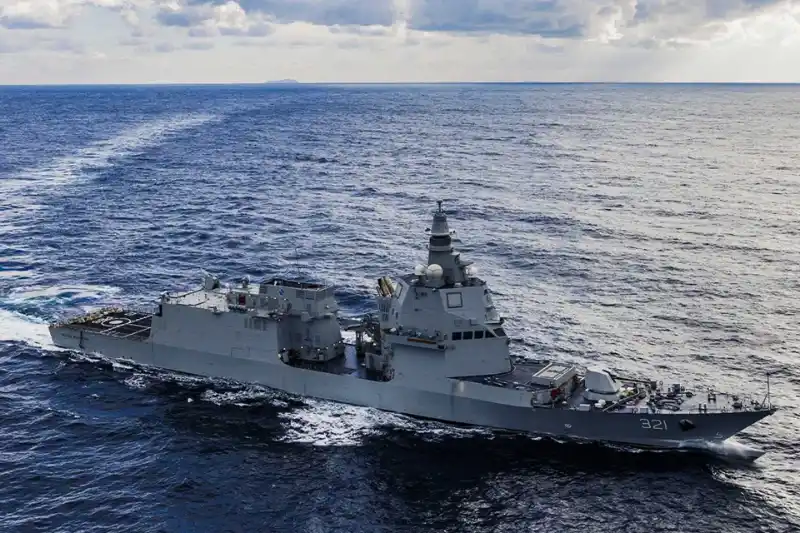
Indonesia has taken a significant step forward in its naval modernization drive with the start of sea trials for the offshore patrol vessel KRI Prabu Siliwangi (321) in Italy, marking the first operational sailing of the ship under an Indonesian crew and signaling the transition from acquisition to active readiness.
The first sea trial, conducted on January 8, 2026, unfolded in Italian waters shortly after the vessel’s commissioning in December 2025. This milestone represents more than a routine technical exercise; it is the first time the former Italian Navy ship has operated at sea fully under Indonesian command, with Indonesian sailors directly handling navigation, propulsion, and onboard systems in real maritime conditions. The trial sets the foundation for a structured series of evaluations that will ultimately prepare the vessel for its long voyage to Southeast Asia and eventual operational deployment.
Originally built for the Italian Navy and previously known as Ruggiero di Lauria (P435), the vessel’s transition to Indonesian service embodies a broader strategic approach adopted by Jakarta, combining rapid capability enhancement with phased crew integration. Rather than waiting until the ship reaches Indonesian waters, the navy has prioritized early operational familiarization, ensuring that personnel develop confidence and procedural discipline while still close to the shipbuilder and Italian naval infrastructure.
This first sailing was deliberately framed as an introductory yet comprehensive learning phase. While the trial did not aim to certify full combat readiness, it focused on validating the ship’s baseline performance and, equally important, on shaping the cohesion of a newly assembled crew. By conducting the initial sea trial in Italy, the Indonesian Navy leveraged optimal technical support while exposing its sailors to the ship’s behavior in open water for the first time.
Command Leadership and Crew Integration at Sea
The sea trial was conducted under the command of Colonel (Navy) Kurniawan Koes Atmadja, who has been appointed as the inaugural commanding officer of KRI Prabu Siliwangi. Prior to departure, the commander led an extensive all-hands briefing that underscored the importance of safety discipline, clear watchstanding responsibilities, and cross-department coordination. Particular attention was paid to risk management, a critical factor when a crew is operating an unfamiliar platform in live sea conditions.
This preparatory phase was not merely ceremonial. It established a shared operational rhythm between bridge, engineering, and combat system teams, ensuring that procedures were understood uniformly before the ship left port. The Indonesian Navy emphasized that this approach reflects a deliberate effort to instill standardized routines from the outset, reducing the likelihood of procedural errors during more demanding future trials.
Once underway, the crew engaged directly with the vessel’s systems as an integrated whole. Rather than isolating individual drills, the trial emphasized holistic ship handling, requiring coordination between propulsion, steering, navigation, and internal communications. This methodology reflects modern naval training philosophy, where system integration and human-machine interaction are treated as inseparable elements of operational effectiveness.
System Verification and Handling Characteristics
During the voyage, testing activities concentrated on the verification of the ship’s primary propulsion and steering systems. The vessel was run across a range of speed profiles, allowing engineers and bridge officers to observe responsiveness, vibration behavior, and control transitions between diesel, gas turbine, and electric modes. Maneuvering exercises were carried out to assess turning characteristics, stopping distances, and course stability, giving the crew its first tangible sense of how the ship behaves under command inputs.
Navigation systems were also exercised in operational conditions, reinforcing situational awareness workflows and bridge resource management. Internal communications networks were tested while underway, confirming reliable coordination between compartments and command positions. These activities were designed to establish confidence in core functionality rather than to push systems to their operational limits, a task reserved for later trial phases.
At the conclusion of the sailing, an internal evaluation was conducted by the commanding officer, who characterized the trial as a successful initial step within a longer readiness sequence. Early performance was assessed as satisfactory, while acknowledging the need for additional sea time to consolidate proficiency and refine coordination. Further trials are planned before the vessel is cleared for extended transit and routine tasking.
Strategic Context of Indonesia’s Naval Modernization
The sea trial announcement coincided with reaffirmed statements from Indonesian Navy Chief of Staff Admiral Muhammad Ali, who emphasized that platform modernization remains a standing policy objective rather than a series of isolated procurements. In his remarks, the admiral linked the introduction of ships like KRI Prabu Siliwangi to the broader imperative of safeguarding Indonesia’s vast maritime domain, which spans critical sea lines of communication and resource-rich waters.
Within this framework, sea trials are treated as a crucial transition point between commissioning and operational employment. The emphasis is placed on achieving readiness through the alignment of platform capability and crew competence, rather than relying solely on technical specifications. KRI Prabu Siliwangi is thus positioned not as an end in itself, but as part of a sustained effort to build a modern, adaptable fleet capable of long-endurance patrol and multi-role operations.
From Italian Service to Indonesian Colors
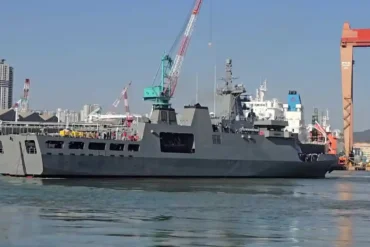
KRI Prabu Siliwangi was constructed by Fincantieri at its Muggiano shipyard, with steel cutting beginning on April 7, 2021, and launch taking place on October 10, 2023. Initially delivered to the Italian Navy as Ruggiero di Lauria, the vessel later became part of a landmark acquisition by Indonesia. A contract signed on March 28, 2024, valued at €1.18 billion, covered the purchase of two ships of the class, supported by a €1.25 billion financing arrangement concluded later that year.
The ship was officially renamed KRI Prabu Siliwangi on January 29, 2025, symbolically linking the modern platform to a legendary figure from Indonesian history. Formal handover followed, and the vessel was commissioned into Indonesian service on December 22, 2025. Its current presence in Italy reflects a deliberate decision to complete training and trials close to the shipbuilder before embarking on the long transit to Southeast Asia.
The Thaon di Revel Class and Its Design Philosophy
KRI Prabu Siliwangi belongs to the Thaon di Revel class, also known as the Pattugliatore Polivalente d’Altura (PPA). Developed by Italy in the 2010s, the class emerged from a fleet renewal strategy aimed at replacing multiple aging frigate, corvette, and patrol ship types with a single standardized hull. Launched under Italy’s 2014 naval law, the program sought to reduce fleet fragmentation while enhancing endurance, automation, and adaptability.
A defining feature of the class is its modular philosophy. Ships share the same hull, propulsion architecture, and core systems, but can be delivered in Light, Light+, or Full configurations. This approach allows navies to introduce vessels with limited armament and sensors, then upgrade them later without major structural changes. The design incorporates a large mission bay, flexible internal spaces, and reduced crew requirements compared to earlier surface combatants.
Technical Characteristics of KRI Prabu Siliwangi
In its current Light+ configuration, KRI Prabu Siliwangi displaces 4,994 tonnes at light load and 6,270 tonnes at full load. The ship measures 143 meters in length with a beam of 16.5 meters, giving it the size and endurance more commonly associated with frigates. Propulsion is provided by a CODAG system, combining a General Electric LM2500+G4 gas turbine, two MTU 20V 8000 M91L diesel engines, and electric motors for low-speed operation, all driving controllable-pitch propellers.
Armament includes a 127 mm main gun and a 76 mm Strales gun, supported by remote weapon stations. Missile and torpedo systems are fitted for but not with, reflecting the modular upgrade pathway envisioned for the class. The ship is equipped with a Leonardo combat management system, integrated sensors, and aviation facilities capable of supporting one AW101 or two AS565 helicopters. Indonesian authorities have indicated interest in a future upgrade to the Full configuration once the ship has entered service and operational experience has been accumulated.
As KRI Prabu Siliwangi continues its trial program in Italian waters, the vessel stands as a tangible expression of Indonesia’s ambition to field a modern, flexible navy. The successful completion of these early sea trials marks the beginning of its transformation from a newly acquired hull into a fully integrated instrument of maritime security.