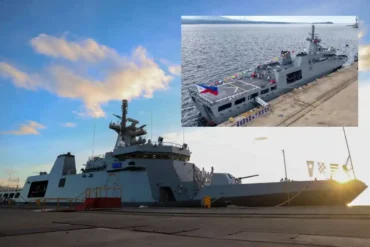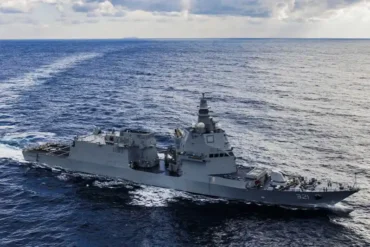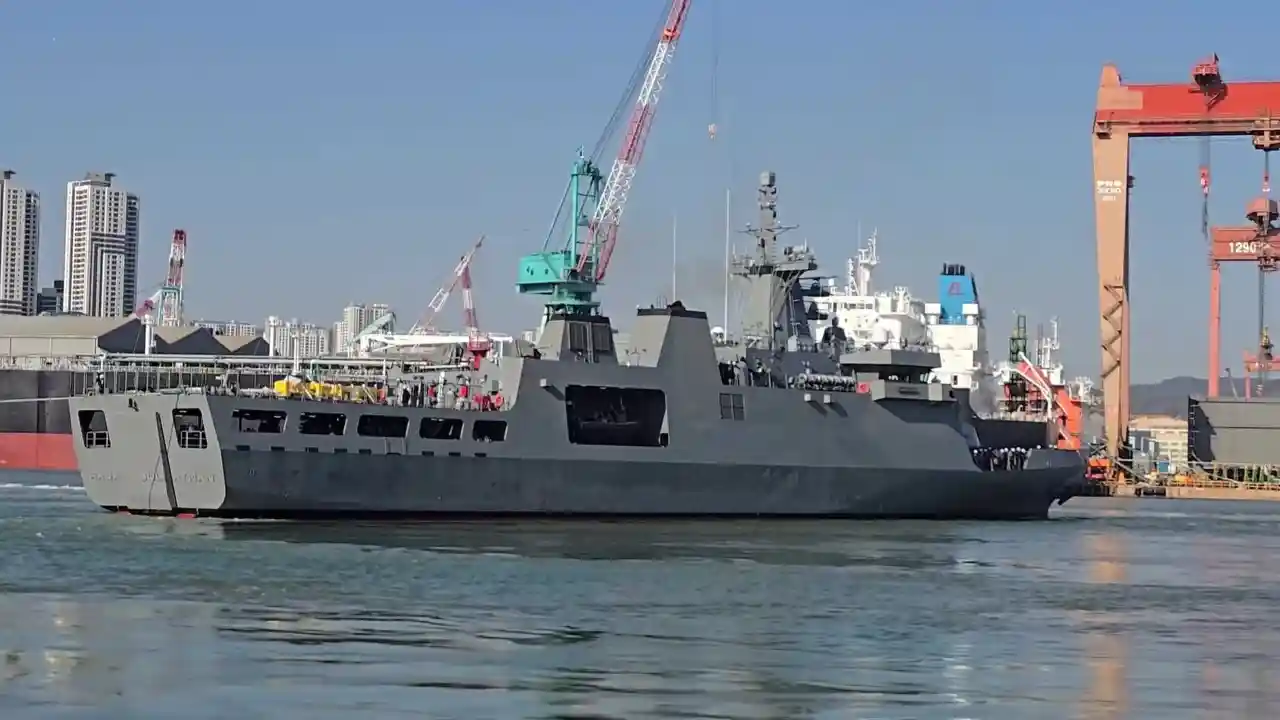
The departure of the BRP Rajah Sulayman (PS-20) from South Korea marks a decisive milestone in the Philippine Navy’s long-running modernization effort, signaling the transition from shipbuilding to operational readiness for a new generation of offshore patrol vessels. Leaving the HD Hyundai Heavy Industries shipyard in Ulsan, the lead ship of the Rajah Sulayman-class has begun its delivery transit to the Philippines after successfully completing sea trials and final fitting-out activities. This moment represents not only the physical movement of a warship across seas, but also the tangible arrival of years of planning, procurement, and strategic intent aimed at strengthening the country’s maritime security posture.
The delivery voyage, expected to conclude in late January 2026, places the vessel on a direct course toward Subic, where final inspections, acceptance procedures, and commissioning will follow. For the Philippine Navy, the timing is significant, as the ship is set to enter service during a period of heightened maritime awareness in surrounding waters. The BRP Rajah Sulayman is designed to operate persistently and independently over long distances, offering a platform tailored for sustained presence rather than short-duration patrols, a capability long identified as a critical requirement.
Public confirmation of the vessel’s departure emerged after a January 13, 2026 video surfaced online, capturing the ship underway and leaving Ulsan behind. The footage provided a rare external glimpse of the completed vessel at sea, underscoring that the transition from construction to delivery had formally begun. For defense observers and naval planners alike, this moment confirmed that the program’s lead ship had moved beyond the theoretical and entered the practical phase of fleet integration.
Strategic Significance of the Rajah Sulayman-Class Program
The Rajah Sulayman-class offshore patrol vessels are central to the Horizon 2 phase of the Revised Armed Forces of the Philippines Modernization Program, a framework focused on addressing long-standing capability gaps. Unlike high-end combatants optimized for fleet engagements, these ships are built for persistent maritime security, enabling the navy to maintain presence across wide areas without overextending more complex frigates and future corvettes. Their arrival reflects a deliberate shift toward endurance, reach, and operational sustainability.
At a full-load displacement of roughly 2,400 to 2,450 tonnes, the class occupies a balanced space between smaller patrol craft and frontline combatants. Measuring just over 94 meters in length, the vessels offer the internal volume required for extended missions, improved crew habitability, and modular mission spaces. This design philosophy aligns with the navy’s need to operate far from major bases while maintaining readiness for diverse tasks ranging from sovereignty patrols to humanitarian assistance.
The program itself stems from a ₱30 billion contract signed in 2022, covering six ships scheduled for delivery between 2025 and 2028. For the Philippine Navy, this represented a rare opportunity to field a standardized class of long-range patrol vessels, replacing aging platforms whose maintenance and limited endurance increasingly constrained operations. The departure of PS-20 thus serves as a tangible benchmark against which the pace of subsequent deliveries will be measured.
Performance Designed for Sustained Presence
Operational endurance sits at the core of the Rajah Sulayman-class design. The BRP Rajah Sulayman is capable of a cruising speed of 15 knots and a maximum speed of 22 knots, figures that prioritize fuel efficiency and patrol persistence over sprint performance. With an operational range of 5,500 nautical miles at cruising speed and an endurance of 30 days, the ship is well suited for extended deployments across the archipelago and beyond.
Propulsion is provided by a combined diesel and diesel (CODAD) configuration, using two MTU-STX diesel engines driving controllable-pitch propellers. This arrangement emphasizes reliability and ease of maintenance, particularly important for a navy seeking to maximize availability across a growing fleet. Automation systems reduce crew workload, allowing the standard complement of 72 personnel to operate efficiently during long missions without excessive fatigue.
These characteristics collectively enable the vessel to remain on station for weeks at a time, a capability essential for monitoring vast maritime zones. By sustaining presence rather than rotating frequently, the ship enhances deterrence, surveillance continuity, and response readiness in areas where maritime activity is constant and often contested.
Armament and Mission Flexibility
While optimized for patrol rather than high-intensity combat, the BRP Rajah Sulayman carries a credible and flexible armament suite. The primary weapon is a 76 mm OTO Melara Super Rapid naval gun, mounted forward and capable of engaging surface, air, and shore targets. This is complemented by two Aselsan Smash 30 mm remote-controlled weapon systems and additional 12.7 mm heavy machine guns, providing layered defense and precision engagement options.
The ship’s design allows for future enhancements, including potential installation of point-defense missile systems or close-in weapon systems, should operational requirements evolve. This growth margin ensures that the platform can adapt over its service life rather than becoming obsolete as threat environments change.
Mission flexibility is further enhanced by robust small-boat facilities. A stern ramp supports a 9.5-meter rigid-hulled inflatable boat, while two additional 7.2-meter RHIBs are housed in side bays. These assets enable boarding operations, interception of suspect vessels, search and rescue missions, and maritime law enforcement tasks, all without requiring the ship to leave its patrol area.
Aviation, Sensors, and Combat Systems Integration
A key strength of the Rajah Sulayman-class lies in its integrated sensor and command architecture. The combat management system, supplied by Hanwha Systems, serves as the digital backbone, fusing sensor data and enabling coordinated responses. Surveillance is provided by a Leonardo SPS-732 air and surface search radar, paired with a Safran PASEO XLR electro-optical system for identification and fire control.
Navigation and ship handling are managed through an Anschütz Synapsis NX integrated bridge, supported by Hensoldt SharpEye Mk.11 navigation radars, ensuring safe operation in congested or challenging waters. Defensive systems include Terma C-Guard DL-6T decoy launchers, offering infrared and radio-frequency countermeasures against incoming threats.
Aviation facilities consist of a flight deck and hangar capable of supporting helicopters up to 10 tonnes, such as the AW109, as well as unmanned aerial vehicles. This organic air capability significantly extends the ship’s surveillance horizon, allowing it to detect and track contacts far beyond the limits of surface sensors.
From Concept to Construction Milestones
The journey of the BRP Rajah Sulayman from concept to delivery reflects a carefully managed industrial process. The vessel’s keel was laid on February 5, 2025, followed by launching on June 11, 2025, marking rapid progress through the early construction phases. Sea trials commenced in November 2025, validating propulsion, navigation, and combat systems in South Korean waters.
The January 2026 departure represents the culmination of these efforts, transitioning the ship from builder responsibility to customer delivery. Final acceptance is expected after arrival in the Philippines, with formal handover anticipated by March 2026. The remaining ships of the class are advancing through their own construction timelines, with BRP Rajah Lakandula (PS-21) already launched and others following in sequence.
Program momentum suggests the possibility of accelerated deliveries, potentially completing all six vessels by 2027 or early 2028, provided construction and trials continue at the current pace. Such an outcome would significantly advance fleet renewal goals ahead of original projections.
Strengthening Maritime Security Through Partnership
The Rajah Sulayman-class represents the third consecutive major naval project between the Philippines and HD Hyundai Heavy Industries, following earlier frigate and corvette programs. Once current contracts are fulfilled, the shipbuilder will have delivered 12 warships to the Philippine Navy, establishing a long-term industrial partnership centered on common systems and logistical compatibility.
For the navy, this continuity reduces training burdens, simplifies maintenance, and enhances interoperability across platforms. Strategically, the arrival of the BRP Rajah Sulayman reinforces the country’s ability to conduct maritime security, border surveillance, anti-smuggling, anti-piracy, and disaster response operations across critical waterways. As the lead ship of her class sails toward home waters, she carries with her not only steel and systems, but a renewed capacity for sustained presence at sea.