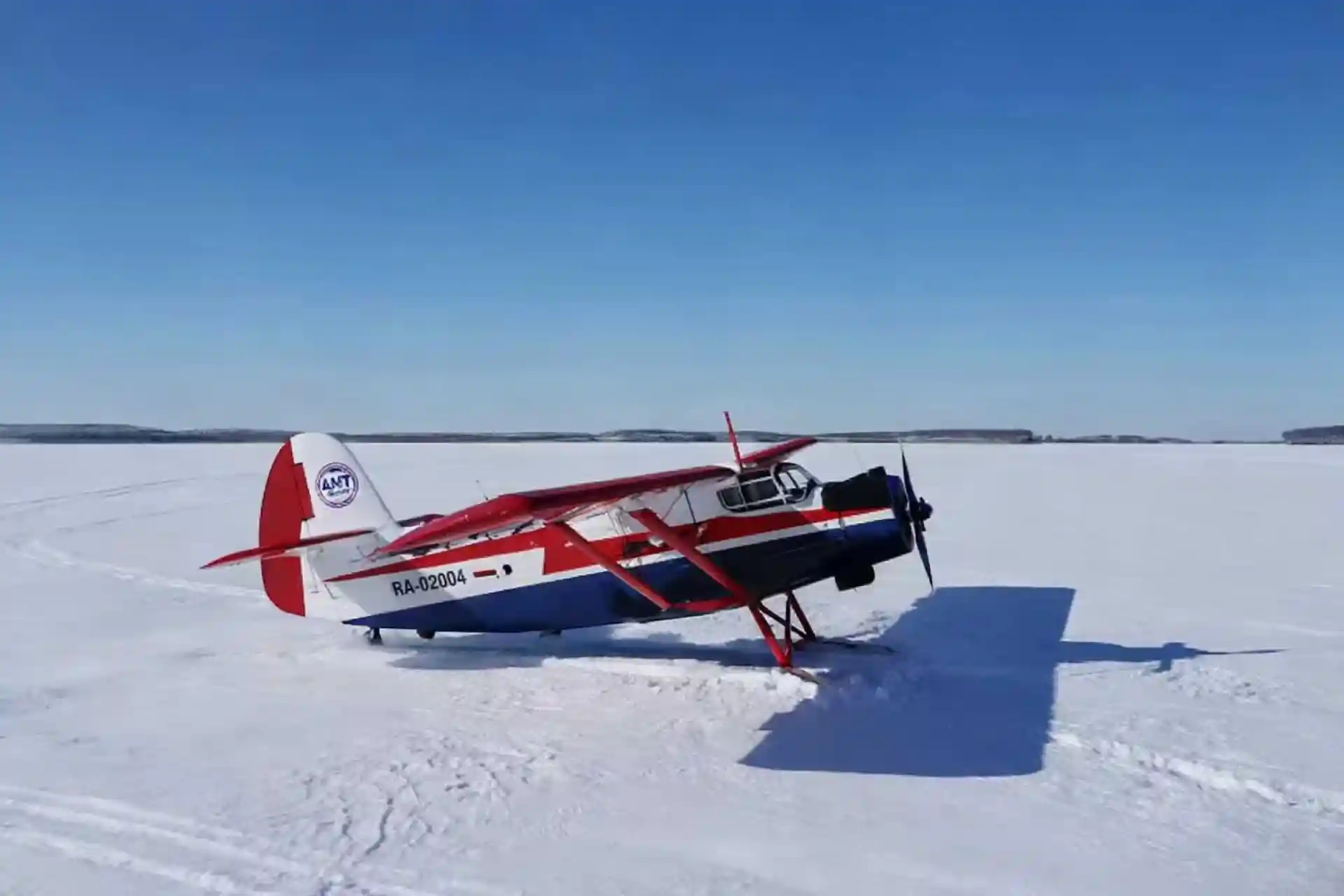
Russia has completed a new series of Arctic demonstration flights featuring a modernized Antonov An-2 biplane equipped with ski landing gear, reinforcing the enduring operational relevance of one of aviation’s longest-serving aircraft types. Conducted on February 8, 2026, by the Omsk-based Aviation Repair Enterprise Motor, the trials evaluated the aircraft’s takeoff and landing performance on deep snow under severe northern conditions. The objective was clear: validate the upgraded An-2 for Arctic patrol, medical evacuation, and winter logistics operations across remote regions where conventional runways do not exist.
The An-2, originally introduced in 1947, has long been synonymous with rugged field performance. In its latest configuration, the aircraft replaces its traditional wheeled undercarriage with reinforced skis, allowing operations from snow-covered surfaces and unprepared winter airstrips where wheel-based aircraft would struggle. During the Omsk trials, pilots executed multiple takeoff and landing cycles on deep snow to assess ground handling characteristics, structural response, and controllability under Arctic stress conditions.
The modernization effort extends beyond the landing gear. Engineers introduced wing modifications, including a lengthened upper wing, and reinforced the landing gear assembly to enhance load tolerance during uneven snow operations. Updated onboard systems were integrated to improve reliability and mission flexibility. These changes are designed to extend the aircraft’s service life while Russia awaits broader deployment of the new LMS-901 Baikal light multipurpose aircraft, whose development has experienced delays.
An Arctic-Optimized Upgrade for Northern Operations
The combination of revised wing geometry and ski undercarriage represents a deliberate adaptation to Arctic realities. Deep snow presents unique aerodynamic and structural challenges. Resistance during takeoff increases significantly, while uneven surfaces impose irregular stress loads on landing gear assemblies. By lengthening the upper wing, engineers improved lift characteristics at low speeds, preserving the An-2’s hallmark short takeoff and landing (STOL) performance even when operating from soft, high-drag surfaces.
The reinforced landing gear structure compensates for snow compression variability and hidden sub-surface irregularities. Unlike standard wheel configurations, ski gear distributes weight more evenly across snowpack, reducing the risk of bogging down. The integration of updated avionics and onboard equipment further enhances situational awareness during operations in low-visibility Arctic conditions, where whiteout environments can obscure surface definition.
This modernization program is implemented in cooperation with the regional branch of the Union of Machine Builders of Russia. Yuri Petrov, head of Motor and an honorary polar explorer, has recently been appointed head of the aviation support sector of the Northern Sea Route Association. His dual involvement directly links the upgraded An-2 program with logistical aviation support along the strategically significant Northern Sea Route, where year-round aerial access remains critical.
The Enduring Design Philosophy of Oleg Antonov
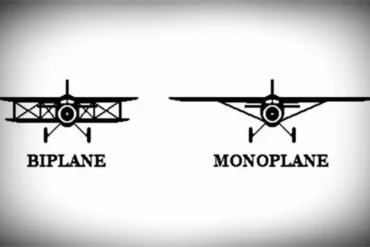
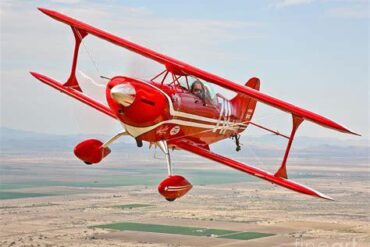
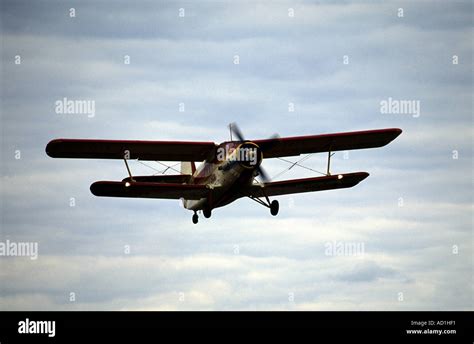
The An-2’s resilience is rooted in the design philosophy established by Oleg Antonov in the immediate post–Second World War period. Developed in response to a Soviet Ministry of Forestry requirement for a rugged agricultural and utility aircraft, the An-2 was conceived not for aerodynamic elegance, but for operational survivability. Its braced biplane configuration sacrifices high-speed efficiency in favor of extraordinary lift generation at very low airspeeds.
Automatic leading-edge slats deploy without pilot input as speed decreases, delaying stall and maintaining controllability. Large flaperons further increase lift and roll authority at low speeds. These features allow the An-2 to maintain stable flight at approximately 50 km/h stall speed, an unusually low figure for an aircraft of its size. This capability enables operations from short, improvised strips, frozen riverbeds, and snowfields across Siberia and the Arctic.
The aircraft’s structure emphasizes mechanical simplicity. Fabric-covered control surfaces, accessible systems, and minimal reliance on ground support equipment were deliberate choices to ensure maintainability in remote regions. Antonov prioritized reliability and short-field performance over speed, a philosophy that remains aligned with Arctic patrol requirements today.
Production Scale and Global Footprint
Few aircraft in aviation history have achieved the production longevity of the An-2. Following its first flight on August 31, 1947, serial production began in 1949. Manufacturing continued in Kyiv, later expanded to Poland’s WSK PZL-Mielec facility from 1960 to 2002, where 11,915 aircraft were produced. China also manufactured the type under the Y-5 designation. Total output exceeded 18,000 aircraft, making it one of the longest continuously produced aircraft types worldwide.
This expansive production base created a vast fleet still operating across Eastern Europe, Central Asia, and East Asia. The aircraft’s adaptability supported agricultural spraying, firefighting, meteorological research, floatplane operations, cargo transport, and military training. Ski-equipped variants have existed previously, but the current modernization focuses on structural reinforcement and avionics integration tailored for sustained Arctic patrol roles.
Technical Specifications Supporting Arctic Viability
In its standard configuration, the An-2 measures 12.4 meters in length, with an upper wingspan of 18.2 meters and a lower wingspan of 14.2 meters. Total wing area is 71.52 square meters. Maximum takeoff weight ranges from 5,440 to 5,500 kilograms, depending on configuration. The aircraft can carry up to 2,140 kilograms of payload or 12 passengers.
Power is provided by the Shvetsov ASh-62IR nine-cylinder radial engine rated at 1,010 horsepower, driving a four-bladed constant-speed propeller. Maximum speed reaches 258 km/h, with cruising speed around 190 km/h. Range extends to approximately 845 kilometers, and service ceiling is 4,500 meters. Takeoff distance under standard conditions is approximately 235 meters, while landing roll is about 225 meters.
These performance characteristics, particularly the short-field capability and low stall speed, remain directly relevant for Arctic operations. Snow-covered terrain effectively lengthens required takeoff distances due to drag, making high-lift design essential.
Military and Strategic Roles
Since the early 1950s, the An-2 has served in various military roles, including transport, airborne training, reconnaissance, and logistical supply missions. Soviet Airborne Troops operated dedicated squadrons equipped with the aircraft for parachute training. The platform was employed during the Korean War and by the Vietnam People’s Air Force for transport and limited attack missions.
In recent years, An-2 aircraft have continued to support airborne training and logistical supply missions in remote regions. In 2024, Russian airborne conscripts conducted parachute training from an An-2 at 1,000 meters altitude and approximately 160 km/h using D-10 main parachutes. The aircraft’s ability to operate from improvised strips supports isolated garrisons and border installations where infrastructure remains minimal.
The Arctic modernization aligns with this historical mission set. Northern patrol missions require aircraft capable of sustained low-speed surveillance, transport of small teams, emergency evacuation, and supply drops in environments where paved infrastructure is absent.
Engine Modernization and Strategic Continuity
In February 2025, Russia announced plans to restart production of the TVD-10 turboprop engine, originally developed in 1965 by the Omsk Engine Design Bureau. The TVD-10B variant delivers 1,025 horsepower, with a dry weight of 230 kilograms and a service life of 10,000 hours. Production is planned to resume in Omsk to support modernization and potential re-engining of An-2 aircraft.
This decision follows delays in certification of the VK-800 engine intended for the LMS-901 Baikal aircraft. The projected unit cost of the Baikal increased substantially, from 120 million rubles to 445 million rubles, complicating rapid fleet replacement. Serial production of the VK-800 is expected to begin in 2026, but until full deployment of replacement aircraft is achieved, modernization of existing An-2 platforms ensures continuity of light utility aviation capability.
Re-engining with turboprop power would reduce fuel consumption, improve reliability, and potentially enhance performance in cold-weather starts compared to radial piston engines. In Arctic conditions, engine reliability is paramount, as mechanical failure can have immediate operational consequences in remote terrain.
Arctic Aviation and the Northern Sea Route
The renewed focus on Arctic-capable aviation corresponds with growing strategic emphasis on the Northern Sea Route. As maritime traffic increases along Russia’s northern coastline, aviation assets are required for search and rescue, medical evacuation, environmental monitoring, and logistical support of remote settlements.
The modernized An-2 offers a low-cost, immediately deployable solution while next-generation aircraft programs mature. Its structural robustness, field maintainability, and high-lift aerodynamics make it particularly well-suited to the extreme variability of Arctic surfaces, from compacted snowfields to frozen tundra strips.
A Postwar Workhorse Reinvented for Polar Realities
Nearly eight decades after its first flight, the An-2 continues to demonstrate adaptability in environments that demand simplicity and reliability over speed. The ski-equipped modernization tested in Omsk illustrates how incremental structural and systems upgrades can extend the operational life of legacy platforms in strategically significant theaters.
Rather than replacing the aircraft outright before successor programs are fully mature, Russia has opted to reinforce and adapt a proven airframe. The Arctic trials confirm that with targeted engineering enhancements, the An-2 remains capable of performing patrol, evacuation, and logistical missions across snow-covered terrain where infrastructure is scarce.
The aircraft’s survival is not an accident of nostalgia but a consequence of deliberate design principles that prioritized low-speed lift, mechanical resilience, and field operability. In the Arctic, where runways are temporary and weather is unforgiving, those qualities remain operational currency.